In March this year, the U.S administration imposed sanctions on the Rwanda Defence Force (RDF) and four top military commanders allegedly for “Rwandan backing of M23 rebels enabling serious human rights abuses and mass displacement.” The U.S further asserts that, “these military actions” violated the U.S. brokered Washington Accords for Peace and Prosperity.
When the U.S. administration proposed to broker a peace deal between Rwanda and the Democratic Republic of Congo (DRC), it was believed that Washington understood the seriousness of the problem and had the good will to help both sides settle their differences. However, the sanctions seem to be an indicator that the U.S. administration has derailed from addressing the root causes of the crisis in eastern DRC and instead focused their own geopolitical interests.
Before the signing of the Washington Accords between President Kagame and Tshisekedi, on December 4, 2025, the U.S. administration worked behind the scenes with DRC president Felix Tshisekedi to seal a minerals deal. By the end of 2025, American mineral companies had signed contracts with the Kinshasa government. For example, the KoBold Metals Company linked to American tech.
From Household Name to Clubless: What happened to Daniel-Kofi Kyereh?
Billionaire Jeff Bezos, signed a mineral contract to develop a Lithium mine in Manono-southern DRC. Another minerals consortium- Virtus Minerals in partnership with Orion Resources linked to former U.S military and Intelligence officials signed deals to own Chemaf copper and cobalt mine, across the Haut-Katanga and Lualaba provinces. The deal intentionally disrupted a sale process that was going on between a Chinese mining company Zijin and the DRC government, pointing to a geopolitical competition between U.S. and China for critical minerals.
The examples above raise questions on the neutrality of U.S. administration in brokering a peace deal between Rwanda and DRC. Since DRC has critical minerals that the U.S badly needs, Washington keeps a blind eye on DRC as an enabler of a genocide agenda in the region, while Rwanda carries the cross of “backing” the M23 rebels, disregarding existential threats to Rwanda and Congolese Tutsi caused by FDLR. It should be known that FDLR comprises of remnants of the perpetrators of the 1994 genocide against the Tutsi in Rwanda.
The Washington Accords deals with settling misunderstandings between Rwanda and DRC, caused by the presence of the genocidal force-FDLR, incorporated in the DRC national army, with intentions of invading Rwanda to continue the genocide against the Tutsi. The issues regarding the war in eastern DRC between the DRC government and M23 rebels were being addressed through other mechanisms like the Doha talks between DRC and M23 rebels as well as regional efforts like Nairobi and Luanda.
As far back as 1965, the U.S. administration knew well the root causes of the problem in eastern DRC, while today it seems a forgotten story. The U.S. Consul then in Bukavu, André J. Navez, informed his government with detailed account on the killings of Kinyarwanda speaking Congolese (U.S. declassified cable dated October 29, 1965). “…North Kivu Provincial Government seeks to picture the Banyarwanda [Kinyarwanda-speaking Congolese] as refugees (which they are not) and not as Congolese citizens (which they are) …. No attempt has been made by the provincial government to correct or even recognize the grievances of the Banyarwanda [Kinyarwanda-speaking Congolese]. Instead, the North Kivu Government claims that there is a vast conspiracy organized by the ‘Rwandan emigres…” the U.S consul wrote. The eastern DRC problem existed when Kagame was a toddler in Uganda refugee camp and the sanctioned RDF was not yet born.
The U.S administration therefore, with good knowledge of the genesis of the eastern DRC crisis that sanctions are not the right means to end it.
DRC leadership continues to disown Kinyarwanda speaking Congolese by referring to them as foreigners and Rwandans. Currently, Tshisekedi is pushing for a Constitutional change, partly to expurge Kinyarwanda speaking Congolese out of the Constitution. The same historical injustice against Kinyarwanda speaking Congolese still prevails 60 years later, exposing how sanctions against Rwanda and M23 are irrational and complicate the process aimed at solving root causes of the eastern DRC crisis.
There is a one sided blame game narrative that has been created by DRC and amplified by western capitals, where M23 rebels are referred to as “Rwanda backed,” yet with all evidence that the DRC government has incorporated FDLR within its national army, there is no single reference to “DRC backed FDLR.” This creates the impression that without Rwanda, M23 rebels cannot fight for their rights. Although the M23 controlled territory is safe and peaceful, Washington blames the rebels for mass displacement of people. Even after the capture of Goma by M23 rebels and settling over 10,000 displaced persons, the process was called “unlawful” by western agencies.
Genocide is a crime against humanity yet the DRC government which has incorporated a genocidal force –FDLR within its national army, is not under sanctions. Mineral deals are being signed in Washington while Kinyarwanda speaking people are being killed and cannibalized in eastern DRC with the support of the government. When minerals come first before saving lives of people in danger, humanity loses its face and meaning. Asking Rwanda to lift its defensive on its borders with DRC when the later has backtracked on neutralizing FDLR as agreed in the Washington Accords is creating space for another episode of genocide against the Tutsi in Rwanda.
In January 2025, hundreds of Romanian mercenaries fighting alongside the Congolese army (FARD) were captured in Goma. The Mercenaries were protected by UN force (MONUSCO), knowing well that under international law the use of mercenaries is illegal and a crime against peace and security, under the African Union (OAU Convention for the Elimination of Mercenerism in Africa). The DRC government was not sanctioned.
In December 2024, the DRC government signed a five-year military contract with Erik Prince, a former US Navy SEAL and founder of Blackwater mercenaries to provide training, use of drones and coordinate DRC’s military operations in the Kivu region and Ituri. The DRC government has not been sanctioned because Eric Prince serves U.S. interests in the Great Lakes region.
The U.S. administration which mediated the Washington Accords cannot be expected to bring peace in eastern DRC, by selectively imposing sanctions disregarding existential threats against Rwanda, failure to address historical injustices that led to an armed conflict between DRC and M23 rebels, while cuddling Kinshasa which legitimized a genocidal armed group FDLR. The threat of FDLR in the region is not about numbers, it’s more about the genocide ideology.
The author is a Pan-Africanist and former Rwandan Diplomat in Kenya
Zinabu Issah wins silver at GLASGOW Commonwealth games
Opinions of Thursday, 6 August 2026
Columnist: Gerald Mbanda
Why Washington sanctions on Rwanda will not end eastern DRC crisis
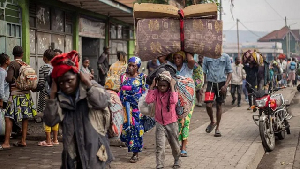 Civilians in DR Congo struggle as crisis deepens