For many Ghanaian workers, the phrase “minimum wage” has become less a symbol of protection and more a reminder of how difficult survival has become. A wage floor is supposed to guarantee that a person who works hard every day can afford the basic necessities of life: food, shelter, transport, healthcare and some dignity. In Ghana today, that promise remains largely unfulfilled.
Ghana’s national daily minimum wage currently stands at GH¢21.77 per day, following a 9 percent increase approved by the National Tripartite Committee for 2026. The adjustment raised the previous rate of GH¢19.97 and took effect on January 1, 2026. While any increase is welcome, the bigger question remains: can GH¢21.77 realistically sustain a worker in today’s Ghana? The answer, for many ordinary Ghanaians, is NO!
PHOTOS: President Mahama leads tributes at funeral of Ambassador Victor Gbeho
Even if a worker earns the minimum wage for 27 working days, the monthly income is roughly GH¢588. That amount must compete with rising costs of rent, transportation, food, utilities, school fees and healthcare. In major cities such as Accra and Kumasi, where the cost of living has risen sharply, such earnings are nowhere near a comfortable standard of living.
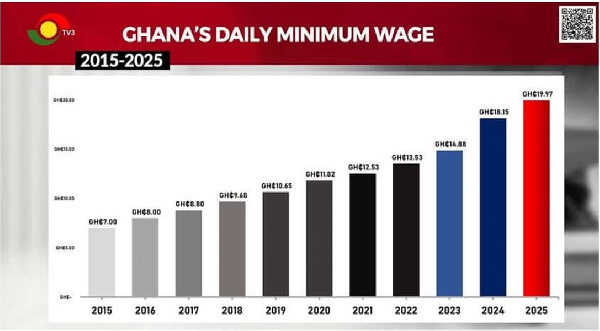
The history of Ghana’s minimum wage shows a pattern of periodic adjustments, but the increases have often struggled to keep pace with economic realities. Under the Akufo-Addo administration, the National Tripartite Committee approved a 10 percent increase for the 2023 minimum wage, raising it to GH¢14.88 from GH¢13.53. That decision came alongside a 15 percent Cost of Living Allowance as government and labour attempted to cushion workers against economic pressures.
However, the problem is not simply about increasing the number on paper. The bigger issue is whether wage policy is designed around survival or dignity.
A worker should not have to choose between paying transport costs and buying food. A parent should not have to decide whether a child’s education or a medical bill comes first. Employment should provide a pathway out of hardship, not simply a daily struggle to remain afloat.
Trade unions have repeatedly raised this concern. In 2025, the Trade Union Congress (TUC) called for a shift from the current minimum wage approach towards a living wage framework that considers essential needs such as housing, healthcare, education and transportation.
This conversation is important because Ghana’s wage debate has often been trapped between two arguments: workers demanding better pay and businesses warning about increased costs. Both concerns are legitimate. Small businesses, particularly those already struggling with high operating expenses, cannot be ignored. But protecting businesses cannot mean maintaining wages that leave workers unable to survive.
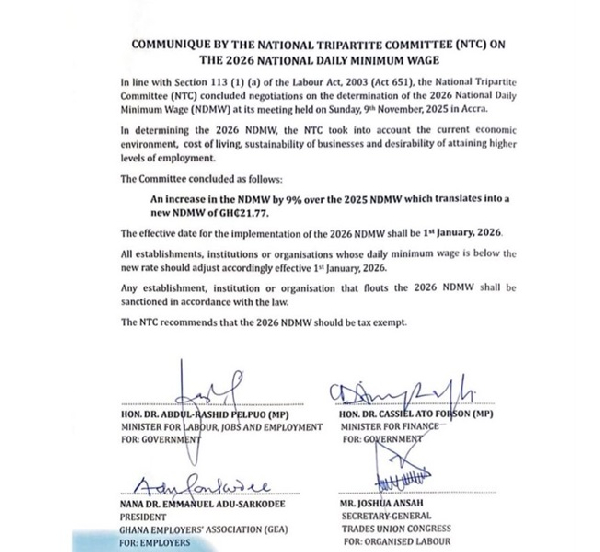
National Tripartite Committee (NTC)
A stronger approach would involve a realistic living wage strategy supported by economic growth, productivity improvements, targeted support for small businesses and stronger enforcement of labour laws. Government cannot simply announce wage increases without addressing inflation, housing costs and the broader economic environment. But neither can it continue to treat low wages as an unavoidable reality.
The question Ghana needs to ask is not whether workers deserve higher wages. The question is whether the economy can continue to demand productivity from people while paying them wages that barely cover their basic needs. A country’s development should not only be measured by GDP figures, infrastructure projects or investment numbers. It should also be measured by whether ordinary citizens who wake up every day to work can afford a decent life.
Ghana needs to move from a minimum wage culture to a living wage vision. Workers are not asking for luxury. They are asking for the ability to live with dignity.
Your Dream Property Is Just a Few Clicks Away – GhanaWeb Real Estate
Opinions of Sunday, 2 August 2026
Columnist: Oral Ofori
Ghana's Minimum Wage Crisis: Why workers need a liveable wage
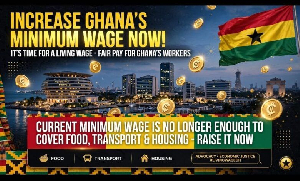 An image with inscription calling for wage increment