Our governance architecture remains tethered to a cycle of reactionary leadership. For decades, we have remained trapped in a loop of persistent crises, struggling to address systemic failures.
This is not for a lack of resources or intellectual capital, but for a profound deficit in proactive policy design. Our leadership has historically relied on the limited scrutiny of a populace exhausted by systemic dysfunction, creating a low-accountability environment where institutional incompetence is normalized.
The historical trajectory of flooding in Ghana, particularly in Accra, is a study in administrative inertia. The catastrophic event of June 3, 2015, should have served as a terminal point for reactive policy, demanding an immediate pivot to evidence-based, long-term infrastructure investment.
Instead, we have seen a regression. Following the June 2026 floods, the discourse from the highest levels of leadership remained focused on the surface-level symptom of waste disposal, conveniently ignoring the underlying systemic vulnerabilities.
The recent two-day national cleaning exercise, declared in the wake of the devastating floods of June 29, 2026, serves as a poignant reminder of the widening chasm between the state’s stated intentions and its actual performance. While the mobilization of resources and personnel to mitigate the aftermath of the floods is a necessary emergency measure, it has once again highlighted a persistent, systemic issue in our governance, the reliance on ad-hoc, performative interventions at the expense of substantive, institutionalized infrastructure management.
As a development practitioner, I view this mobilization not as a triumph of community spirit, but as an indictment of our current development trajectory. It is the clearest indicator yet of a systemic reliance on Performative Governance, a cycle where the state substitutes structural resilience with the optics of a cleaning day.
The Accountability Gap: A Policy Perspective
The relationship between the Ghanaian state and its citizens is governed by a social contract. The 1992 Constitution, through the Directive Principles of State Policy (Chapter 6), establishes the blueprint for responsible governance. Article 36(9) places a direct duty upon the state: "The State shall take appropriate measures needed to protect and safeguard the national environment for posterity." This is not a suggestion but a constitutional directive.
Furthermore, the operationalization of this mandate is delegated to the Metropolitan, Municipal, and District Assemblies (MMDAs) under the Local Government Act (Act 936). This legislation grants MMDAs the specific legal authority and responsibility for waste management, the maintenance of drainage systems, and the enforcement of environmental by-laws. When these authorities fail to perform their routine duties, allowing drains to choke and neglecting the maintenance of public infrastructure, they are in direct violation of the professional standards and responsibilities entrusted to them.
The Pathology of Projectized Development
We have reached a point where the administrative state has abdicated its core function. In functional governance models, waste management is a utility, not a civic mobilization exercise. Whether through integrated utility billing (water and electricity) or dedicated local taxes like the Council Tax model, developed nations have successfully commodified and professionalized sanitation. There, the State exists as a service provider; here, it operates as a bystander that only interferes to declare "national days of mourning" or to mobilize temporary cleanup crews after the catastrophe has already occurred.
However, we find ourselves in a cycle of administrative gaslighting. The state, having failed to execute its statutory responsibilities to plan, build, and maintain our cities, now pivots to "national mobilization" to fill the void. Requesting the citizenry to perform the tasks that we already fund through our taxes and municipal levies, is effectively abdicating its role as a professional service provider.
This is not merely a matter of inefficiency but a fundamental shift in governance strategy. We have moved toward "projectized" administration, where policy is defined by visibility and short-term political return on investment (ROI). It is far easier to declare a national cleanup day and secure the associated media coverage than it is to engage in the tedious, subterranean, and politically inconvenient work of urban re-engineering or the strict enforcement of zoning laws. This preference for optics over architecture is the primary roadblock to a resilient Ghana.
A Path Forward: From Optics to Architecture
Governance does not require rocket science, yet we continue to bypass common-sense solutions in favour of spectacles. To move beyond this sorry state of affairs, we must advocate for a departure from the optics of crisis management. My recommendations for institutional reform are as follows:
● Implement Mandatory Data-Driven Asset Management. MMDAs should transition from reactive crisis management to proactive maintenance by utilizing geo-referenced digital registers to track the health of all drainage networks. We cannot manage what we do not measure.
● Professionalize Local Service Delivery. MMDAs must transition to decentralized, autonomous waste management entities. Costs should be recovered through transparent billing mechanisms such as; property rates, water, or electricity bills, thereby removing the need for periodic, performative cleanup interventions.
● Shift to Integrated Closed-Loop Waste Governance. Policy must move toward three-stream source segregation (biodegradable, recyclable, and residual). Managing waste at the point of origin is a fundamental necessity for preventing the systemic clogging of our drainage networks at the source.
● Prioritize Institutionalized Stakeholder Oversight. Governance should not be top-down. Establishing community-based monitoring committees, with the legal authority to verify maintenance work before contractor payments are released, will bridge the current trust deficit and ensure accountability.
● Decentralize Accountability. We must move from centralized, reactive Anti-Flood Committees, which often lack the necessary technical expertise in hydrology and urban planning, to local, technocratically-led drainage boards that operate on a permanent, daily basis.
● Commit to Exceedance Flood Routing. Development planning must acknowledge climate reality. We need to designate specific, low-impact public spaces to safely accommodate excess water. This, combined with the ruthless enforcement of no-build zones in natural waterways, is the only way to transform flood risk from a disaster into a manageable engineering function.
A Call for Institutional Integrity
The sentiment among those who understand the mechanics of policy is one of exhaustion. We are currently operating a system that shifts the burden on citizens to mask the incompetence of the architect. As citizens, we must reject this narrative. We need leadership that prioritizes the boring, unglamorous, and essential work of governance over the fleeting, performative success of a well-staged photo opportunity.
We must refuse to accept the performative as a substitute for the structural. It is time to abandon the optics and return to the architecture of governance. The state must stop asking its citizens to clean up the consequences of its own institutional failures and start fulfilling its constitutional duty to provide the infrastructure upon which our livelihoods depend.
True resilience is not found in the broom held for a camera, but in the sustainable, consistent, and invisible work of a State that performs its duty every single day. Until the state pivots toward professionalized, routine, and transparent administration, the cleaning of our streets will remain a hollow act, a temporary bandage on a wound that requires surgery. We do not need more cleanup days, we need a government that acts every single day.
Opinions of Monday, 13 July 2026
Columnist: Ebenezer Immanuel Obeng-Akrofi
The Governance Paradox: Performative crisis management vs the social contract
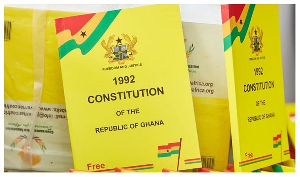 File photo of copies of Ghana's constitution