Our thoughts and prayers are with the families who have lost loved ones this week, and with everyone whose home, business, or savings were destroyed by Monday’s floods. Their loss is the reason this conversation cannot wait. On Monday, June 29, Accra received more rain in a single day than at any point in recent record, roughly 140 millimetres, more than double the previous single-day record set just last year.
By Tuesday morning, the human cost was mounting: lives lost in Alajo and Achimota-Alogboshie, scores more in the Central Region, hundreds rescued from rooftops and submerged homes. This is not Accra’s first such disaster. In 2015, a strikingly similar flood combined with a fuel station explosion to kill scores of people in this same city.
More than a decade on, the diagnosis from engineers, planners, fact-finding committees, and government officials themselves has barely changed: this is not exclusively a weather event. It is a planning failure, a governance failure, and most of all a failure of collective civic responsibility. Cities that experience flooding on the scale of Accra often face the same underlying causes, many of which have long been documented worldwide.
These include waste and plastics blocking drainage systems, settlements built in waterways and wetlands, the paving over of natural floodplains as cities expand, and heavier rainfall linked to climate change.
These problems are not unique to Ghana; they are shared by rapidly urbanizing cities around the world. All of it has been successfully addressed elsewhere, including right here on this continent, which is the genuinely hopeful part of this story.
Kigali, Rwanda, is currently executing the largest city-wide urban wetland rehabilitation in Africa: nearly 500 hectares of wetlands restored as living flood buffers, expected to generate between $45 million and $90 million in avoided flood damages while creating 5,000 jobs. Rwanda’s environment authority put it plainly: “True urban resilience isn’t built with concrete alone, it is strengthened by restoring nature to the heart of our city.”
Porto-Novo in Benin, Ghana’s neighbour two countries to the east, combined conventional drainage engineering with green infrastructure to transform flood-prone neighbourhoods into thriving cultural districts, proof that this model works in West African cities.
China’s Sponge City programme, now a national standard that requires permeable surfaces, rain gardens, and constructed wetlands in all new urban developments, was not introduced as a luxury for rich countries but as a direct response to the same devastating urban floods Ghana faces today. These are not distant aspirations; they are policy choices governments like ours can make.
Ghana can act on three horizons simultaneously, starting now. Immediate steps, a sustained, properly enforced campaign against littering and dumping, particularly plastics in gutters and drains, organised community drain-clearing ahead of every rainy season, and consistent, non-reversible enforcement against new building in waterways and floodplains.
A comprehensive policy on dealing with single use plastic, this week showed how quickly drains neglected for months turn heavy rain into a national emergency, and how unauthorised structures get rediscovered only after the water has already taken lives.
Enforcement that survives a change of minister or administration matters more than enforcement announced once and then quietly reversed. Expanding SMS and radio flood-warning systems tied to Ghana Meteorological Agency forecasts is a low-cost addition that saves lives in the hours before water rises, not only in the days after.
In the medium term, the government should retrofit drainage capacity in the corridors that flood every year, the Odaw basin, Kaneshie, Circle, Weija, and require sustainable drainage standards, permeable surfaces, and rain gardens in new developments and major retrofits, rather than treating them as optional.
Flood-risk mapping should sit directly inside the permitting system at the Metropolitan, Municipal, and District Assembly level, so a building permit simply cannot be issued inside a mapped floodway, removing the discretion that allows encroachment to recur generation after generation.
Restoring degraded wetlands such as the Korle Lagoon, Kpeshi etc., as flood buffers, rather than dumping grounds, and scaling the parametric flood insurance product already piloted with the Finance Ministry and development partners, would mean a single flood no longer wipes out years of a family’s progress.
Longer term, the most durable fix is structural. Ghana’s land tenure system makes it extremely difficult to assemble the large, contiguous parcels that proper planning requires, so most new housing still gets built few plots at a time, with no shared drainage and no capacity to absorb the cost of building it.
Government can change that calculus: work with the chiefs and family custodians to make land available at scale to developers willing to build centralised infrastructure in from day one, especially in peri urban areas to help decongest Accra, fast-track approval for projects that meet real drainage standards, and back longer thirty year mortgage tenors so well-planned, flood-resilient communities are commercially viable at the scale the housing deficit actually requires. Done well, this converts one-off government support into decades of recurring, taxable, sustainable, well-maintained developments, the opposite of the current informal sprawl no assembly can effectively tax or protect.
The floodwaters will recede, the rains will abate, as they always do. The test is whether the country treats that relief as permission to wait for the next storm, or as the start of a roadmap. We do not have an unsolvable problem. It has a known one, with solutions other cities have already proven, in Rwanda, in Benin, across the developing world at every horizon from this week’s clean-up to the next decade’s planning law. Every part of that roadmap is within reach. The only question is whether we start now.
Opinions of Wednesday, 1 July 2026
Columnist: Mantselux Homes Ltd
Ghana's Floods are not a Mystery: Here is the roadmap to stop them
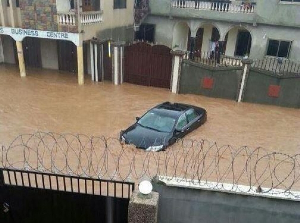 Cars were submerged and swept away by the floods