I write to you today, Monday, June 29, 2026, as Accra wakes to flooded streets — again. I write to you as a Ghanaian citizen from the Volta Region, from a community in the Adutor Electoral Area that has also watched floodwaters take its farms, its roads, and its dignity, season after season, while waiting for a state that comes with relief items but never with lasting solutions.
I write to you not with the anger of someone who has given up on government, but with the urgency of someone who believes that government can still act — if it chooses to. Ghana is in a flood emergency. It is not approaching. It is not forecast. It is here, today, right now. And the question before Your Excellency is not whether this is a crisis. The question is whether this government will be the one that finally treats it like one.
What is Happening Right Now, Across this Country
Your Excellency, in the last three weeks, Ghana has not suffered one flood. It has suffered a cascade.
In the Western Region, the Tano and Semre rivers overflowed following days of continuous rainfall. More than 1,710 people were displaced in the Wassa Amenfi West Municipality alone. Communities like Samreboi, Cocoase, and Popolozo were submerged. A cocoa farmer named Samuel Nartey watched the two-room house he had built for his children's education collapse into the floodwaters. Displaced residents are sleeping in school classrooms and church buildings — the same buildings that should be open for learning and worship.
https://www.ghanaweb.com/GhanaHomePage/NewsArchive/12-Dead-150-Rescued-GNFS-gives-breakdown-of-June-29-flood-tragedy-2041119
In the Central Region, 18 deaths have been recorded following torrential rains that swept across 13 districts over the weekend. Eighteen Ghanaians who woke up last week with plans did not survive the rain. Eighteen families are in mourning that no emergency advisory, no condolence statement, and no relief item can address.
In the Volta Region — my region — schools and a health centre were submerged in South Tongu. Adutor, where I live, flooded. Communities that have been appealing for drainage infrastructure for years were again left to wade through the aftermath on their own. The feeder roads that connect these communities became rivers themselves.
And this morning, Monday, June 29, 2026, Accra — the capital city, the seat of your government — woke up flooded. The N1 Highway. Kaneshie. Darkuman Junction. Spintex Road. Weija. Madina. Achimota. Atomic Roundabout. Workers could not get to work. Students could not get to school. Vehicles were abandoned in floodwaters. The Ghana Meteorological Agency has forecast continued rainfall across southern Ghana today — meaning that what already flooded this morning may flood again by evening.
This is not one regional flood. This is a national flood emergency unfolding simultaneously across the Western Region, Central Region, Volta Region, Greater Accra, and beyond.
June 3 was Supposed to Change Everything - It Changed Nothing
Your Excellency, on June 3, 2026, Ghana marked the eleventh anniversary of the June 3, 2015 disaster that killed over 200 people. The OneGhana Movement gathered at Kwame Nkrumah Circle to lay wreaths for the dead. While they did so, parts of the same city were being flooded again. A storey building collapsed in Adenta. Fires gutted shops at Makola and Tudu markets amid the flooding — an echo so direct of the 2015 fire-and-flood convergence that Ghanaians could only ask: why always June 3rd?
Eleven years. Reports written. Recommendations made. Frameworks produced. Committees constituted. Promises delivered. And on the anniversary of the disaster that was supposed to be Ghana's turning point, the same conditions were fully operational.
"A country that can write better flood risk assessments than it can build drainage systems is not suffering from a knowledge deficit. It is suffering from a governance deficit." — Priscilla Akaibe Anderson, Esq.
Your Excellency, I do not say this to indict your administration alone. Ghana's flooding crisis is the accumulated product of decisions made over decades, by governments of both parties, in an institutional culture that responds to floods with emergency supplies rather than structural solutions. But you ran on a Reset. You promised a different kind of governance.
The flood crisis is where that promise meets its first serious test at scale. The entire country is watching what you do — not what you say — in the coming days.
What the Country Needs From YOU Right Now: Six emergency Actions
Action One - Declare a National Flood Disaster
Your Excellency, declare a national flood disaster — not a regional one, because this emergency is simultaneously affecting Greater Accra, Western Region, Central Region, and Volta Region. That declaration must trigger immediate interagency deployment: NADMO, Ghana Armed Forces, Ghana Police Service, Ghana National Fire Service, and Ghana Health Service. The Ministry of Interior issued an advisory today noting emergency contacts. An advisory is not a command. A contact number is not a rescue operation. What is needed is a presidential order that places every relevant government agency on an emergency footing for the duration of this rainy season.
Action Two - Pre Position EMegency Supplies Before the Next Rain
The Ghana Meteorological Agency forecasts continued rainfall across southern Ghana today. The communities that flooded this morning may flood again tonight. Displaced families sleeping in classrooms in the Western Region need food, clean water, medicines, and temporary shelter now — not after a procurement process. NADMO must be directed to pre-position emergency supplies in every flood-affected district before the next rainfall. Speed is the entire point of emergency response. In disaster response, every hour of delay has human consequences.
Action Three - Emegency Audit Drainage Infrastructure in All Affected Districts
The Ghana Institution of Engineers has said publicly that Ghana has done things the wrong way for 30 to 40 years in urban planning. Natural water-retention wetlands have been paved over. Drainage systems are blocked, inadequate, or simply absent. Your Excellency, direct the Ministry of Works and Housing and the Ministry of Local Government to conduct an emergency audit within 30 days of drainage infrastructure in every flood-affected district. Not a study — an audit, with named responsible officials, binding timelines, and public reporting. Remediation work must begin before the minor rainy season in September.
Action Four - Hold Illegal Developers and Galamsey Operators Accountable
In the Western Region, affected residents told reporters directly that illegal mining is partly responsible for the catastrophic flooding — mining activities have severely degraded the land and obstructed natural waterways. In Accra, construction in floodplains and wetlands has destroyed the natural water-retention capacity that once protected communities.
In both cases, illegal actors have been permitted to operate while communities pay with their homes, farms, and lives. Direct the EPA, the Lands Commission, town and country planning departments, and the anti-galamsey task force to identify and prosecute illegal developers and miners who have destroyed waterways and built in prohibited flood zones. Accountability must not remain abstract.
Action Five: Opeartionalise the Parametric Flood Insurance Programme
Your Excellency, the UNDP, in collaboration with your own Ministry of Finance and international insurance partners, has already designed, tested, and validated a parametric flood insurance solution for Greater Accra. This is not a proposal — it is a ready-to-implement programme. Parametric insurance automatically triggers payouts when predefined flood thresholds are reached, delivering immediate financial support to affected households without lengthy claim processes.
The UNDP has been explicit: the time for feasibility studies and discussions has passed. In Ghana, roughly seven out of ten people lack any insurance coverage. Direct the Ministry of Finance and the National Insurance Commission to operationalise this programme before the end of the current rainy season. The cost of implementation today is far lower than the cost of rebuilding tomorrow.
Action Six - Visit the Affected Communities in Person
Your Excellency, your presence matters. Not as a photo opportunity — but as a signal to every civil servant, every district assembly, every NADMO official — that the President of Ghana considers this emergency worthy of personal attention and direct accountability. Visit Samreboi in the Western Region. Visit South Tongu in the Volta Region. Visit the Central Region communities where 18 Ghanaians lost their lives. And while you visit, make specific, public commitments — with timelines, named officials, and follow-up dates — that your government will keep.
The Structural that Every Flood Confirms
Your Excellency, Ghana floods not because the rain is extraordinary but because our systems are inadequate. The rain has not changed in eleven years. What has changed is the built environment — more concrete, more blocked drains, more development in floodplains, more wetlands paved over — and the governance environment — weaker enforcement, softer accountability, shorter political attention spans.
In communities like Alajo in Accra, flooding is no longer an emergency. It is a season. Refrigerators are placed on concrete blocks before the rains. Furniture is moved to higher ground when the forecast turns dark. Shop owners monitor weather apps the way others check stock prices. This normalisation of annual disaster is not resilience. It is the state's failure wearing the mask of community adaptation.
The rain may trigger the disaster. But the decisions that created the conditions for disaster were made years — sometimes decades — earlier. And those decisions were made by governments.
A Personal Word: From Auditor to Jubilee House
Your Excellency, I write from the Adutor Electoral Area in the South Tongu District of the Volta Region. I am 18 years old. I have grown up watching my community flood. I have watched the farms of people I know disappear underwater. I have watched the road that connects Adutor to the rest of the district become a river. I have watched schools close because buildings are submerged. I have watched mothers unable to reach the health centre because the road is impassable.
I am not writing as a victim seeking pity. I am writing as a Ghanaian citizen who pays attention, who records what he sees, and who believes that the state owes its people more than annual sympathy. Your Excellency, your Reset agenda promised that this government would be different. This rainy season — this week, this very morning — is the test of that promise.
The people of Adutor are watching. The families sleeping in classrooms in Samreboi are watching. The eighteen families in the Central Region burying their dead this week are watching. The citizens of Accra who could not get to work this morning because the capital flooded overnight are watching. They are not watching for statements. They are watching for action.
In Closing: Act Now and not Later
Your Excellency, flood is sweeping this country. It is sweeping it today. It swept it last week. It will sweep it again before this rainy season ends. The communities underwater tonight cannot wait for the next budget cycle. The farmer who lost his harvest cannot wait for a medium-term development plan. The family sleeping in a classroom in Samreboi cannot wait for a committee to finish its report.
Every emergency action must be quickly triggered. Every agency with a role in flood response must be activated now. Every pre-positioned resource must be deployed now. Every regulatory agency that has allowed illegal development in floodplains must act now. And every commitment this government makes in response to this crisis must be followed through — publicly, with accountability, and without the amnesia that has followed every previous flood that was declared an emergency and then quietly forgotten when the waters receded.
Ghana can solve this problem. It is not beyond our means. What has been beyond us is the will. Your Excellency, let this be the moment that changes.
Massive traffic gridlock forces commuters to trek along Old Barrier-Kasoa highway after flood
Opinions of Tuesday, 30 June 2026
Columnist: Makafui Kwadzo Dzames
Flood is sweeping our country and every emergency action must be quickly triggered
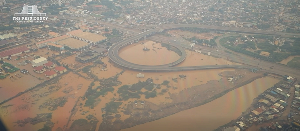 The June 29 floods submerged several roads and communities across Ghana