Every morning, somewhere in Ghana, someone wakes up, gathers the waste that has accumulated in their home, takes it outside, and sets it on fire. In their mind, they are solving a problem. The waste disappears. The compound is clear. Life moves on.
What does not disappear is the smoke. It rises from that compound and travels; across the fence into the neighbour’s yard, down the street, into the lungs of a child playing outside, into the respiratory system of an elderly woman who has never in her life lit a fire of that kind. It travels, in the form of microscopic particles invisible to the naked eye, up to three kilometres from its source and beyond.
And it leaves behind, in the bodies of everyone it touches, a slow accumulation of damage that will show up years later as chronic lung disease, cardiovascular illness, compromised child development, and premature death.
This is not mere speculation. It is what the science tells us, clearly and consistently. And it is why we must shout from the mountain tops that open burning of waste is illegal in Ghana. It has always been illegal. And we must be determined to ensure that the law means something.
The prohibition on open burning is not new, and it is not obscure. It is embedded in our national environmental legislation and reinforced by the by-laws of metropolitan, municipal, and district assemblies across the country.
The Accra Metropolitan Assembly’s by-law of 2017 is among the most explicit; prescribing fines and imprisonment for those found guilty of open burning. Environmental health officers at every assembly have the authority to investigate complaints and prosecute offenders.
The Environmental Protection Authority (EPA) says it was to counter a persistent misconception that the law on open burning is somehow unclear or unenforced by design. The EPA says it is neither. The law is there.
The institutional mandate is there. What we all want to see urgently and continuously, is a strengthening is the chain of action between the law as written and the law as experienced in communities across Ghana.Ghana Economic Forum
That chain depends, in the first instance, on citizens. It depends on neighbours who are willing to speak up, on communities that hold themselves and each other to account, and on individuals who understand that the environment they are protecting is not an abstraction; it is the air their children breathe today and the world their grandchildren will inherit.
What open burning actually does to you
Let us spend a moment on the health science, because if we truly understood what open burning does to the human body, fewer of us would do it, and more of us would find the courage to speak up when their neighbours do.
The experts tell us that when waste is burned openly, it releases particulate matter into the air. The most dangerous of these particles — what scientists call PM2.5, particles smaller than 2.5 micrometres in diameter — are small enough to pass through the body’s natural defences and lodge deep in the lungs.
From there, they enter the bloodstream. Over time, consistent exposure to these particles causes inflammation, damages blood vessels, impairs lung function, and significantly increases the risk of heart attack, stroke, and lung cancer.
When plastics are burned, and much of what is burned in our residential areas is plastic; the danger compounds. Burning plastics releases dioxins, furans, and polycyclic aromatic hydrocarbons: toxic compounds with well-documented links to cancer, hormone disruption, immune system damage, and harm to foetal development. These are not the consequences of living near an industrial facility. They are the consequences of what happens when a household fire is lit fifty metres from where your child sleeps.
I often make this point to people directly: you do not smoke. You have never smoked a cigarette in your life. You consider yourself a healthy person. But if you are living next door to open burning, or if you are the one doing the burning, there is no meaningful difference between your exposure and that of a habitual smoker. You are inhaling the same class of toxins. You are accumulating the same class of damage. You are shortening, by degrees you cannot see or feel today, the years that God has given you.
This is not a matter of inconvenience. It is a matter of life and death.
Pollution knows no boundaries
One of the most important things we must understand is that open burning is not a private act. It feels like one, it happens in your compound, with your waste, on what you may think of as your time. But the moment that smoke rises, it becomes everyone’s problem.
The EPA has deployed real-time air quality monitoring sensors across Greater Accra, the Volta Region, the Ashanti Region, and the Northern Region. These sensors give us live readings of air quality conditions across multiple communities, and we publish these readings daily on our social media platforms.
Green Economy insights What those sensors show us, consistently, is that air quality does not respect property lines. A fire in one part of a neighbourhood affects readings across a wide radius. The particulate matter does not stop at the gate of the compound where it was generated.
This has a direct implication for how we think about open burning as a social issue. When you burn your waste, you are not making a decision that affects only you. You are making a decision that affects your neighbour, their children, the elderly person two houses down, the school at the end of the street, and the trader who sits by the roadside all day with no choice about the air she breathes. You are, in the language of economics, externalising a cost, transferring the consequences of your action onto people who had no say in it and receive no benefit from it.
This is why the law treats it as an offence. And this is why the EPA treats enforcement of that law as a non-negotiable part of our mandate.
What the EPA is doing
The EPA says its response to open burning operates on two main fronts: sustained public education and enforcement where necessary. On the education side, the Authority works with schools, churches, community groups and local leaders, while also supporting assemblies to strengthen by-laws, train environmental health officers and build capacity for effective enforcement.
It is also assisting some assemblies to explicitly incorporate open burning provisions into their sanitation by-laws, as national sanitation regulations undergo review. The Extended Producer Responsibility (EPR) framework is also being strengthened, with officials pointing to visible reductions in certain packaging waste as evidence of its impact when properly implemented.
On monitoring, the EPA is expanding its air quality sensor network nationwide, tracking compliance with national air quality standards in real time. Where pollution levels consistently exceed safe thresholds, the Authority says it triggers investigations rather than waiting for formal complaints.
On enforcement, it maintains that prosecution remains a last resort, but warns that existing laws, which provide for fines and custodial sentences of up to six months, will be applied where education and community engagement fail. The EPA adds that it is prepared to apply the full extent of its enforcement mandate where necessary, in collaboration with assemblies and other institutions.
What you can do
This is for the rest of us, because ultimately the environment cannot be protected by the EPA alone.
If you observe open burning in your community, begin with your neighbour. Explain what the practice does, to them, to you, to the children in the area. In my experience, many people who burn their waste do so out of habit and ignorance of the consequences, not out of malice. A frank, respectful conversation is often enough.
If the burning continues, report it. Go to the environmental health department of your district, municipal, or metropolitan assembly. Give them the details. Ask for a response. The law gives them the authority to act, and your report gives them the information they need to use it. You are not being a troublesome neighbour. You are being a responsible citizen. And you are protecting people, including yourself, who cannot protect themselves from what they cannot see.
Support the sanitation initiatives in your community. Where tree-planting campaigns, clean-up exercises, or school environmental programmes are happening, participate in them. These are not peripheral activities, they are the practical expression of a commitment to the environment that, if it takes hold widely enough, makes the EPA’s enforcement work less necessary because communities are governing themselves.
Finally, think about waste differently. Waste is not simply a problem to be disposed of, it is a resource that our economy is currently failing to use. When you separate your waste at source, organic from plastic from paper from metal, you reduce the volume that needs to be disposed of, you create value that others in the waste economy can capture, and you eliminate the temptation to burn. The circular economy is not a distant aspiration. It is a practical choice that households across Ghana can begin making today.Green Economy insights
A borrowed environment
Let us close with the thought that, for me, gives this entire subject its deepest urgency.
We did not inherit this environment. We borrowed it, from our children, and from their children, and from generations of Ghanaians not yet born who will have to live in whatever condition we leave it. Every fire we light in a residential compound, every plume of toxic smoke we send into a shared sky, is a charge against that borrowing. It is a debt we are accumulating silently, in the bodies of our neighbours and in the fabric of our air and water, that future generations will be left to repay.Ghana Economic Forum
The environment belongs to all of us, and its protection is the responsibility of all of us, institutions and citizens alike.
Open burning has always been illegal. It will remain illegal. And together, we can make it rare.
Opinions of Friday, 26 June 2026
Columnist: Ebenezer Chike Adjei Njoku
Open burning and the stewardship of a borrowed environment
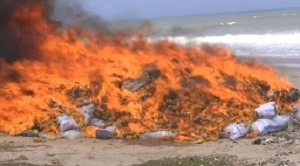 The prohibition on open burning is not new, and it is not obscure