Every year, the rains come. And every year, the Adutor Electoral Area pays the price. Floodwaters swallow farms. Roads dissolve into mud. Children wade to school — or do not go at all. Health facilities are cut off from the communities they were built to serve.
And then the waters recede, the headlines disappear, and life limps back to a fragile normalcy — until the next rainy season arrives and the cycle begins again. This is not a natural disaster. It is a governance disaster wearing the mask of nature.
A COMMUNITY HELD HOSTAGE BY WATER
The Adutor Electoral Area, nestled within the South Tongu District of the Volta Region, sits at the convergence of geographical vulnerability and institutional neglect. It is part of a district that lies entirely within the Lower Volta Basin — a zone characterised by flat, low-lying terrain, poor natural drainage, and proximity to the Volta River system.
When the rains come with intensity, the land has nowhere to send the water. Communities flood. And those who suffer most are ordinary people — farmers, traders, mothers, school-going children — who did nothing to deserve the annual torment they endure.
In June 2026, Adutor once again made the headlines. CitiTV's cameras captured what residents already knew by heart: the community had been hit by severe flooding following heavy rains. But this was not a one-off event.
Records and community testimonies show that Adutor and surrounding communities in the Shime area — including Agortoe, Tregui, and Blamezado — have been inundated repeatedly over the years. The floods destroy farms, displace families, and cut communities off from each other and from essential services.
And they are not alone.
Just days after Adutor flooded in June 2026, Citi FM and CitiTV were also reporting on a broader flood crisis in South Tongu that had submerged schools and a health centre. In Sogakope, the district capital, torrential rains had earlier displaced hundreds.
These are not isolated incidents. They are symptoms of a systemic problem that government after government has refused to treat.
THE GEOGRAPHY OF SUFFERING: WHY ADUTOR FLOODS
To understand the flooding crisis in the Adutor Electoral Area, one must first understand the terrain. The South Tongu District occupies a total land area of 643.57 square kilometres in the southern Lower Volta Basin. Its topography is characterised by flat, low-lying land with little natural elevation to channel runoff away from communities.
The district is bounded to the west by the Volta River — a body of water that, while a source of life, also poses existential risk when its levels rise.
The road network within the district compounds the problem. Untarred feeder roads — which connect Adutor and surrounding communities to the rest of the district — become unmotorable during the rainy season.
According to the South Tongu District Assembly's own data, road conditions deteriorate drastically in the rains, hindering the movement of goods, services, and people. When flooding hits, therefore, communities like Adutor are doubly isolated: by water, and by infrastructure collapse.
There is also the matter of the River Tordze. This river, which drains into the Avu Lagoon, has been identified by authorities as a significant flood risk. During a previous flooding crisis in the area, the then-Keta Municipal Chief Executive warned that the volume of water the River Tordze was discharging into the Avu Lagoon threatened to make an already bad situation far worse.
These hydrological risks are well known. They are documented. They are predictable. What is not predictable is when the government will act on them.
THE AKOSOMBO DAM FACTOR: A STRUCTURAL THREAT
Beyond seasonal rainfall, the communities of South Tongu — including the Adutor Electoral Area — live under another sword: the Akosombo Dam. Ghana's largest hydroelectric dam, completed in 1965, transformed the Lower Volta forever.
The dam ended the natural cycle of annual flooding that had nourished the land for centuries and forced communities to adapt by settling in lower-lying areas closer to the Volta River. When the dam's water levels become critical and a controlled spillage is ordered, those very communities become ground zero for disaster.
The 2023 Akosombo Dam spillage is the most recent and most catastrophic example. On September 15, 2023, the Volta River Authority (VRA) began releasing water from the dam to prevent it from overtopping. The result was devastating: over 35,000 people were displaced in nine districts along the Lower Volta River.
North and Central Tongu Districts bore the brunt, with communities like Mepe and Battor suffering the most, but the entire Lower Volta basin — including South Tongu — was at heightened risk. Farms were submerged. Homes destroyed. Crops lost. And the very settlement patterns that made these communities vulnerable had been shaped by the dam's construction in the first place.
This is not a new story. Researchers and policy analysts have documented for decades that the construction of Akosombo Dam fundamentally altered the ecology of the Lower Volta, pushing communities into flood-prone zones. Warnings were issued as far back as the 1956 preparatory commission report on the Volta River Project.
Ghana's policymakers ignored them. Sixty years later, communities in the Adutor Electoral Area and across South Tongu are still paying for that failure of foresight.
SCHOOLS UNDERWATER, HEALTHCARE CUT OFF: THE HUMAN COST
Flooding in the Adutor Electoral Area is not merely an inconvenience. It is a human rights crisis. When floodwaters rise, the first casualties are education and healthcare — the very services upon which a community's future depends.
In June 2026, CitiTV reported what residents had long complained about: schools and a health centre in South Tongu had been submerged. For children in the affected communities, this means interrupted schooling at critical periods — including BECE and WASSCE examination seasons.
For patients, it means inaccessible healthcare during a time when waterborne diseases — cholera, typhoid, skin infections — are at their peak. For pregnant women and nursing mothers, the consequences can be fatal.
In 2023, UNICEF intervened in nearby North and Central Tongu Districts with educational materials and health kits following the Akosombo spillage. Fourteen-year-old Beatrice from Mepe, who was in Class 6 at the time, described waking up to see floodwaters rushing toward her home.
Her story humanises a statistic that Ghana's government too often treats as a footnote. But UNICEF's emergency response, while welcome, is not a substitute for the permanent drainage infrastructure, elevated school buildings, and resilient health facilities that communities in the Volta Region are entitled to as Ghanaian citizens.
Farmers in the Adutor Electoral Area face a particular kind of grief. South Tongu is an agrarian district where agriculture sustains nearly half the working population. The major crops — cassava, maize, beans, rice, pepper, okro — are cultivated in the very lowland areas most susceptible to flooding.
When the rains come hard, entire harvests disappear underwater. Livelihoods vanish. Food insecurity rises. And families that were already poor are driven deeper into poverty — with no government compensation, no insurance, and no structured recovery plan.
A DISTRICT ASSEMBLY THAT MUST DO MORE
The South Tongu District Assembly has a critical role to play in protecting the Adutor Electoral Area from the annual flood catastrophe. Its mandate includes local planning, infrastructure development, and disaster preparedness. But for far too long, residents have experienced the gap between mandate and delivery as a chasm.
Good governance demands proactive action, not reactive relief. It is not enough for the District Assembly to wait until homes are submerged and then appeal to NADMO for emergency supplies. The Assembly must invest in proper drainage infrastructure across the Adutor Electoral Area and surrounding communities.
It must enforce building regulations to prevent settlement expansion into known floodplains. It must work with the Ghana Meteorological Agency and the National Disaster Management Organisation to establish early warning systems that give communities advance notice when severe rains are approaching.
It must also demand accountability from higher levels of government. The Volta River Authority cannot continue to make decisions about dam spillages in boardrooms while their consequences are borne entirely by communities like Adutor.
The District Assembly must amplify the voices of its people in those conversations, and push for the compensation and flood mitigation infrastructure that communities downstream of the Akosombo Dam have been denied for decades.
The Concerned Citizens of South Tongu demonstrated in June 2026 over the district's acute water crisis — a crisis compounded, ironically, by too much water in the wrong places and not enough clean water where it is needed. Their protest was a reminder that communities are not passive sufferers.
They are active citizens demanding what is rightfully theirs. Their courage must be matched by institutional responsibility.
THE NATIONAL GOVERNMENT'S RESPONSIBILITY
The flooding crisis in the Adutor Electoral Area is a local manifestation of a national failure. Ghana has experienced devastating floods repeatedly — in Accra in 2015, in northern Ghana in 2010, in the Volta Region in 2023. Each time, the pattern is the same: emergency response, political statements of sympathy, a few relief items — and then nothing. No structural change. No permanent investment. No accountability.
The Mahama administration must take a different approach. Climate change is intensifying rainfall patterns across Ghana. The Ghana Meteorological Agency (GMet) has issued multiple severe weather alerts in 2026 alone. The flooding of Adutor and South Tongu is not a surprise.
It is a predictable outcome of known geographical vulnerabilities, climate trends, and decades of underinvestment in drainage infrastructure. Predictable problems demand deliberate solutions — not annual emergency performances.
Ghana must move beyond its reactive approach to flooding. The Ministry of Local Government, together with the Ministry of Works and Housing, must develop and fund a comprehensive flood resilience programme for the Lower Volta Basin that includes proper drainage channels, elevated road beds, flood-resistant school and health facility design, farmer compensation funds, and community early warning systems.
The World Bank's Global Facility for Disaster Reduction and Recovery has already invested in flood forecasting for the Volta Basin — the government must build on that foundation with domestic political will and budgetary commitment.
THE ASSEMBLY MEMBER'S IMPERATIVE
At the community level, the Assembly Member for the Adutor Electoral Area carries a particular responsibility. The Assembly Member is the closest point of contact between the people and the government. When children cannot get to school because roads are flooded, when farmers watch their crops drown, when a health centre is submerged, the Assembly Member's voice must be the loudest in the halls of the District Assembly — not the quietest.
Assembly Members must document every flooding incident in detail. They must compile data on affected households, damaged farms, disrupted schooling, and health impacts. They must use every District Assembly meeting as an opportunity to demand infrastructure solutions — not just emergency relief.
They must build coalitions with civil society, media, and fellow Assembly Members to amplify the message that the Adutor Electoral Area will no longer accept annual flooding as fate.
Attitude matters in public service. Complacency in the face of preventable suffering is not neutrality — it is complicity.
WHAT NEEDS TO HAPPEN: A CALL TO ACTION
The residents of the Adutor Electoral Area deserve concrete action, not seasonal sympathy. Here is what must happen:
First, the South Tongu District Assembly must commission an immediate drainage assessment of the Adutor Electoral Area and surrounding communities, identifying the most vulnerable points and designing appropriate interventions. This assessment must be funded, not merely promised.
Second, the Volta River Authority must establish a formal early warning and community notification protocol for all communities in the Lower Volta Basin before any dam spillage is initiated. Communities must not wake up to floodwaters without warning.
Third, the National Disaster Management Organisation (NADMO) must pre-position emergency supplies in flood-prone districts — including South Tongu — before the peak of the rainy season, not after the catastrophe has already struck.
Fourth, the Ministry of Food and Agriculture must activate a flood-related crop loss compensation programme that provides immediate financial support to farmers in the Adutor Electoral Area and similar communities who lose their livelihoods to flooding every year.
Fifth, the Ghana Education Service must develop contingency learning plans for schools in the South Tongu District that ensure no child's academic year is lost to flooding — whether through temporary learning facilities, mobile classrooms, or academic calendar flexibility.
Sixth, the Member of Parliament for the South Tongu Constituency must use their platform and resources to advocate loudly for the Adutor Electoral Area's flood crisis at both the district and national levels — and must be held accountable by constituents for doing so.
CONCLUSION: FLOODS ARE POLITICAL
In the Adutor Electoral Area, flooding is not an act of God. It is an act of governance — or the absence of it. The geography has not changed. The rivers have not moved. What has changed, with each passing year, is the evidence that this community's suffering is preventable, and the indictment that it continues to be permitted.
The children who miss school when the floodwaters rise are not abstract statistics.
They are Ghana's future. The farmers who watch their cassava and maize disappear underwater are not acceptable casualties of the rainy season. They are citizens with rights. The mothers who cannot access a health centre because the roads are submerged are not an unfortunate inconvenience. They are a measure of how seriously this country takes the lives of its most vulnerable people.
Adutor must not flood again without consequence — not for the government, not for the District Assembly, and not for the elected representatives who swore to serve these communities. The rain will come. The question is whether the state will finally be ready.
Opinions of Tuesday, 23 June 2026
Columnist: Makafui Kwadzo Dzamesi
Adutor’s flood nightmare returns as residents await lasting solutions
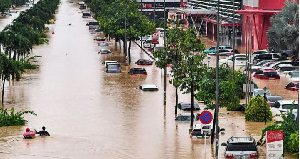 Residents question the State as floods return to Adutor






Entertainment

Van Vicker 'slaps' LilWin with GH¢10m defamation suit


Opinions