On June 3, 2026 — eleven years to the night that floodwaters and fire consumed over 150 souls at the GOIL station near Kwame Nkrumah Circle — Accra flooded again. A building collapsed. Markets burned. Citizens wept in the same streets, in the same communities, under the same broken skies that have failed them every rainy season for over a decade. And three days before this renewed disaster, President John Dramani Mahama, addressing Ghanaians at a diaspora forum in London, declared that Accra's flooding is 'not an engineering problem' but 'a problem of indiscipline.'
This article — written as both a scholarly critique and a personal reflection by a governance and legal professional who believes that institutional accountability is not optional — interrogates that declaration with rigour and honesty. It traces eleven years of promises, partial progress, and persistent structural failure. It engages the unresolved justice demands of survivors.
It analyses the compound governance, engineering, and climate dimensions of Ghana's flooding crisis. And it closes with a step-by-step solution framework for transforming words into institutional change. Because eleven years of commemoration without transformation is not governance. It is a ritual of managed grief.
1. A Personal and Professional Opening: Why this matters
I did not set out to write a polemic. As a governance and legal professional whose work spans institutional compliance, risk management, and development policy, I am trained to follow evidence wherever it leads — even when, and especially when, it leads somewhere uncomfortable.
And the evidence of the past eleven years, examined honestly, leads somewhere very uncomfortable indeed for the governance architecture of this republic I call home.
On June 3, 2026, I watched, as did millions of Ghanaians, the same footage that plays on the same date every year: submerged streets, stranded motorists, crying families, damaged homes, and a city brought to its knees by rain. But this year carried a weight that ordinary flooding cannot — because this was the eleventh anniversary of the night that over 150 Ghanaian citizens died at a fuel station, seeking shelter from a storm in a city that had no shelters for them. And on this same night, eleven years later, Makola and Tudu markets burned amid the floods, a building collapsed in Adenta, and nine people had to be physically rescued from floodwaters in Oyarifa and Ashongman.
Three days before this, our President had stood before Ghanaians in London and told them — told us — that Accra's flooding is not an engineering problem. It is just a problem of indiscipline.' As someone trained in law, governance, and institutional risk, I felt the inadequacy of that framing immediately. Not because it is wrong — citizens do dump waste in drains; buildings do sit in waterways; wetlands have been encroached upon — but because it is profoundly incomplete. And in governance, incompleteness is not a minor analytical error. It is a policy architecture failure with human consequences.
This article is my attempt, as a professional committed to accountability and institutional integrity, to offer what the moment demands: a rigorous, honest, and actionable analysis of where Ghana stands eleven years after its most devastating peacetime disaster — and a concrete, step-by-step framework for what genuine transformation would require. It is written with equal parts sorrow, analytical rigour, and stubborn hope.
“Eleven years is long enough to have transformed this crisis. That it has not been transformed is a governance choice, not an inevitability.” — Priscilla Akaibe Anderson, Esq.
2. The night that should have changed everything:
2.1 What Happened on June 3, 2015
The events of June 3, 2015, have been documented in official records, parliamentary inquiries, and media archives. That evening, over 100 millimetres of rain fell on Accra over several hours — exceptional by any measure, but not unprecedented for a coastal West African city in peak rainy season. The catastrophe was not the rain itself. It was everything the rain revealed.
Floodwaters rose rapidly across low-lying districts of the capital. Hundreds of citizens, with nowhere else to go — no emergency shelters, no elevated public buildings left open, no communicated evacuation routes — sought refuge at the GOIL petrol station near Kwame Nkrumah Circle. At approximately 11:45 PM, overground fuel tanks ignited, almost certainly triggered by floodwater carrying burning debris from nearby cooking fires in the informal settlement immediately adjacent. The explosion and resulting inferno killed between 150 and 256 people, depending on which official source one consults — a disparity that is itself a governance indictment. Hundreds more were severely burned or injured. The physical scars on survivors have, in many cases, never fully healed. The psychological ones certainly have not.
What the disaster revealed was not unusual rainfall. It revealed blocked drains that could not convey stormwater. It revealed a fuel station operating without adequate safety infrastructure in a demonstrably flood-prone zone. It revealed the total absence of designated emergency shelters in a densely populated urban area. It revealed regulatory agencies — the NPA, the AMA, the planning authorities — that had not performed the oversight their mandates required. It revealed, in the most brutal possible terms, what happens when institutional failure meets citizen vulnerability in a warming, flooding city.
2.2 What Was Promised in Its Aftermath The response of the Mahama government — in its first incarnation — was swift in its rhetoric. A National Day of Mourning was declared. Parliamentary emergency sessions were convened. An infrastructure review was commissioned. The President, in his memorial speech to survivors and families, spoke with evident emotion of ensuring that 'something' was learned from the 'mistakes and failings.' He acknowledged that 'there is plenty of blame to go around.'
Civil society demanded more: an independent commission of inquiry with legal teeth, criminal accountability for regulatory negligence, comprehensive drainage investment, and a resettlement programme for communities living in floodplains.
The government agreed, in principle, to most of these. The OneGhana Movement, formed partly in the crucible of the June 3 aftermath, took the further step of filing a civil lawsuit on behalf of survivors — a lawsuit that, as of the 11th anniversary in June 2026, has still not been determined.
“The disaster of June 3 was needless. It ought to have been avoided if those entrusted with the responsibility to take care and exercise duty of care to all and sundry were up to their task.” — Senyo Hosi, Convener, OneGhana Movement, June 3, 2026
3. Eleven Years Later: An honest audit
3.1 What has been accomplished
Intellectual honesty requires acknowledging real progress. The Accra Sanitation and Flood Resilience Programme, supported by the World Bank and European Union, has channelised and rehabilitated key drains in the Odaw River basin. Early warning systems have improved. The Land Use and Spatial Planning Act of 2016 updated the statutory planning framework.
NADMO has expanded community preparedness training. The Mahama government's current National Flood Control Programme, announced in early 2026 by the Works and Housing Minister, includes storm drain construction, waterway dredging, and deployment of modern flood monitoring systems. These are real. They are nothing.
But they are not enough. And the evidence of June 3, 2026 — eleven years to the day — makes that impossibly clear.
3.2 What has not been done
The structural conditions that produced the June 3, 2015, disaster remain, in their essential form, unremedied. The same communities flood. The same drains are blocked by the same plastic waste. The same waterways are encroached upon by the same illegal structures. The same planning enforcement gap allows the same violations. And the same survivors are still waiting — eleven years later — for a court to determine what happened to their loved ones and whether institutions that failed them will be held accountable.
The civil lawsuit filed by the June 3 survivors in 2015 remains unresolved. Witnesses from GOIL PLC and the NPA have admitted under cross-examination that stronger regulatory oversight could have prevented the deaths. The AMA has faced serious criticism in proceedings for its conduct. Survivors are seeking GH¢40 million in damages. No criminal accountability has been established. No state compensation has been paid. The dealer of the GOIL station at the centre of the disaster died during proceedings, creating further complications. The lawyers representing survivors have done so pro bono for eleven years. The state has provided no interim humanitarian support to victims while the legal process continues.
This is not primarily a legal system failure — though the delay is troubling. It is a governance failure. Governments across eleven years and two political parties have had the capacity to provide interim humanitarian support to documented victims. They have chosen not to prioritise it.
4. On The President's London Declaration: A legal and governance critique:
4.1 The Diagnosis -Partial Truths and Their Limits
Let me be direct about what President Mahama got right on May 31, 2026, in London: the behaviour he described is real. Ghanaians dump sachet water bags, polystyrene containers, and plastic packaging into drains. Buildings have been constructed on river beds, wetland margins, and natural water channels with regularity. The Densu River basin, Odaw corridor, and multiple Ramsar-designated wetlands in Greater Accra have been progressively encroached upon. When the President warns that officials who issue permits for development in waterways will be dismissed, he is addressing a genuine and documented regulatory failure.
A leader who refuses to name citizen complicity in environmental degradation for fear of political unpopularity is not serving the public interest. On this narrow point, Mahama deserves credit for candour that is often politically costly.
4.2 What the Framing Omits — and Why That Omission Is Legally and Governance-Critically Significant
As a governance and compliance professional, I must identify what is absent from the President's framing — because in institutional governance, what a leader chooses not to say shapes policy as profoundly as what they say.
The President did not acknowledge the state's own structural failure to enforce the very regulations he now decries citizens for violating. Ghana has had planning laws, building codes, and environmental protection regulations for decades. These have been comprehensively violated — not because Ghanaian citizens have a unique cultural disposition toward lawlessness, but because the enforcement architecture of the state has been chronically underfunded, understaffed, politically compromised, and institutionally fragmented across agencies that do not coordinate. Calling out citizen indiscipline without acknowledging state enforcement failure is analytically incomplete and, from a governance standpoint, misleading in its assignment of primary responsibility.
The President's declaration that flooding is 'not an engineering problem' is also, as a matter of technical fact, contestable. Accra's drainage infrastructure was designed for a fraction of its current population and a precipitation regime that predates both its exponential growth and the intensification of rainfall attributable to climate change. The city's own Drainage Master Plan identifies an investment gap of approximately USD 2.5 billion. When drainage infrastructure is structurally inadequate for the urban population it serves and the climate conditions it faces, flooding is — at minimum, in significant part — an engineering problem. To declare otherwise risks providing political cover for underinvestment.
“In governance, framing is not merely rhetorical. It determines where resources go, who is held responsible, and which solutions are considered. A frame that centres citizen indiscipline without centring state infrastructure failure will produce citizen-discipline programmes, not drainage systems.” — Priscilla Akaibe Anderson, Esq.
Finally — and this matters profoundly from an accountability standpoint — the declaration was made in London, to a diaspora audience of investors and professionals, three days before Accra flooded again on the anniversary of its worst peacetime disaster.
The communities of Kaneshie, Adenta, Ashaiman, and Adabraka, who waded through waist-deep water on June 3, 2026, did not need a diagnosis of their indiscipline delivered to Ghanaians in the United Kingdom.
They needed drainage. They needed enforcement. They needed shelters. They needed a state that had, over eleven years, taken their recurring suffering seriously enough to transform the conditions producing it.
5. June 3, 2026: The announcement that indicted us all:
What unfolded in Accra on June 3, 2026, was not simply another flood. It was, in its cruel symbolic precision, a national reckoning. On the night that Ghana was meant to be remembering its dead, parts of the same city were again submerged. A storey building collapsed in Adenta, killing at least one person. Fire gutted shops at Makola and Tudu markets — the central business district — amid flooding, in an echo so direct of 2015's fire-and-flood convergence that Ghanaians on social media could only ask, in bewilderment and grief: 'Why always June 3rd?'
The Ghana National Fire Service deployed four engines to contain the market fires. Rescue teams retrieved nine persons trapped by floodwaters in Oyarifa and Ashongman — successfully, without casualties in those specific incidents, which speaks to genuine improvements in emergency response capacity. But the simultaneity of crises — fires, collapses, rescues, inundated neighbourhoods from Kaneshie to Sakumono — told a story that emergency response improvements, however real, cannot obscure: the structural vulnerability of Accra to flooding has not been fundamentally altered in eleven years.
While these events unfolded, the OneGhana Movement and the Coalition of June 3 Victims held their 11th anniversary memorial at Kwame Nkrumah Circle. Survivors laid wreaths for their dead while, across the same city, the same conditions that killed those dead were again operational. This is not a metaphor. This is the literal governance reality of Ghana in 2026: a state that commemorates preventable disasters while the conditions producing them persist.
What June 3, 2026, Confirmed: After eleven years of promises, reviews, plans, and frameworks, Accra remains a city acutely vulnerable to the compound risks of flooding, fire, and structural collapse during major rainfall events. The communities most exposed are, as in 2015, predominantly low-income, informally housed, and without viable alternatives.
6. The architecture of a preventable crisis:
6.1 The governance failure layer
Institutional analysis of Ghana's flooding crisis reveals at least four intersecting governance failures that no amount of citizen behaviour change can resolve on its own. First, jurisdictional fragmentation: flood risk management responsibilities are distributed across NADMO, the Ghana Hydrological Services Authority, the Works and Housing Ministry, the EPA, metropolitan assemblies, and the Drainage Division — without an empowered coordinating authority. This fragmentation produces the classic pathology of multi-agency governance: each institution has partial responsibility, no institution has full accountability, and disasters fall through the cracks between them.
Second, enforcement deficit: planning and building regulations are not enforced at the local level because district assembly planning departments are under-resourced, understaffed, and frequently subject to political and commercial pressure to approve or overlook non-compliant development. The President's threat to dismiss officials who approve waterway development is welcome, but individual dismissal threats do not substitute for systematic enforcement architecture.
Third, recurrent maintenance failure: new drainage infrastructure is constructed but not systematically maintained. Maintenance contracts are inconsistently funded, and the result is that expensive capital investments deteriorate within years of completion, restoring vulnerability faster than new investment can reduce it.
Fourth, the justice deficit: eleven years without a determined civil lawsuit and without state compensation for June 3 survivors signals to institutions and citizens alike that governance failure at the cost of human life carries no meaningful consequence. Accountability is the immune system of governance. When it fails, the pathology recurs.
6.2 The Climate Amplification Layer
Every one of these governance failures is being systematically worsened by climate change. The IPCC's Sixth Assessment Report identifies West Africa as a region of heightened exposure to compound climate hazards — including intensifying precipitation extremes. Ghana's Meteorological Agency data shows a trend toward higher-intensity rainfall events in southern Ghana. Climate projections consistently indicate that the precipitation events currently considered extreme will become increasingly frequent and severe under middle and high emission scenarios.
This means that the drainage infrastructure adequate for yesterday's rainfall is already inadequate for today's, and will be further inadequate for tomorrow's. The engineering gap is not static; it is a moving target that accelerates with every degree of global warming. A national flood governance strategy that does not incorporate climate projections into its infrastructure design standards is planning for a climate that no longer exists.
6.3 The Citizen Behaviour Layer — With Honesty and Compassion
Citizens dump waste in drains. But they do so, overwhelmingly, in communities where formal waste collection is either unavailable, unreliable, or unaffordable — where the choice is between informal disposal and no disposal at all. Behaviour change without service infrastructure is the governance equivalent of asking someone to be clean without providing water.
Citizens do live in floodplains. But they do so because affordable, secure, formal housing in non-flood-risk areas is, for most low-income urban Ghanaians, simply not an option. The housing market is dysfunctional. Formal tenure is inaccessible. And the economic cost of relocation from an established community — social networks, proximity to livelihoods, familiarity — is immense for people with no financial buffer. Addressing settlement in flood-risk zones through enforcement alone, without addressing the housing system driving settlement, is not flood management. It is displacement.
7. Deep Reflection: What eleven years have shown us:
I think about the survivors of June 3, 2015 — the ones named in the OneGhana Movement's anniversary statement: Alex Mensah, Kassim, Suraj, Francis Abia, Silas Odru. They are not statistics. They are people who went to a filling station in a storm because there was nowhere else to go, who survived something that should not have happened, and who have spent eleven years navigating courts, grief, physical injury, and economic hardship without state support, sustained by pro bono lawyers and the stubborn conviction that accountability should be possible in a constitutional democracy.
Eleven years is not an accident. It is a policy choice, distributed across administrations, budgets, and political calendars, that has consistently placed the justice claims of poor disaster survivors below other priorities. It is a choice that can be made differently. The current President has an opportunity — and, I would argue, a moral obligation — to demonstrate that the 'Resetting Ghana' agenda means something to the people who were failed most fundamentally by the Ghana that preceded it.
Beyond individual justice, eleven years have shown us something systemic: Ghana is institutionally capable of acknowledging the causes of its flooding crisis with great sophistication, and institutionally resistant to doing the structural work required to resolve them. We have excellent diagnostic literature. We have adequate legal frameworks. We have committed to civil society. What we have not had is the sustained political will to translate diagnosis into structural transformation — to make the difficult decisions, enforce the unpopular regulations, invest in the unsexy infrastructure, and hold powerful actors accountable for regulatory failures with fatal consequences.
“A country that can write better flood risk assessments than it can build drainage systems is not suffering from a knowledge deficit. It is suffering from a governance deficit.” — Priscilla Akaibe Anderson, Esq.
The question that the June 3, 2026, floods put before us — starkly, undeniably, on the anniversary of the worst day this city has known — is whether we are willing to move from diagnosis to transformation. The step-by-step solution framework that follows is this article's attempt to provide a concrete, actionable roadmap for that transformation.
8. Conclusion of the critical analysis:
June 3 has become Ghana's most significant date in the governance of urban disaster risk — not because of the disaster itself, as devastating as it was, but because of what the eleven years following it have revealed about the state's capacity and willingness to protect its citizens from preventable harm.
President Mahama's diagnosis of indiscipline is not wrong. But governance requires more than correct partial diagnoses. It requires the institutional courage to name the state's own failures with the same frankness applied to citizens. It requires the political will to invest in infrastructure rather than just announce it. It requires moral seriousness to deliver justice to survivors who have waited eleven years. And it requires the strategic intelligence to build enforcement systems robust enough to outlast any single administration's goodwill.
The 12th anniversary of June 3 will arrive in 2027. Whether Accra is safer on that day than it was on this one depends entirely on what happens between now and then — in Parliament, in local assemblies, in courts, in procurement offices, in drain maintenance contracts, in waste collection routes, and in the daily choices of a state that has, for eleven years, chosen incrementalism over transformation. The framework that follows is an attempt to specify, concretely and honestly, what transformation would actually look like.
Opinions of Wednesday, 17 June 2026
Columnist: Akaibi Anderson ESQ
Eleven Year of Silence and Floods: A critical reflection on Ghana's flooding crisis
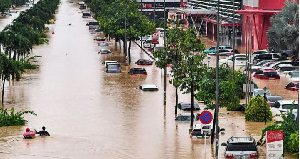 A file photo of a flooded community





Entertainment