For years, the reefs off Pemba Island, in Zanzibar, died to the sound of explosions. Fishers dropped dynamite onto reefs that hold four-fifths of the coral kinds found in East Africa, and neither patrols nor fines did much to slow it.
Then the Mufti of Zanzibar, working with the Islamic Foundation for Ecology and Environmental Sciences, named the destruction what their faith already called it: a violation of amana, the trust God places in human hands to keep creation.
The water was declared a hima, a sanctuary under Islamic law, and people complied, because they were no longer obeying a rule but keeping a trust. The coral grew back, the fish returned, and the 11,400 people who depend on that water watched their nets fill again.
Conservationists call this a success story. It is really a form of governance, older than any environmental ministry, and it worked where patrols and fines had failed. Along these coasts, faith and custom have managed the sea this way for centuries, long before the word sustainability existed.
This month, for the first time, the Our Ocean Conference meets on African soil, in Mombasa, under the theme "Our Ocean, Our Heritage, Our Future". Africa is an ocean continent: coastal states, 30,000km of shore. Yet it has sat at the edge of the rooms where the sea's future is decided. Mombasa can move it closer to the centre.
The African continent brings both a coastline and a way of seeing and understanding the ocean. On the Swahili coast, the ocean is addressed as ancestor and witness; on the West African shore, sacred closures still rest the fishing grounds by season. This practical ethic shows us that the crisis of the ocean is moral as much as ecological.
And its costs are not shared evenly. Africa loses an estimated $11bn a year to illegal fishing, most of it off West Africa, according to Stop Illegal Fishing and the Africa Defense Forum. Off Senegal and Mauritania, the small fish that fed families for generations are ground into meal and shipped north; the Blue Empire investigation found that in 2020 alone, enough West African fish to feed as many as 4 million people went into Norwegian salmon feed. The rules that decide who may fish are written far to the north, as if the ocean were a warehouse.
This is the blind spot of ocean governance. For decades, it has run on states, scientists, NGOs, and industry, overlooking the institutions that actually shape how most people behave at the water's edge. More than eight in ten people identify with a faith.
Their houses of worship reach the last mile of every coast, trusted where a government ministry is not. Where a fisheries officer can issue a fine, a preacher can change what a community believes it owes the sea.
There are countless other stories from coastal regions around the world. In Cambodia, as the Mekong's Irrawaddy dolphins drowned in nets, the Buddhist Supreme Patriarch declared their protection a sacred duty, and the killing slowed.
The population, once below 90 individuals, has stabilized. At Watamu, on the Kenyan coast, a Christian-inspired team pairs marine science with creation theology, training young people as reef scouts along one of East Africa's most biodiverse stretches of coastline. Coral cover at their sites has risen 12 percent since 2016.
In Jewish communities across 30 countries, the ancient Rosh Hashanah ritual of casting sins into water has been inverted. Congregations now pull humanity's waste out instead. Last year, 321 communities across six continents removed 11 tonnes of debris from the world's coastlines.
Faith groups are therefore not waiting to be asked to get engaged in ocean governance. On 15 June, the day before the summit opens, institutions from across the world's traditions will gather in Mombasa at the Ocean Interfaith Forum for a blessing on the beach and working sessions on fisheries and coral.
There, we will launch the Faith High Ambition Coalition for the Ocean, through which faith communities make time-bound, public pledges to protect the sea: teaching congregations, safeguarding reefs and fishing grounds, watching over marine protected areas, and rallying the young people and the women who do half the work of every fishery.
The ocean's crisis is too large for any single sector, which is why faith communities are bringing their networks, their moral authority, and their coastal relationships to the table alongside governments and conservation partners.
For us, heritage is our lifeblood. We have been governing the ocean for centuries. Mombasa is where that governance finally enters the room.
Opinions of Monday, 15 June 2026
Columnist: Dickson Juma Shekivuli
Our heritage is a way of governing the ocean
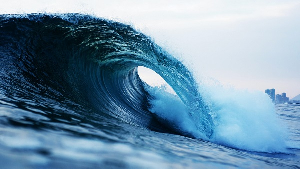 A file photo of the ocean