As the world marks International Day of Play on June 11th, Ghana is reaffirming a simple but important message: play is not separate from learning- for young children, play is learning.
The Government of Ghana remains committed to strengthening quality Early Childhood Education (ECE) and Early Childhood Development (ECD) because the early years are the foundation for every child’s future success.
Right now, Ghana is scaling innovative approaches that help children learn, grow, and thrive from the very start of life.
At the centre of this effort is Play-Based Learning (PBL), an approach that supports children to learn through exploration, creativity, movement, storytelling, games, and interaction.
In play-based classrooms, children are not passive learners memorising information. Instead, they actively build foundational skills such as early literacy, numeracy, communication, and problem-solving through engaging, hands-on experiences.
Research continues to show that play-based learning improves both academic outcomes and overall child development. It helps children develop confidence, curiosity, teamwork, resilience, and creativity - all essential skills for success in school and beyond.
Quality ECE and ECD are critical because children’s brains develop most rapidly in the early years. Children who access quality early learning are more likely to succeed in primary school, stay engaged in education, and achieve better long-term outcomes.
Strong foundations in the early years lead to stronger futures for children, families, and the nation.
This is why Ghana is taking bold action
This year, the Government is scaling Play-Based Learning to all public kindergartens nationwide. Approximately 30,000 KG teachers are being trained in teaching through play, fully aligned with the national curriculum.
This marks a major milestone in ensuring that every young child, regardless of location, has access to joyful, inclusive, and effective learning experiences.
At the same time, Ghana is expanding a parental activation model that recognises an important truth: the home is a child’s first classroom, and parents and caregivers are a child’s first teachers.
Simple activities such as storytelling, singing, counting household objects, drawing, and regular conversations, can be integrated into everyday life and routines, thereby significantly improving children’s learning and school readiness.
Learning through play at home strengthens children’s confidence, language development, and progress in both kindergarten and primary school - and it is easy and simple for parents to do.
However, achieving quality early education is not the responsibility of government alone.
The Government is calling on parents and communities across the country to actively support learning through play by working closely with their local schools and teachers.
Parents can attend PTA meetings, visit classrooms, encourage play-based learning into daily home activities and routines, and maintain regular engagement with teachers about their children’s progress.
Communities can also support schools by contributing materials and furniture that can be used in play-based classrooms. Items such as round tables, chairs, bottle tops, cardboard, fabric, sticks, clay, and containers can become valuable learning tools that help children explore and learn creatively.
Parents and community members can also support teachers to create teaching and learning materials from these no-cost or low-cost materials to transform classrooms into engaging, attractive places for children to learn.
By supporting schools, encouraging play at home, and valuing early learning, communities can help create the strong educational foundations every Ghanaian child deserves.
On this International Day of Play, Ghana proudly celebrates the rollout of play-based learning in every public kindergarten across the country. We look forward to continuing to work hand-in-hand with schools, teachers, parents, and communities to harness the power of play- ensuring every child gets the strongest possible start, both at home and at school.
Opinions of Friday, 5 June 2026
Columnist: Ministry of Education
Play is Learning: Ghana's push for stronger early years
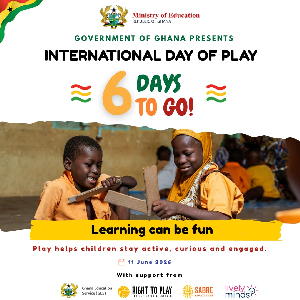 Ghana marks International Day of Play as govt scales play-based learning in all public kindergartens