We are very good at demanding Ghana. We speak of it at funerals, at churches, at town halls, and on radio phone-ins with the conviction of people who want nothing more than to see this country rise.
We demand good roads, reliable electricity, clean water, functioning hospitals, and accountable leaders. We wear our Ghana jerseys with pride and sing the national anthem with feeling.
And then, on the way home, we throw our sachet water bag out of the window. This is not a comfortable article to write. It is far easier — and politically safer — to write about failing institutions, corrupt officials, and incompetent governments.
Those stories are important, and they must be told. But there is another story, less told, more uncomfortable: the story of how ordinary Ghanaians, in their everyday attitudes and choices, are themselves obstacles to the development they say they want.
Ghana’s problem is not only at the top. It lives in all of us.
The Littering Nation
Let us begin with something visible. Drive through any major Ghanaian city — Accra, Kumasi, Takoradi, Tamale — and what you see is a country at war with its own environment. Gutters choked with plastic. Roadsides lined with refuse.
Drainage channels that function more as open dumps than waterways. And yet, in almost every case, the person who threw the rubbish there is the same person who will complain bitterly when flooding devastates their community.
According to the 2021 Population and Housing Census, only 51.4 percent of urban households have their solid waste collected, leaving nearly half without formal waste services.
By March 2023, only 25 percent of Ghanaian households had access to basic, safe sanitation infrastructure. A cholera outbreak between October and December 2024 in constituencies like Ahanta West affected 345 people and killed four — a direct consequence of poor sanitation conditions.
Ghana’s Sanitation Minister has described indiscriminate littering, open defecation, and illegal dumping as “completely unacceptable.”
Researchers at the University of Cape Coast have confirmed what most Ghanaians already know: littering is rampant and, in many communities, socially acceptable.
People litter not because they do not know it is wrong, but because they calculate that everyone else does it, that nothing will happen to them, and that the environment is someone else’s problem.
That calculation is the problem. And it is not a government calculation. It is a personal one.
We Know the Rules — and Choose to Ignore Them
Ghana has laws. There are by-laws against littering. There are regulations governing the dumping of waste. There are traffic codes that are flouted every single day by drivers who know them perfectly well.
There are building standards that contractors ignore. There are tax obligations that individuals and businesses routinely dodge.
The issue is rarely ignorance. A study examining litter prevention behaviour in Ghana found that individuals will change their behaviour when environmentally friendly interventions are implemented that appeal to self-responsibility and moral obligation.
In other words, Ghanaians know better. What is often missing is the moral compulsion to act on that knowledge when no one is watching.
This is the culture of selective compliance: obey the rules when there is an inspector present, a camera running, or a fine being issued. Discard the rules the moment the coast is clear.
It manifests in the driver who respects traffic lights only when a police officer is visible. In the contractor who uses substandard materials because the building inspector can be settled.
In the civil servant who arrives at work only when the boss is in the office. This is not a poor person’s problem or an uneducated person’s problem. Ghana’s sanitation authorities have noted with alarm that even the educated are not exempt from deliberate littering.
The graduate who litters. The professional who jumps the queue. The business owner who dumps waste at midnight. Indiscipline in Ghana cuts across class, education, and geography.
The ‘What’s In It for Me’ Mentality
Closely related to indiscipline is a deeper attitudinal problem: the privatisation of the public good. Too many Ghanaians relate to national resources, public infrastructure, and shared spaces through a single lens — what can I extract from this for myself?
Public property is treated as nobody’s property. Street lights are vandalised for scrap metal. Manholes are stolen. Pipes are tapped illegally. Election infrastructure is destroyed by supporters of losing parties.
Trees planted along roads are uprooted. The logic, unstated but pervasive, is that if it belongs to ‘government,’ it belongs to no one — and therefore to whoever can take it first.
This mentality extends into Ghana’s governance culture. Surveys of Ghanaian civic attitudes reveal high levels of stated civic responsibility, but also a significant trust deficit in leadership.
Ghanaians say they feel responsible for national progress. But many simultaneously believe that their individual honesty counts for nothing in a system they perceive as fundamentally corrupt. The result is a collective action failure: everyone waits for someone else to be honest first.
Analysts studying urban disorder in Accra, Kumasi, and Tamale have found that the chaos of Ghana’s cities arises not only from weak institutions, but from conflicting mindsets among citizens, traditional authorities, and government agencies.
Urban disorder is not simply imposed from above. It is co-created, daily, by the choices of ordinary people.
Politics as Tribalism, Not Ideology
One of the most damaging expressions of Ghana’s attitudinal problem is the way politics is practised and consumed. Ghana’s democracy is the envy of many African nations — and rightly so.
Elections are conducted, transitions of power occur, and the process largely holds. But beneath the democratic machinery lies a deeply tribal political culture in which loyalty to party supersedes loyalty to country.
Too many Ghanaians defend their party’s wrongdoing with the same energy they would use to condemn the same actions from the opposing party. Infrastructure built under one administration is credited to the party, not the nation.
Corruption is prosecuted selectively, and citizens cheer the prosecution of their opponents while shielding their own. Development becomes a partisan weapon rather than a shared aspiration.
Attitudes rooted in entitlement, nepotism, favouritism, and apathy continue to undermine Ghana’s governance at every level. Young people are recruited into party foot-soldier cultures that reward loyalty over merit and violence over engagement.
Older generations in positions of leadership model the very behaviours they publicly condemn. The cycle perpetuates itself. A country cannot build its future on a foundation of ‘my party, right or wrong.’
The ‘Government Must Do It’ Syndrome
There is a particular kind of passivity that has taken root in Ghana’s civic culture: the belief that development is something that happens to citizens, rather than something citizens are agents of.
Roads are ‘government’s job.’ Schools are ‘government’s job.’ Even keeping one’s street clean is, somehow, ‘government’s job.’
This is not entirely irrational. For decades, Ghanaians have paid taxes and received relatively little in return. The state has often failed them. That failure breeds a reasonable reluctance to invest emotionally or practically in public goods.
But the danger is when this legitimate frustration calcifies into permanent passivity — when citizens stop seeing themselves as contributors to national development and become only consumers of it, or more accurately, critics of its absence.
Ghana’s National Commission for Civic Education has acknowledged this, orienting its 2025 civic education programmes around the theme “Ghana’s Future: Our Collective Responsibility.” The emphasis on ‘collective’ is deliberate. Sanitation, law enforcement, and education cannot be ‘government problems’ alone.
They are shared societal responsibilities. Nations that have developed — in Asia, in Europe, in parts of Latin America — have done so because citizens internalised that shared responsibility as a personal obligation, not a government favour.
The Strengths We Must Not Forget
This article would be dishonest if it did not acknowledge what Ghanaians do extraordinarily well. Ghana’s communal spirit — the ability to mobilise around shared loss, celebrate shared achievement, and support one another across ethnic and class lines — is a genuine social asset.
The entrepreneurial energy visible in every market, every roadside business, and every Ghanaian diaspora community around the world is remarkable.
Ghanaians are among the most educated, most networked, and most internationally connected people on the African continent. Ghana’s civil society is active. Its press, though challenged, remains relatively free. Its democratic institutions, though imperfect, function. These are not small things.
Research shows that Ghanaians exhibit high levels of stated civic responsibility and engagement. The desire for a better Ghana is real.
The frustration at its slow arrival is real. What must change is the gap between what Ghanaians want for their country and what they are willing to do — and stop doing — to get there.
The Mindset Reset Ghana Needs
Development will not rain from the sky. No government, however visionary, can build a developed Ghana without citizens who are willing partners in that project.
The mindset reset Ghana needs is not about blaming ordinary people for structural failures that belong to institutions and leaders.
It is about recognising that culture and attitude are not fixed — they can change, they have changed in other countries, and they must change here.
Civic education must be revived and taken seriously. Not as a subject ticked off in school syllabuses, but as a living national conversation about what it means to be a citizen, what obligations citizenship carries, and why those obligations matter for every Ghanaian’s daily life.
Sanctions must be applied consistently and without political favour. The culture of selective compliance will not change until people experience real consequences for violations — regardless of their party affiliation, their social status, or their ability to pay their way out.
Leadership must model the values it preaches. Citizens take their cues, consciously and unconsciously, from those in authority.
A political class that loots, that appoints friends over merit, that makes promises it never intends to keep, teaches ordinary Ghanaians that personal gain is the only rational strategy.
The ‘what’s in it for me’ mentality must give way to a national ethic. This is not naive idealism. It is the historical record of every nation that has made the journey from developing to developed.
It required a cultural shift — in schools, in families, in communities, in churches and mosques — toward the understanding that individual wellbeing is inseparable from collective wellbeing.
Mirror, Not Accusation
This article is not an accusation. It is a mirror.
Ghana has enormous potential — in its people, its resources, its democratic tradition, its geographic position, and its cultural richness. But potential is not destiny.
Every generation of Ghanaians has said it wants a better country. Every generation has, to some degree, handed the next generation the same problems with slightly different packaging.
The generation alive today has a choice. It can continue to blame government for everything and take responsibility for nothing. Or it can begin — in small ways, in daily ways, in personal ways — to become the Ghana it keeps demanding.
Pick up the sachet water bag. Pay the tax. Refuse the bribe. Hire on merit. Show up to the community meeting. Hold your own party accountable.
The development Ghana needs will not be delivered. It must be built — by Ghanaians, one honest, disciplined, and patriotic choice at a time.
Opinions of Thursday, 4 June 2026
Columnist: Makafui Kwadzo Dzamesi
The Enemy Within: Ghanaians, our attitude, and the development we say we want
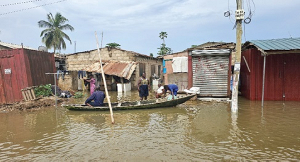 Floods and disease begin where responsibility ends