The Shangri-La Dialogue was meant to be Asia’s forum for security, not sabre-rattling. Yet US Defence Secretary Pete Hegseth’s address reduced a complex theatre of history, identity, and sovereignty to the stale grammar of deterrence. Clueless. Cruel. Crass. Cretinous. Controlling.
These are not just adjectives; they describe a doctrine that mistakes coercion for strategy and assumes peace can be enforced at gunpoint. That is not a strategy. It is a theatre.
There is another grammar available, one rooted in the Asian tradition of deferred confrontation and shared prosperity. China could cement its relationships across the region by signing non-aggression pacts and resource-sharing agreements in disputed areas with all its neighbours, Taiwan included. Such pacts would transform contested waters from flashpoints into commons, and rivalry into mutual gain.
In Taiwan, the model exists in our own historical memory: Hong Kong’s 99-year lease. Agreeing to let Taiwan retain its present status for 99 years, after which it returns to the mainland as a province, offers dignity now and reunification later. It grants Taipei autonomy without humiliation, and Beijing continuity without catastrophe. It is not surrender. It is statecraft measured in generations, not news cycles.
War is always a failure of imagination. The alternative to conflict is not capitulation, but creativity. If the Asia Pacific is to avoid becoming the 21st century’s powder keg, we must ask whether peace can be bought with time, not blood. The answer, if we are brave enough to try, is yes. Peace in the Asia Pacific can be bought with time, not blood.
Opinions of Tuesday, 2 June 2026
Columnist: Kofi Thompson
Can peace in the Asia pacific be bought with time, not blood?
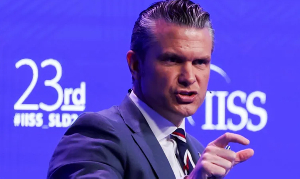 US Defence Secretary Pete Hegseth





Entertainment