The growing rumours surrounding a possible reshuffling of the Operations Director of National Anti-Illegal Mining Operations (NAIMOS), Col Dominic Buah, have become deeply worrying to me and many Ghanaians who genuinely care about the fight against High-Tech Galamsey (HTG) and the environmental future of this country.
At a time when illegal mining has evolved into a sophisticated and destructive national security threat, this is not the moment to disrupt leadership that is beginning to restore public confidence in the anti-galamsey campaign.
For years past, Ghanaians watched successive efforts against galamsey collapse under the weight of political interference, weak enforcement, selective justice, and compromised leadership.
Under the previous NPP administration, the country painfully witnessed how the illegal mining menace expanded into many forest reserves and water bodies despite repeated promises to stop it.
What began as ordinary galamsey gradually transformed into a dangerous phenomenon now widely as l described as HTG, an organized and heavily financed operation that deploys advanced machinery to destroy the environment at an alarming rate.
Today, several rivers remain heavily polluted, forests continue to disappear, and vast farmlands have been reduced to lifeless wastelands. In many communities, access to clean water has become increasingly difficult because of the reckless activities of illegal miners.
This environmental destruction is no longer simply an ecological issue. It is a threat to public health, food security, livelihoods, and national survival.
It is precisely because of this dangerous reality that the current Mahama administration must avoid repeating the mistakes of the past. The fight against HTG cannot succeed where political calculations override competence, discipline, and commitment.
Ghanaians have already seen the consequences of weak political will in the anti-galamsey campaign. The nation cannot afford another era where environmental destruction flourishes under the watch of the state while a few powerful interests continue to benefit from the suffering of the majority.
Against this backdrop, the work of Col Dominic Buah and the NAIMOS team deserves recognition and reinforcement rather than disruption. Since assuming leadership, the team has projected uncommon seriousness in confronting the HTG menace.
Unlike the familiar cycle of rhetoric and public relations exercises that characterized previous anti-galamsey campaigns, the current NAIMOS leadership has consistently demonstrated operational focus, transparency, and urgency.
The regular press briefings and quarterly updates provided by the team have helped restore some level of public trust in the state’s commitment to confronting illegal mining.
More importantly, Col Buah has publicly demonstrated the courage and clarity expected from a commander leading a difficult national assignment. His firm declaration that NAIMOS is deploying both kinetic and non-kinetic approaches against illegal mining operators reflects an understanding that the galamsey menace can no longer be treated with half measures.
Indeed, HTG has become an organized assault on Ghana’s ecological stability. The individuals and networks behind it are not merely violating environmental regulations.
They are systematically undermining the future of this country for personal enrichment. No serious nation should tolerate such destruction without a firm and uncompromising response.
This is why any attempt to reshuffle Col Dominic Buah at this critical stage will inevitably raise serious public concern and suspicion.
Many Ghanaians will naturally ask why a commander perceived to be producing results should suddenly be removed in the middle of an intensified national operation.
Others will question whether certain interests, uncomfortable with the renewed anti-galamsey efforts, are attempting to weaken the fight by influencing leadership changes within NAIMOS.
These concerns cannot simply be dismissed as politics because public confidence in the anti-galamsey campaign remains fragile. The Mahama administration must therefore proceed carefully and protect the credibility of its environmental governance agenda.
Once the perception of political interference enters the anti-galamsey fight, public trust begins to erode rapidly.
President Mahama has a historic opportunity to distinguish his administration from the failures of the past.
Ghanaians are not expecting perfection, but they expect seriousness, consistency, and courage. They want to see a government prepared to defend the national interest even when powerful individuals are affected.
For this reason, the current NAIMOS leadership should be empowered with stronger logistical support, improved intelligence coordination, adequate funding, and sustained political backing to continue the fight against HTG.
Environmental restoration is a long-term national responsibility that requires continuity in leadership and clarity in purpose. Constant disruptions only weaken momentum and embolden criminal networks.
As a climate advocate and a concerned Ghanaian, I respectfully appeal to President Mahama to keep Col. Dominic Buah and the NAIMOS team intact.
Ghana’s environmental crisis has reached a dangerous stage, and this is not the time for avoidable experimentation or politically motivated reshuffling.
History will not be kind to leaders who fail to protect the ecological foundations of their nation. Future generations will remember those who defended Ghana’s rivers, forests, and lands when they were under attack.
President Mahama must, therefore, stand firmly behind the NAIMOS team and demonstrate to the nation that the fight against HTG is a genuine national priority and not another temporary political slogan.
Opinions of Friday, 29 May 2026
Columnist: Dr John-Baptist Naah
President Mahama, no reshuffle of the NAIMOS director
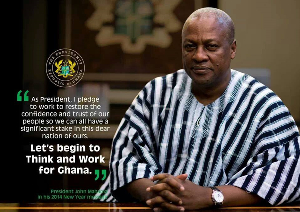 Ghanaians want results in the fight against illegal mining, not disruptions




Entertainment

Singer Chichi survives ghastly Car accident in US

Opinions