THE 24-HOUR ECONOMY AGENDA CANNOT THRIVE IF EXIM BANK FAILS TO SUSTAIN INDUSTRIES
President John Dramani Mahama has consistently signaled a national reset toward industrialization, job creation, export growth, and import substitution. The Bank of Ghana is also making difficult macroeconomic reforms aimed at lowering inflation, stabilizing the cedi, i and gradually reducing interest rates to restore confidence in the economy.
However, if Ghana’s development finance institutions, as especially Ghana Export-Import Bank, fail to align with this national direction, then the country risks losing billions in industrial investments, thousands of jobs, and years of economic opportunity.
The President, therefore, has every reason to demand accountability for production losses and unrealized job capacity caused by underfunded industrial projects that were never properly supported to maturity.
This is because many Ghanaian industries did not collapse because the ideas were bad, but because their financing stopped halfway.
Ill-funded industries cannot reach full capacity
Across Ghana, several agro-processing and manufacturing projects were financed only partially — enough to build infrastructure and acquire machinery, but not enough to secure raw materials, working capital, market expansion, guarantees, or operational sustainability.
Factories designed for 24-hour production have been left operating at below 10% capacity, not because the vision was wrong, but because the financing structure was incomplete.
Many of these businesses:
Built factories
Imported processing lines
Created jobs
Secured export markets
Opened international trade channels
Sustained operations under extreme pressure
Yet after all these investments, many industries were denied the very instruments development banks around the world use to help strategic sectors survive and scale.
This is where the national frustration begins.
Ghana cannot continue celebrating factory commissioning ceremonies while those same factories quietly struggle for survival months later due to a lack of operational support.
Industrialization is achieved when factories survive, expand, employ people continuously, and produce competitively for decades.
Development Banks Are Meant to De-Risk Industry — Not Abandon It Globally, development banks do far more than provide loans. They provide: 1. Credit guarantees
2. Equity participation
3. Letters of Credit (LCs)
4. Raw material financing
5. Export guarantees
6. Structured moratoriums
7. Working capital support
8. Supplier contract financing
9. Interest support mechanisms
10. Risk-sharing frameworks with commercial banks
If EXIM had strategically deployed these instruments, many Ghanaian industries would have become bankable enough for commercial banks to participate confidently.
Instead of industries being viewed as distressed, they could have become:
Expansion opportunities
Export champions
Job creation engines
Foreign exchange earners
Anchor borrowers for syndicated financing
The painful reality is that some industries that should have become national success stories are today struggling merely to survive.
The Central Bank Is Doing Its Part — EXIM Must Complement It The current efforts by the Bank of Ghana to stabilize the economy and reduce interest rates are important foundations for industrial recovery.
But lower interest rates alone cannot revive industries already burdened by:
Under-capitalization
High utility costs
Raw material shortages
Long gestation periods
Heavy capex exposure
Foreign exchange pressures
This is where the Ghana Export-Import Bank should become transformational.
EXIM should complement the Central Bank by:
Providing guarantees to reduce lending risk
Taking strategic equity positions in critical industries
Supporting export expansion
Financing contract farming and raw material security
Supporting youth supply chain programs under “Feed the Industries.”
Creating blended finance structures with commercial banks
When a development bank backs an industry properly, commercial banks gain confidence to participate because the risk profile changes.
Production Capacity Losses Are National Economic Losses
When factories operate at 5% or 10% capacity:
Thousands of potential jobs are lost
Tax revenues decline
Imports rise
Export opportunities disappear
Idle machinery depreciates
Loan repayment becomes impossible
Youth unemployment worsens
Ghana loses industrial competitiveness
The issue is therefore not merely about individual businesses.
It is about national productivity losses.
A factory built for 24-hour operation but left without raw material financing or operational support represents:
Lost employment capacity
Lost export value
FX generation
Lost industrial momentum
The President must therefore demand measurable KPIs from EXIM:
Jobs created and sustained
Factories operating at full capacity
Export growth achieved
Industrial survival rates
Raw material security programmes financed
Commercial bank leverage achieved through guarantees The number of distressed industries successfully restructured instead of being foreclosed
Youth employment ecosystems created
Because a development bank that finances factories but cannot sustain industrial productivity risks becoming only a lender, not a development institution.
Ghana Must Shift From Collateral Banking to Development Banking Many Ghanaian industries are asset-rich but cash-flow-constrained during growth stages.
A development bank should recognise:
Installed factory capacity
Market access potential
Export contracts
Employment impact
Strategic national value
Supply chain influence
Instead, too much emphasis has historically been placed on collateral recovery rather than industrial growth recovery.
No industrial economy in the world develops sustainably by aggressively collapsing productive assets during temporary financial distress.
True development banking measures success by:
Economic transformation
Jobs created
Exports generated
Import substitution achieved
Industrial ecosystems built
Not simply by foreclosures.
Because once factories collapse, rebuilding them costs far more than restructuring and sustaining them.
The President’s 24-Hour Economy Depends on Industrial Survival. The 24-Hour Economy vision cannot succeed if existing industrial investments collapse under financial pressure, after billions have already been invested into infrastructure and machinery.
Ghana cannot continuously talk about youth employment while factories capable of employing thousands remain underutilized. Nor has the country achieved export-led growth, while processing industries struggle to secure operational financing.
The faster path to economic transformation is not starting entirely new factories every year.
It is:
Reviving underutilized factories
Expanding existing processors
Supporting raw material ecosystems
Financing youth supply chains
Unlocking export growth
Helping industries move from survival to scale
This is why the President must demand stronger alignment between: Bank of Ghana
Ghana Export-Import Bank
commercial banks
Industrial policy agencies
Agribusiness supply chains
Export development programmes
Conclusion:
If Ghana truly wants industrial transformation, then development finance institutions must be measured not only by loan recovery, but by:
Factories sustained
Production capacity unlocked
Exports expanded
And youth jobs created.
The President, therefore, has legitimate grounds to hold Ghana Export-Import Bank accountable for production and employment capacity losses where strategic instruments such as guarantees, equity participation, restructuring support, and raw-material financing could have transformed struggling but viable industries into globally competitive national assets.
Opinions of Tuesday, 26 May 2026
Columnist: Elikem Desewu
Why the president should hold EXIM Bank accountable
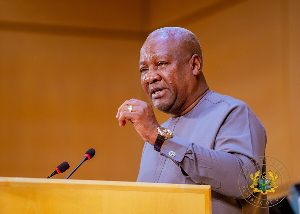 President John Dramani Mahama