As Africa commemorates its 63rd AU Day this year, the conversation around economic sovereignty, resource nationalism and value addition has once again taken centre stage across the continent. For decades, Africa has remained one of the world’s richest mineral-producing regions while deriving only a fraction of the full economic value of its natural resources. Raw mineral exports, illicit financial flows, smuggling and foreign domination of commodity markets have long deprived African economies of the transformative benefits of their own resources.
Today, however, a new model is beginning to emerge from Ghana through the bold reforms and strategic interventions of the Ghana Gold Board.
Within barely a year of operation, the GoldBod has rapidly evolved from a newly established institution into one of the most closely watched mineral governance models on the African continent. Through its aggressive formalisation drive, anti-smuggling reforms, traceability systems, value addition agenda and strategic gold purchasing programme, the institution is increasingly being viewed as proof that African countries can take greater control over their mineral resources and deploy them deliberately for national development.
The impact of the GoldBod has already begun attracting attention far beyond Ghana’s borders. Officials and delegations from countries including Tanzania, Mozambique, Zimbabwe and other African states have visited the institution to understudy its operational model and understand how Ghana is repositioning its gold sector to retain more value locally. The growing continental interest reflects a broader realization that Africa’s mineral wealth can no longer continue to serve primarily as raw material for foreign industrialization while African economies struggle with unemployment, currency instability and limited industrial growth.
At the heart of the GoldBod’s success story is its strategic role in aggregating gold from Ghana’s artisanal and small-scale mining sector and supporting the Bank of Ghana to significantly increase gold reserves and foreign exchange inflows. This intervention has contributed to improved reserve accumulation, enhanced market confidence and stronger macroeconomic support for the country’s economy.
What makes this achievement even more significant is that much of the impact so far has been driven largely by the artisanal and small-scale mining sector. The implication is profound: if properly structured ASM gold can contribute meaningfully to national reserves and foreign exchange stability, then Africa’s broader mineral resources, when strategically managed, can become even more powerful tools for economic transformation.
The GoldBod’s reforms are also changing the conversation around responsible mining and mineral governance. Through ongoing traceability initiatives, anti-smuggling operations, district gold buying centres and mining support programmes, the institution is formalising a sector that for years operated largely outside structured national oversight. This has not only improved transparency and accountability but has also strengthened Ghana’s position within responsible global gold supply chains.
The institution’s investment in geological surveys and cooperative mining programmes further signals a shift away from extractive models that exclude local communities. Instead, the GoldBod is championing a model that seeks to combine responsible mining, local participation, job creation and sustainable economic inclusion.
These reforms align strongly with the vision of John Dramani Mahama, who has pledged that by 2030, Ghana will add value to all its mineral resources before export. The policy direction represents one of the clearest declarations yet of Africa’s growing determination to move beyond the colonial-era model of exporting raw materials while importing finished products at far higher value.
Under this vision, gold, lithium, bauxite and other strategic minerals are no longer being viewed merely as export commodities, but as instruments for industrialisation, currency stability, manufacturing growth and economic sovereignty.
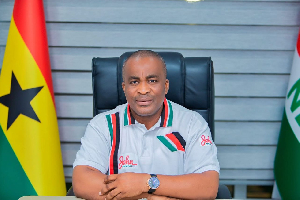
A major figure driving this transformation is the Chief Executive Officer of the GoldBod, Sammy Gyamfi, Esq. whose leadership has become central to the institution’s rapid rise and growing credibility. Under his stewardship, the GoldBod has pursued ambitious reforms with unusual speed and clarity, positioning the institution as a strategic pillar within Ghana’s economic architecture.
From championing value addition and ASM formalisation to strengthening anti-smuggling operations and expanding responsible sourcing systems, Gyamfi has emerged as one of the leading voices advocating for a more deliberate and nationally beneficial management of Africa’s mineral wealth.
As Africa marks another Africa Day, the GoldBod story is increasingly becoming symbolic of a broader continental aspiration; an Africa that controls its resources, processes its minerals, builds value chains, strengthens local industries and captures a greater share of the wealth generated from its natural endowments.
For many observers, the message emerging from Ghana is becoming clearer: Africa’s minerals can do far more for Africans when African institutions take ownership of the value chain.
Opinions of Monday, 25 May 2026
Columnist: Prince Kwame Minkah
AU Day: How GoldBod is redefining Africa's control over its mineral wealth
 The Ghana Gold Board (GoldBod)