When soldiers seized power in Bamako in 2020, Ouagadougou in 2022, and Niamey in 2023, they offered a familiar promise: civilian governments had failed, foreign partnerships had grown corrupt, and only military rule could restore sovereignty, security, and national dignity. Across the Sahel, millions exhausted by years of insecurity and perceived foreign condescension believed them.
Several years on, the evidence tells a brutal and irrefutable story. The security situation across Mali, Burkina Faso, and Niger, the three countries that form the self-styled Alliance of Sahel States (AES), now reveals something the juntas can no longer paper over with slogans. Large portions of northern and eastern Burkina Faso are either under jihadist influence or violently contested.
In Mali, the regions of Taoudéni, Timbuktu, Ménaka, Gao, and much of Mopti remain outside effective state authority. Niger retains a stronger foothold around Niamey and Maradi, but insecurity is steadily creeping into Diffa, Tahoua, and Agadez. The trajectory across all three countries is identical: state presence is shrinking; militant mobility corridors are expanding southward.
The April 2026 coordinated attacks across Mali, striking Mopti, Gao, Kidal, Sévaré, and approach routes to Bamako simultaneously, confirmed what conflict monitors at ACLED and the Critical Threats Project had been documenting for months. Jama'at Nusrat al-Islam wal-Muslimin (JNIM) and Islamic State affiliates are not retreating.
They are growing more sophisticated, more coordinated, and operationally bolder. When insurgents can strike urban and semi-urban centres, spaces that house military headquarters, administrative institutions, and strategic infrastructure, with precision and impunity, military presence alone has clearly ceased to guarantee territorial control.
The core problem is structural. Terrorism in the Sahel has never been purely a military challenge. Extremist organisations thrive where governance collapses, public trust erodes, and economic opportunities evaporate. Governments may announce the destruction of militant camps or the recapture of towns. But if corruption, unemployment, food insecurity, and local grievances go unresolved, recruitment resumes elsewhere. The cycle continues.
Military-led governments are structurally ill-equipped to break that cycle. Officers trained for battlefield command are now expected to manage fragile economies, attract investment, regulate inflation, and deliver social services. Predictably, all three juntas have addressed profoundly complex national crises almost entirely through a security lens.
The consequences are visible: authority in Burkina Faso barely extends beyond Ouagadougou and a few southern towns; Bamako's security perimeter has reportedly contracted; central Mali remains an unresolved warzone.
Meanwhile, judicial independence weakens, civil society operates under pressure, media freedoms narrow, and decision-making grows opaque and personalised. Investor confidence has collapsed. Trade routes have frayed. The result is a self-reinforcing cycle: insecurity discourages investment, weak development fuels grievance, grievance powers recruitment, and governments respond with yet more militarisation.
The junta compounded this failure with a catastrophic strategic miscalculation: they dismantled every cooperative framework that had previously helped contain extremist expansion. MINUSMA was expelled. French military operations ended.
American intelligence and surveillance assets withdrew. EU training missions deteriorated or closed. ECOWAS security cooperation collapsed. In their place came Russian-linked security actors, first the Wagner Group, then the Africa Corps.
This shift has not produced decisive results. Western and multilateral partners had provided drone surveillance, aerial logistics, rapid evacuation support, command training, and multinational operational coordination. Russia's deployment has remained narrower, more militarised, and heavily oriented around regime protection rather than population security.
The fall of Kidal said everything. Once showcased as proof that expelling Western forces and embracing Moscow represented strategic genius, Kidal instead exposed the new model's core vulnerability. When Russian-linked personnel reportedly withdrew as Malian forces came under attack, it shattered years of carefully cultivated political messaging. Facts eventually overpower slogans, and those facts are now arriving at a pace.
The consequences no longer stop at the AES border. The Sahel has become a sanctuary where extremist organisations regroup, recruit, train, and launch operations southward into coastal West Africa. Benin has already suffered deadly attacks near Pendjari National Park.
Côte d'Ivoire endured the Grand-Bassam massacre and continues fortifying its northern frontier. Togo has seen infiltration pressure mount. Ghana, which has not yet experienced large-scale jihadist violence, is not insulated from what is coming.
The expansion of JNIM and IS-affiliated operations into southern Burkina Faso has intensified arms trafficking, infiltration networks, and radicalisation risks along Ghana's northern border. The Bawku conflict, rooted in ethnic and chieftaincy tensions, presents precisely the kind of local instability that extremist organisations have exploited elsewhere to gain a foothold.
Ghanaian security agencies have responded with Operation Conquered Fist, expanded border surveillance, joint intelligence operations, and counter-extremism programmes, all reflecting a growing, sober recognition that this crisis is no longer distant. It is at the door.
The lesson the Sahel has taught, at enormous human cost, is clear: no country defeats a transnational insurgency through isolationist nationalism or militarised governance alone. Security and development are inseparable. Roads, schools, healthcare, agriculture, jobs, and functioning local governance are as essential to counterterrorism as soldiers and weapons. Where states are absent, extremists fill the space.
West Africa's future security architecture must be African-led, regionally coordinated, and built on genuine interoperability: shared intelligence, joint border operations, and integrated economic resilience. External partnerships have a role, but one that strengthens African institutional capacity rather than substituting for it. Sustainable security cannot be outsourced to mercenaries or purchased through battlefield operations alone.
Ghana and the wider ECOWAS community cannot afford to treat the Sahel as someone else's problem. The region's long-term stability will depend on building states that citizens trust, economies that create opportunity, and institutions capable of collective action.
The AES experience has shown, at devastating cost, what happens when those foundations are abandoned. West Africa cannot afford to learn that lesson twice.
Joseph McCarthy is an analyst and researcher specialising in governance, security, and political transitions in the Sahel. He writes on geopolitics, development, and African diplomacy.
Opinions of Thursday, 21 May 2026
Columnist: Joseph McCarthy
Sahel on Fire: Why Ghana and ECOWAS cannot ignore the collapse of the AES
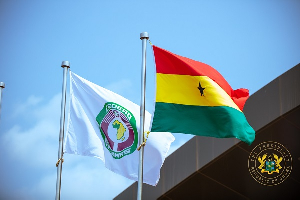 A file photo of the ECOWAS and Ghana flag




Entertainment