The illimitable human rights abuses by Ghana’s security personnel amid the recent arrests and detentions of the NPP operatives over free speech and freedom of opinion cannot be allowed to go without commenting.
I would, therefore, like to stand on the broad shoulders of the noble and altruistic human rights exponents to launch my harmless, albeit thought provoking missiles at the direction of human rights abusers.
We should not lose sight of the fact that the right to freedom of opinion and expression stretches to queer and unpopular ideas and statements which “shock, offend or disturb”,-encapsulated in international law -Article 19 of the Universal Declaration of Human Rights and Article 19 of International Covenant on Civil and Political Rights.
More significantly, freedom of opinion and expression has been given meaning in Ghana’s 1992 Constitution.
Free speech, in fact, is an inalienable right to seek, receive and convey information and ideas of all kinds, by any means which may be deemed appropriate.
In other words, the right to freedom of expression denotes the ideas of all kinds, including those that may be deemed offensive.
That being said, freedom of opinion and expression may be subject to restrictions, but these shall only be such as are provided by law and are necessary: restrict in the public interest on grounds of national security, to preserve public order, to protect public health, to maintain moral standards, to secure due recognition and respect for the rights and freedoms of others or to meet the just requirements of the general welfare of a democratic society.
Nevertheless, the fact that freedom of opinion and expression is not absolute and is subject to permitted abridgment does not mean that the right can be curtailed arbitrarily according to legislative, executive or judicial discretion.
This right, like others, may be restricted to protect and balance other rights and interests. However, it is the complexion and the degree of these restrictions that is often contended in extant human rights and security jurisprudence.
Suffice it to stress that the ways in which restrictions are to be determined and imposed and the criteria which apply to the formulation of permitted abridgement are crucial.
Let’s face it, if freedom of opinion and expression is to be meaningful, it cannot be subject to crude majoritarian dictates.
What differentiates a human right from any other right is that a human right is available to, and enforceable by a minority, however small and even against the wishes of a majority.
More so, if freedom of opinion and expression was to become subject to ordinary legislature, executive or judicial control, it would be no different from any other statutory right which the authorities are free to confer and withdraw at their pleasure.
Thus, the restriction of freedom of opinion and expression becomes a crucial and delicate question. For any restrictions cannot be based on ideological perceptions of legislature, executive or judicial, but must be predicated on objectively founded and comprehended criteria.
It is, however, true that the international law requires states to prohibit hate speech: “Any advocacy of national, tribe, racial or religious hatred that constitutes incitement to discrimination, hostility or violence (Article 20(2 of the ICCPR)”.
Even though, Article 20(2) does not obligate states to prohibit all negative statements towards national groups, tribes, races or religions, if a statement “constitutes incitement to discrimination, hostility or violence,” it must be condemned in no uncertain terms”.
Actually, the two known restrictions on the right to freedom of expression are: The prohibition of advocacy of any national, racial or religious hatred and the prohibition of propaganda.
Interestingly, while propaganda for genocide is codified as an international crime, the propaganda for the incitement to aggressive war is not.
Nevertheless, incitement to commit an illegal act is in itself illegal under international law.
Moreover, incitement, instigation, abetment and solicitation are all common to various criminal codes world-wide.
These are generally considered "inchoate offense[s]" or "a step toward[s] the commission of another crime, the step itself being serious enough to merit punishment”.
In the English common law for instance, there are three general inchoate offenses: 1) attempt; 2) conspiracy; and 3) incitement.
“ Incitement conveys a "general label to cover any use of words or other device by which a person is requested, urged, advised, and counselled, tempted, commanded, or otherwise enticed to commit a crime."
Rene Cassin, one of the principal drafters of the universal declaration of Human Rights, adopted by the General Assembly in 1948, subsumed the main tenets of human rights by juxtaposing them with the portico of a temple.
Drawing on the battle cry of the French revolution, Cassin identified the four pillars of the declaration as: ‘dignity, liberty, equality, and brotherhood’ (Ishay 2004).
Apparently, the 27 articles of the declaration were divided among these four pillars. The pillar underpinned the roof of the portico (articles 28–30), which stipulated the conditions in which the rights of individuals could be realized within society and the state.
The first pillar covered in the first two articles of the declaration stands for human dignity shared by all individuals regardless of their religion, creed, ethnicity, religion, or sex.
The second, specified in articles 3–19 of the declaration, invokes the first generation of civil liberties and other liberal rights fought for during the Enlightenment.
The third, detailed in articles 20–26, addresses the second generation of rights, i.e. those related to political, social and economic equity and championed during the industrial revolution.
The fourth (articles 27–28) focuses on the third generation of rights associated with communal and national solidarity, as advocated during the late 19th century and early 20th century and throughout the postcolonial era (Ishay 2004).
Based on the preceding explications, we can draw an adverse inference that human rights are the basic rights and freedoms that belong to every person in the world, from birth until death.
More significantly, human rights can never be taken away, although they can sometimes be restricted – for example, if a person breaks the law, or in the interests of national security.
Basic human rights are based on values like dignity, fairness, equality, respect and independence. But then again, human rights are not just abstract concepts – they are defined and protected by national and international laws (EHRC).
Much as the right of free speech and expression does not extend to sedition, slander, defamation and obscenity, citizens and denizens cannot be arrested and detained on alleged cases of defamation and slander.
In sum, the fact that the freedom of opinion and expression is not absolute and is subject to permitted abridgment does not mean that the right can be curtailed arbitrarily according to legislative, executive or judicial discretion.
Opinions of Friday, 15 May 2026
Columnist: Kwaku Badu
President Mahama, in the name of God, don’t criminalise free speech
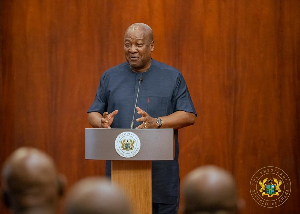 President John Dramani Mahama




Entertainment