As Macron and Ruto hosted the Africa Forward Summit, pan-African organizations gathered across town declared that France had simply moved its colonial interests east after being driven out of the Sahel. While French President Emmanuel Macron and Kenyan President William Ruto co-chaired proceedings at the Kenyatta International Convention Centre, a different kind of gathering took shape across town at Ufungamano House, a building with deep roots in Kenya's tradition of civic resistance. The Pan-Africanism Summit Against Imperialism, known as PASAI, brought together movements from across the continent and its diaspora under one clear position: France is not welcome.
The official summit was styled as "Africa-France Partnerships for Innovation and Growth," the first of its kind to be held in a non-Francophone African country. The choice of Nairobi was not accidental. It came precisely as France had been pushed out by force of popular will from three of its traditional bases in the Sahel. Military governments in Mali, Burkina Faso, and Niger, each brought to power amid mass anger at the French military presence, expelled French troops and cut diplomatic ties in succession. Where ordinary people were allowed to speak clearly enough, they spoke against Paris. France's response to this rejection was not reflection but a pivot east across the African continent.
France Arrives Before the Law Does
Booker Omole, Secretary-General of the Communist Party Marxist-Kenya and one of PASAI's key organizers, had no patience for soft language. He described the Nairobi summit as "a war council of imperialism convened under the mask of diplomacy." His framing was backed by facts on the ground.
Before Kenya's parliament had formally approved the bilateral defense agreement between Nairobi and Paris, approximately 800 French soldiers had already arrived on Kenyan soil. The agreement, when eventually passed, gave those soldiers something most Kenyan citizens do not enjoy: near-diplomatic immunity from local courts, with France retaining primary jurisdiction over crimes committed by its troops in the country.
Foreign boots arrived first, legal cover followed, and public debate came last.
Vijay Prashad, historian and director of the Tricontinental: Institute for Social Research, who addressed the counter-summit, laid out the longer record with care. "You just need to look at the record of France in Africa to know what is going to come in Kenya," he told those gathered. The record he pointed to ran from France's central role in the destruction of Libya, through its military intervention in Cote d'Ivoire that removed a disputed leader to install a Paris-preferred one, to the long French military presence in Mali and Burkina Faso. In Niger, French troops were stationed close to the uranium mine at Arlit, the same mine whose ore has for decades powered French nuclear reactors. "What were they there for?" Prashad asked.
"Resources. Not for the people."
The Sahel is among the poorest regions on earth. It is also among the richest in minerals that light up European cities.
The Sahel Said No, So France Turned East
The expulsions from Mali, Burkina Faso, and Niger represented something that decades of structural adjustment and managed dependency did not produce: a clean break. Figures like Captain Ibrahim Traore in Burkina Faso emerged not from the comfort of French military academies, but from the accumulated frustration of populations who watched their countries remain at the bottom of every human development index despite, or because of, six decades of French presence. Prashad described these leaders as expressions of "people's anger at the fact that France was basically allowing, if not supporting," the conditions that kept those countries poor while taking their wealth.
PASAI's organizers, which include the Communist Party Marxist-Kenya, the All-African People's Revolutionary Party, and the International League of Peoples' Struggle, read France's pivot to East Africa in exactly this light. In a press statement issued on April 17, they described the Nairobi summit as "a rebranded offensive of imperialist recolonization disguised behind the mask of environmental diplomacy and financial reform," and were direct about where the weight would fall: while the cooperation would bring gains to local comprador capitalists and bureaucrat elites in the form of business partnerships, it would bring "only misery, poverty and hardship to the African masses." The Sahel closed one door. Macron came looking for another.
Ruto and the Question of Who He Answers To
Omole's address at Ufungamano did not limit its critique to France. The Kenyan government's own role was put squarely in the picture.
He drew a sharp line between change that comes through polite appeal and change that comes through organized popular pressure. When Kenyan youth took to the streets in 2024 and forced Ruto to pull back the Finance Bill, it was not because the President had a change of heart. As Omole put it plainly: "His fear was his government losing control." Ruto came before the country to say he had listened. But the harder question Omole raised was: who would answer for the blood spilled before he retreated?
That is the class reality beneath the official summit's diplomatic facade. Ruto and Macron share what the PASAI counter-summit calls a comprador arrangement, a local political class whose interests are tied to those of foreign capital: Washington's financial system, Paris's military and resource networks. Their governance cannot be separated from those interests, however much the language of innovation and green investment tries to cover it. "Their arms are full of lies," Omole told the gathering. "That is what they share."
The official summit's agenda, green industry, digital infrastructure, climate finance, was not rejected by PASAI because these topics are unimportant. They were rejected because the terms under which they were being pursued kept the basic extraction in place. Macron announced 27 billion dollars in investment across energy transition, agriculture, and artificial intelligence. For movements gathered at Ufungamano, the figure was beside the point. Foreign capital continues to pull profits from African economies on its own terms, delivering gains to local elites and hardship to working people.
What Macron Revealed Without Meaning To
Speaking at the University of Nairobi, Macron framed the summit as a "partnership of equals" and argued that Europe was not among "the predators of this century." He also walked uninvited onto the stage during a youth session to publicly scold attendees for noise, telling the crowd, "So this is a total lack of respect." The moment, captured widely on video, cut against every word of the partnership language and gave the movements at Ufungamano an image they did not need to manufacture.
Debt, Reparations and the Bill France Has Never Paid
Beneath the investment announcements and innovation language lay a question the official summit had no intention of answering: what does France owe? PASAI's Nairobi Declaration from Below was unambiguous on this point. It named debt not as an economic condition to be managed but as a weapon of domination, one that keeps African governments in structural dependency while their resources travel north. The case of Haiti, which was forced to pay France the equivalent of billions in today's money for the cost of its own liberation, remained the starkest example of a debt logic that has never been reversed, only refined. France has never paid reparations. It has, however, continued to collect. For the movements gathered at Ufungamano, no summit promising investment could be taken seriously as long as that foundational question was kept off the table.
Francafrique Has Not Ended
The counter-summit's clearest contribution was its refusal to treat Francafrique as a thing of the past. Fourteen African countries remain bound to the CFA franc, a monetary system that forces member states to deposit up to 50 percent of their foreign reserves in the French Treasury. These governments cannot print their own money, cannot devalue their currency independently, and cannot pursue genuine monetary sovereignty without French agreement. Critics at PASAI called it a colonial tax still being collected, decades after independence.
French military bases remain across the continent, even as they are expelled one by one. Defense agreements bind African armies into arrangements that, in practice, serve French strategic interests. Niger's uranium still travels north to fuel French reactors. These are not old grievances. They are active arrangements. The Nairobi summit was held on the premise that they amount to partnership, and that is the premise PASAI was assembled to reject.
Praising Lumumba While Burying His Politics
In one of the sharpest moments at Ufungamano, Omole raised the contradiction of political leaders and commentators who praise Patrice Lumumba and Thomas Sankara as heroes while at the same time dismissing the political conditions that produced them and that continue to produce figures like Traore. You cannot celebrate the martyrs of African liberation while cutting off the roots of the politics that gave their lives meaning.
The gathering in Nairobi was not an academic event. It was, as its organizers intended, a political one, part of an effort to turn scattered popular anger into a coordinated political movement. The Nairobi Declaration from Below, produced at the close of the counter-summit, was written not in boardrooms in Paris or Washington, but from the perspective of those who live with the consequences of decisions made in those rooms. It declared that Africa's wealth belongs to Africans, that military occupation must end, that debt is a weapon of domination, and that genuine development can only come through unity and struggle.
Police Move on Protesters as Summit Ends
The response of the Kenyan state to the protests on its streets answered, in its own way, the question PASAI had been raising all along about whose interests the government serves.
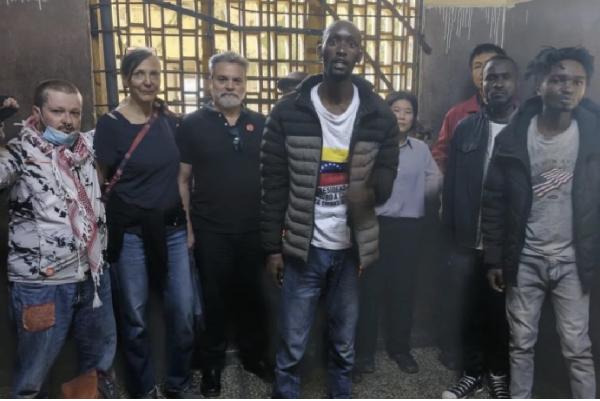
At least 11 people were arrested on the second day of the summit after police dispersed separate groups of protesters attempting to approach venues hosting the proceedings. Anti-riot officers mounted a heavy security operation around the KICC and Serena Hotel, blocking demonstrators from advancing toward areas where heads of state and international delegates were gathered.
Some of the foreigners arrested included nationals from Britain, France, South Korea, and Greece, according to Omole, who was himself among the protesters. Police also arrested seven Kenyans, including activist Julius Kamau. Demonstrators carried placards and chanted slogans calling for an end to what they described as foreign interference in Africa, with banners reading "Nairobi Erupts, Resist French Colonialism" and "Stop the Imperialists' Drive to War."
The protests temporarily disrupted traffic along Uhuru Highway as a Special Weapons and Tactics Team of women police officers initially attempted to block the demonstrators, who insisted their protest was peaceful. Teargas was fired and shots were discharged into the air before crowds were pushed back toward the YMCA area.
The arrests carried a symbolism that no summit communique could paper over. A government that had just co-signed a partnership premised on shared values deployed force against its own citizens for objecting to it.
The Counter-Summit's Final Word
Their declaration had been plain from the start: "We shall not host our executioners. We shall not be the new barracks of colonial domination."
Omole put the stakes with equal clarity: "Any African leader who participates in this summit against the will of the people stands on the wrong side of history, aligned not with liberation but with oppression. The people will remember. The people will judge."
For Pan-Africanists, the question of breaking Africa free from the stranglehold of the European-dominated banking system is absolutely paramount. It is a fight for our continent's very sovereignty. Make no mistake: all that Macron and other Western leaders truly seek is Africa’s wealth — the same wealth they have been looting from this continent since the dawn of colonial rule. They have no intention of stopping now.
Macron, speaking at the official summit, made reference to his remaining friends from the Sahel, a pointed signal in a region where France had been expelled from three countries. The counter-summit read that statement as an admission dressed as confidence. If your measure of success in Africa is counting which allies have not yet thrown you out, you are already losing more ground than you are willing to say.
Two summits. One city. The distance between Ufungamano House and the KICC was not large. The distance between what each gathering represented is the entire history of Africa's relationship with colonial Europe and the open question of whether that history continues, or breaks. The movements at PASAI were clear about who gets to answer that question. Not Macron. Not Ruto. But the people.
The writer, Sumaila Mohammed, is a Pan-Africanist, reparatory justice researcher, and media enthusiast
Opinions of Thursday, 14 May 2026
Columnist: Sumaila Mohammed
Nairobi counter-summit rejects France's African pivot as movements declare 'You are not welcome'
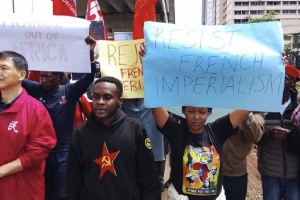 Some activists during a protest against imperialism