A fresh wave of xenophobic attacks against Ghanaians in South Africa has,sparked diplomatic tension and renewed debate about migration, governance, and economic hardship across Africa. Viral videos circulating online show incidents of harassment, intimidation, and violence, with some South Africans reportedly demanding that foreign nationals “go back to their countries.”
One particularly troubling case involved a Ghanaian national who had to,be evacuated for safety after a targeted attack, underscoring the seriousness of the situation.
Why the Attacks Are Happening
Xenophobia in South Africa is not new. It has historically flared during periods of economic strain, high unemployment, and social frustration. Foreign nationals, especially other Africans, are often scapegoated for job scarcity and crime.
Why Ghanaians Leave Home in the First Place
The uncomfortable truth is that migration is rarely random, it is driven by necessity. Studies show that economic hardship and lack of opportunities are the primary reasons many Ghanaians consider leaving the country.
Key drivers include:
Youth unemployment and underemployment.
Low wages compared to global standards.
Skills mismatch in the labour market.
Desire for better living conditions and financial security.
In fact, more than half of Ghanaians who consider emigrating cite the search for jobs as their main motivation. Put simply: people are not leaving because they want to, they are leaving because they feel they must.
What Needs Fixing in Ghana.
If Ghana is to reduce dangerous migration and the humiliation of its citizens abroad, several structural issues must be addressed:
1. Job Creation and Industrialisation;
Ghana must move beyond a consumption-driven economy to one that produces and exports. Industrialisation, especially in manufacturing and agro-processing, can absorb large numbers of young people.
2. Education–Employment Mismatch;
Graduates often lack skills aligned with industry needs. Reforming education toward technical and vocational, training is essential.
3. Economic Stability ;
Inflation, currency instability, and high cost of living push people to seek alternatives abroad. Macroeconomic discipline is critical.
4. Corruption and Governance
Perceived corruption and unequal opportunities discourage confidence in the system, pushing youth to look elsewhere.
5. Support for Entrepreneurship ;
Access to credit, infrastructure, and markets remains limited for young entrepreneurs.
Have Successive Governments Failed?
It would be too simplistic and inaccurate to say Ghana has completely failed. Ghana remains one of West Africa’s more stable democracies with periods of growth and progress. However, there has been a consistent failure to translate macroeconomic gains into widespread opportunity: Growth has not created enough jobs. Youth unemployment remains persistently high.
Economic policies often lack continuity. So while “failure” may be too strong, underperformance is undeniable especially in delivering opportunities for young people.
The Paradox: A Rich Country, Poor Outcomes.
Ghana is resource-rich:
Gold, Oil, Cocoa, human capital, yet many citizens endure hardship. This paradox stems from: Weak value addition (exporting raw materials instead of finished goods). Inefficient public spending. Limited industrial base.
The result is a country that is wealthy on paper but struggles to provide enough dignified livelihoods.
Conclusion
The xenophobic attacks in South Africa are unacceptable and must be condemned without hesitation. But they also expose a deeper African challenge: when young people feel they have no future at home, they will take risks elsewhere, sometimes at great personal cost.
Stopping xenophobia is South Africa’s responsibility.
Reducing forced migration is Ghana’s responsibility.
Until both are addressed, the cycle will continue.
Opinions of Wednesday, 29 April 2026
Columnist: Sir Richie
Rising Tensions: Ghanaians targeted in South Africa is a wake up call
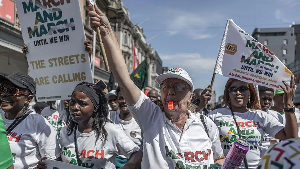 Anti immigrant groups in South Africa during a street protest