Every great institution has a founding myth. A garage in Silicon Valley. A pub in Cambridge. For Ghana, add this: the back seat of a Toyota Land Cruiser.
In 2023, long before he returned to the presidency, John Dramani Mahama spent hours on the road campaigning across Ghana.
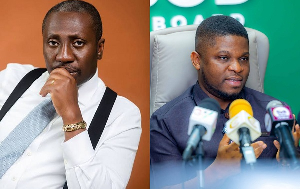
In the back of that Land Cruiser, just him and his Chief of Staff, Julius Debrah, an idea took shape. No consultants. No feasibility study. Just two men, a long drive, and a simple question: What if we turned the world's largest homecoming party into an economic engine?
Three years later, that question has become the Kwahu Business Forum (KBF), one of Ghana's most unexpected and effective public-private platforms.
From a makeshift tent in opposition days to a state-backed initiative targeting over 600 new enterprises, the KBF has brokered real deals, pushed policy conversations in Twi so small traders can participate, and secured commitments for a permanent convention centre and an airstrip in Kwahu.
This is the story of how a conversation in a moving vehicle became a national movement.
Part One: The Land Cruiser Moment
President Mahama himself recounted the origin at the 2026 Kwahu Business Forum:
"How this whole event began… It was conceived in the back of a Toyota Land Cruiser, which myself and my younger brother Julius always occupied the back seat when I went on campaigns."
The year was 2023. Between rallies, the conversation would drift. One recurring topic: Kwahu Easter.
For decades, this had been Ghana's largest annual homecoming. Hundreds of thousands of Kwahu descendants traders, professionals, business owners would close their shops in Accra, Kumasi, London, and New York and return to the mountain towns of Mpraeso, Abetifi, and Nkawkaw. They came to greet family, attend church, fly paragliders, and dance. But they did not come to do business. Not formally.
Mahama and Debrah saw what no one had systematically pursued: a concentration of human and financial capital so large that even a small conversion rate into investment would transform the region.
"Kwahu is easily the biggest homecoming event in the country. Kwahu people are traders, so often they are spread across the country. Easter is the time when they had a clear break, close their businesses and come back to greet family."
The idea was simple: add a business angle to the festival and create a forum where returning traders could meet bankers, where diaspora professionals could find local partners, and where informal networking could be structured, scaled, and made accountable.
All of that was dreamed up in the back of a Land Cruiser.
Part Two: From Makeshift Tent to Convention Centre
The first Kwahu Business Forum took place in 2024. At that time, Mahama and his team were still in opposition. Holding a high visibility business event under those conditions was risky.
"In 2024, we had the audacity to hold a Kwahu Business Forum. It was a makeshift, and I remember they came and sat here. Those days it was dangerous to be identified with the opposition, so it took a lot of courage from them to come and be with us."
Despite the risks, roughly 300 people showed up. The venue was a temporary structure, open to the elements. Yet business people, hungry for connections and capital, chose to attend. Bankers sent representatives and deals were discussed. That first makeshift forum proved the concept.
By 2025, the forum had grown. By 2026, it had exploded. The third edition was held at the newly built Kwahu Convention Centre in Mpraeso, with:
•Over 1,000 registered participants (up from 300)
•More than 20 banks, including NIB, GCB, ABSA, Republic Bank, CBG, Fidelity, and Bank of Africa
•Full cabinet representation, led by President Mahama
•International exhibitors and West African business delegations
The makeshift tent had become a convention centre. The campaign dream had become a national platform.
Part Three: How It Works (Accountability by Design)
The Kwahu Business Forum is not a talk shop. Its engine is a simple, powerful accountability mechanism:
Every participating bank commits to financing at least five bankable enterprises per year. The following year, those beneficiaries return to the forum to testify publicly about their progress.
Julius Debrah explained, "At least each of the banks that will show up is going to pick five projects, five bankable projects for this year. And they expect that next year, when we return to Kwahu, they will invite those five people whom they helped or assisted to come and testify. So if this continues for the next five years, each bank will take a minimum of five people, five enterprises to support."
Do the math. With 20 banks participating, that is 100 new enterprises supported per year.
Over five years: 500 to 600 businesses. Each one backed by formal financing. Each one with a public testimony. Each one a story that future attendees can see, hear, and verify.
President Mahama's target is clear: over 600 new enterprises supported by the end of his current term.
Part Four: Real Results Already
The KBF is young, but it already has a track record. Hon. Seth Terkper, Senior Presidential Advisor on the Economy, reported at the 2026 forum that several SMEs in agribusiness have secured diaspora-backed financing through connections made at the forum.
One standout example: Dr. Octavia Otoo of Golf Chemical Limited.
"In the 2025 forum, she presented a proposal for a biofuel production project in Kwahu Afram Plains, and through engagements facilitated by this platform and the Chief of Staff's office, she successfully secured funding from the ADB. The project is now progressing."
That is the KBF in action. A local entrepreneur with a viable project. A platform to present it. A bridge to financing. And a result that creates jobs and economic activity in a rural area.
Beyond individual deals, the forum has become a genuine feedback loop between the private sector and policymakers. The 2026 programme included a panel conducted entirely in Twi on local sourcing and the rising cost of doing business.
Small traders sat in a Kwahu hall and told the Ghana Revenue Authority, the Ghana Enterprises Agency, and the Ghana Export Promotion Authority exactly what was working and what was not. That is not just networking. That is governance.
Part Five: The Infrastructure Ambition
If the first three editions proved the demand, the next phase is about removing friction. President Mahama used the 2026 forum to announce major infrastructure commitments:
First: a permanent convention, conference, and exhibition centre in Kwahu, developed in partnership with Metalex and Trasacco.
"We want to take this whole thing a step further. We are working with Metalex and Trasacco to build a permanent convention, conference and exhibition centre on this site."
Second: an airstrip.
"We want to have an airstrip here so that flights can come in, both domestically and from outside the country, for people who want to attend conferences."
Third: upgraded roads to address the severe congestion that has historically choked Kwahu Easter travel.
These investments anchor the forum as a permanent feature of Ghana's economic calendar, insulating it from political cycles.
Conclusion: From Back Seat to Boardroom
The Kwahu Business Forum did not begin with a ribbon cutting ceremony. It began with a long drive, two tired men, and a question about what was possible.
Three years later, that question has answers. Over 1,000 participants. Twenty banks. A convention centre under construction. An airstrip on the drawing board. And a simple accountability mechanism that has already sent real money to real businesses in Kwahu Afram Plains.
The Land Cruiser is long gone. But the idea it carried is now moving on its own.
And that is the lesson for every Ghanaian. You do not need a corner office to start something that changes a region. You do not need a feasibility study to test a good idea. Sometimes, you just need a vehicle, a conversation, and the audacity to hold the first meeting in a makeshift tent when everyone says it is too risky.
The Kwahu Business Forum was born in the back of a Land Cruiser. But it belongs to every Ghanaian who believes that the best investment opportunities are not in London or New York but they are right here, at home, waiting for someone to build the bridge.
Opinions of Tuesday, 7 April 2026
Columnist: Isaac Israel Selassie
From a Land Cruiser to a National Platform: The Kwahu Business Forum story
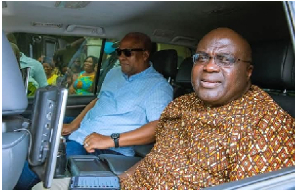 A photograph of President John Mahama (L) and Julius Debrah (R)