In every structured system, there are moments that reveal its true character, not in times of failure, but in how it responds to measured success. The recent treatment of Otto Addo presents such a moment in Ghana football. It compels a deeper reflection on leadership, continuity, and the underlying forces shaping the trajectory of the Black Stars.
I write not as a distant observer, but as one shaped by the very culture I now examine. I remember when football in Ghana was not something I merely followed, it was something I belonged to.
The rediffusion box carried more than commentary; it carried identity. I listened, imagined, and connected to a team that felt close, familiar, and grounded in places I knew. From the fields of Government Boys School to Asem L/A in Kumasi, where A, B, and C Parks nurtured young talent, football was not an abstraction, it was a lived experience.
Those memories are not nostalgia; they are a standard. They remind me that what Ghana once achieved in football was not accidental, it was constructed through alignment, discipline, and continuity.
In that earlier era, figures such as George Ainsley functioned within a defined administrative structure, supported by the vision of Ohene Djan.
Under Kwame Nkrumah, football became a national project, anchored in local development and guided by purposeful leadership. The Black Stars were not assembled in haste; they were built from a cohesive base, drawing from Real Republicans and strengthened by clubs such as Asante Kotoko, Accra Hearts of Oak, Sekondi Hasaacas, and others that served as vital feeders.
What defined that period was not merely talent, but cohesion, players who understood one another, shared a footballing language, and operated within a consistent system. This cohesion was cultivated, sustained and deepened under C. K. Gyamfi, whose long association with the national team extended across decades.
His tenure provided continuity, allowing philosophy to mature and success to be sustained. The Black Stars did not merely win; they evolved.
It is against this backdrop that the present must be measured.
Today, the Black Stars appears as an aggregation of talent, largely foreign-based players brought together intermittently, expected to perform without the benefit of shared development.
The absence of a cohesive ambit is evident. The team plays, but too often it does not flow. This is not a failure of individuals, but a reflection of structural inconsistency.
Within the Ghana Football Association, there appears to be a growing imbalance between authority and continuity.
Administrative hegemony, manifested through excessive control, reactive decision-making, and frequent disruption of technical direction, has created an environment in which long-term planning struggles to take root.
Coaches operate under pressure, but without the sustained support required to build.
It is in this context that the treatment of Otto Addo must be understood. A coach who contributes to qualification under difficult circumstances should, by all reason, be supported to consolidate that progress.
Instead, what emerges is a pattern of scrutiny and blame. This response reflects a system that acknowledges achievement, yet fails to protect it.
Such a pattern carries consequences. When progress does not guarantee stability, leadership becomes uncertain. Decision-making shifts from long-term construction to short-term survival. The role of the coach is diminished, and with it, the possibility of sustained development.
This is not an argument against accountability. Rather, it is a call for balance, an understanding that evaluation must exist within a framework that values continuity, context, and growth. Without this balance, correction becomes disruption, and disruption prevents progress from maturing into success.
My reflections are not offered in condemnation, but in caution. I believe firmly that Ghana football retains the capacity to rebuild and to reclaim its identity. But such a restoration will not emerge from constant change. It will require discipline, structural clarity, and a renewed commitment to long-term vision.
The lesson, as I have come to understand it, is simple but demanding: success is not an isolated event, it is a process that must be protected.
If Ghana is to move forward, it must address not only who leads the team, but how the system supports that leadership. It must rediscover the principles that once guided it, cohesion, continuity, and trust.
Because in the final analysis, a system that fails to protect progress will struggle to sustain it. And when progress cannot be sustained, even the most promising achievements risk becoming temporary moments, rather than the foundation of lasting greatness.
Opinions of Wednesday, 1 April 2026
Columnist: Nana Akwah
Blamed After Qualification: A reflection on leadership, continuity, and the Black Stars
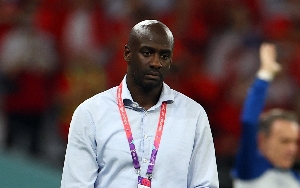 Otto Addo was the head coach of the senior men's national team, the Black Stars





Entertainment