When the Inspector-General of Police (IGP), Christian Tetteh Yohuno, steps onto the parade ground on ceremonial occasions, he is not merely a man in uniform; he is a repository of symbols a living testimony of state authority meticulously stitched, polished and carried with intent.
On Ghana’s national and state ceremonial days from the State of the Nation Address (SONA) and Independence celebrations to Police Memorial Day and guard-of honour receptions the IGP’s attire carries deep meaning. Each emblem and accessory reflects history and symbolism.
Even though he moves smartly and quietly, as has always been his nature, the dress itself signals to onlookers the importance of decorum, honour and vigilant service.
History
Historically, Ghanaian police uniforms — especially those worn on ceremonial occasions such as state functions, independence celebrations or guard-of-honour parades are far from casual.
These dresses are codified visual statements steeped in discipline, blending institutional tradition with Ghanaian culture.
The ceremonial ensemble worn by the IGP and other service commanders often referred to in military and policing circles as full dress or parade uniform is among the most formal styles in police attire.
It serves a distinct purpose. Beyond functional wear, it signals authority, continuity, legitimacy and formal respect during moments of national significance.
Ceremonial dress dates back to the colonial era and has been worn by all former IGPs from H W M Bamford, the first colonial IGP (1924–1938), to E R T Madjitey, Ghana’s first Ghanaian IGP (1958–1964) and now to Yohuno.
Similar ceremonial attire is worn by service commanders across Ghana’s security services, including the Chief of Defence Staff (CDS), though colours and elements may differ depending on the service.
Elements of Ghana’s Ceremonial Dress
Atop the IGP’s head sits a peaked cap, its rigid visor trimmed with silver-tone oak leaves known in police parlance as laurel embroidery, signifying senior rank.
The headgear represents authority, echoing British-inspired uniform traditions that have been adapted into Ghana’s own ceremonial culture.
The cap’s lines are crisp, its brim polished to a deep sheen, sitting like a visual overture to the order the rest of the attire represents.
Senior officers’ ceremonial attire typically includes a dark-coloured tunic or jacket worn over a crisp shirt, trousers matching the jacket’s hue, and the peaked cap a symbol of command worn by police officers.
However, the IGP’s ceremonial dress is designed to stand out, reflecting his position as primus inter pares first among equals.
He wears a high-neck ceremonial tunic with gorgets affixed around the collar. On both shoulders are epaulettes displaying the rank insignia of the IGP.
Rank insignia and medals are displayed prominently on the chest, while dress accessories such as lanyards and aiguillettes distinguish him, together with senior commissioned officers, from other ranks.
Medals: History Worn on the Chest
Pinned to the left breast are medals clusters of metal discs and ribbons representing years of service, commendations and national recognition.
Although the specific decorations worn by individual IGPs may vary over time, medals on ceremonial uniforms tell a story of both personal and institutional achievement.
They embody duty rendered and honours earned symbols of individual merit and collective history.
In Ghana’s ceremonial settings, medals elevate a uniform from mere clothing to a moving ledger of service.
They are read silently by those who understand their language of sacrifice, leadership and solemn pledge.
During state functions, the IGP wears these medals on the left side, close to the heart, signifying the importance of such achievements.
Arranged in order of merit, they typically begin with national honours, followed by sub-regional and international decorations.
The Aiguillette
Perhaps the most striking ornament in the ensemble is the white aiguillette draped over the shoulder.
These braided cords a feature of ceremonial dress for commissioned officers in Ghana’s security services serve more than a decorative purpose.
They symbolize ceremonial duty and institutional tradition, a feature shared across the security services, including the military.
The cords curl in gleaming loops against the dark fabric of the tunic, conveying readiness and formality.
In motion, they catch the light with every step, visually reinforcing the IGP’s presence and authority.
The Sash: A Belt of Ceremony
Across the torso, beneath the aiguillette and over the service coat, the sash forms a bold stroke of regimental colour.
Historically, sashes were worn both in battle and in royal courts. Today, they serve as a ceremonial reminder of the wearer’s solemn responsibility.
Gold or service-coloured sashes are typically reserved for senior ranks on parade and special occasions, symbolizing both office and honour.
The sash works hand-in-hand with the ceremonial command sword.
It is designed in such a way that the IGP can rest his hand in an L-shaped position, ensuring that the sword of authority remains secure whether he is standing or seated.
The Sword: Old Steel, New Symbol
At the IGP’s side hangs the ceremonial sword, sheathed and slung at a slight angle, its hilt polished to a soft gleam.
Though no longer a weapon of combat, the sword remains a powerful emblem of authority and command. Its presence in modern policing attire reflects traditions inherited from colonial military dress codes themselves rooted in battlefield symbolism.
Today, the sword signifies that the power being exercised is that of the rule of law, not force without restraint.
During full-dress parades, the sword is carried with great respect an artefact of pageantry anchoring the formality of the uniform.
Its scabbard and knot are detailed with service-coloured accents that visually connect it to the rest of the ceremonial ensemble.
Boots: The Grounded Step
The final element of the ceremonial outfit is the polished black boots — often ankle-high and shined to a mirror finish.
They are the quietest yet most essential component of the ensemble, grounding the wearer and completing the vertical line from head to heel.
In ceremonial drill, synchronized marching punctuates the rhythm of the occasion, each step echoing discipline and precision.
Boots are more than functional footwear; they serve as the punctuation mark at the end of a sentence that reads: discipline, readiness and respect.
Adding to their significance is the gold heel plate, which produces a distinct sound when the officer walks subtly signalling the arrival of authority.
Ceremonial Dress as Narrative
On Ghana’s ceremonial lawns and parade squares, the attire of the IGP is far more than decorative clothing. It is a narrative device telling stories of duty, institutional legacy and national pride.
To the casual observer, the white aiguillette, the gleam of medals, the weight of a sword and the sheen of boots may appear ornamental.
But to those who serve and those who understand they represent the eloquent language of service made visible: a uniform not merely worn but lived.
So, the next time you see the IGP and the Chief of Defence Staff (CDS) in full regalia at a state function, positioned beside the President of the Republic know that they are not only in ceremonial dress but are also serving as Aides de-Camp (ADCs) to the President for that occasion, as protocol demands.
Opinions of Friday, 6 March 2026
Columnist: Geroge Owusu
In the Lace of Authority: The IGP’s ceremonial dress and the language of uniforms
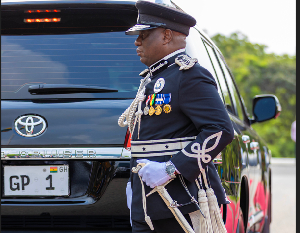 Christian Tetteh Yohunu is the Inspector General of Police