Ghana is Africa's top gold producer and the world's sixth highest. Yet illegal mining, locally called galamsey, is destroying the country faster than it is creating wealth. What began as an environmental crisis has now become a threat to human rights, with innocent people being injured, attacked, and killed.
From the lynching of Major Maxwell Adam Mahama in 2017, who was on an official anti-illegal mining duty, to the helicopter crash in August 2025 that involved cabinet ministers and security officials on an anti-illegal mining enforcement mission, it is clear Ghana is fighting galamsey in ways that cost lives but change nothing.
Ghana can save lives, protect the environment, and restore personal freedoms only if the government targets the powerful enablers behind galamsey and helps artisanal miners transition into safe, legal mining systems.
Illegal mining in Ghana is not only a violation of individual rights but also contributes to environmental crises. Approximately sixty percent of Ghana’s water bodies are polluted with mercury and cyanide, contributing to the widespread destruction of forests and farmlands.
These environmental harms directly endanger the livelihoods and safety of ordinary miners and residents. Continued environmental harm puts the lives, liberty, and economic freedom of people at risk, but also threatens the nation’s future and that of future generations.
Stopping illegal mining in Ghana requires shifting enforcement from poor miners to the powerful sponsors behind the trade. Prosecuting low-level miners has failed to curb galamsey while exposing communities to violence and human rights abuses.
The government can address the root of illegal mining by targeting financiers, equipment suppliers, and political patrons who sustain corrupt networks and reap the greatest profits. Similar strategies in countries such as Peru and the Philippines show that focusing on organized illicit networks, rather than individual laborers, reduces illegal mining and protects vulnerable populations.
To drive this shift, the Attorney-General, in collaboration with the Office of the President and Cabinet, should champion the creation of a specialized Independent Anti-Corruption Prosecutor within the Office of the Special Prosecutor. This body should be empowered to investigate financial flows and prosecute high-level actors through a fair and transparent process.
Its work can be strengthened through partnerships with private satellite companies, civic-tech organizations, and investigative journalists to provide real-time monitoring of illegal mining sites using drone and satellite imagery. This combined legal and technological approach will enhance accountability, weaken exploitative networks, and protect communities, the environment, and the livelihoods of small-scale miners and rural households affected by galamsey.
Many miners turn to illegal mining out of necessity, and without alternatives, enforcement alone cannot stop the trade. Therefore, it is crucial to support artisanal miners in transitioning to safe and legal mining practices. Voluntary miner cooperatives offer a practical solution, with private gold buyers, civil society groups, and equipment suppliers collaborating to form these cooperatives under clear rules, safer training, and mercury-free techniques.
Public-facing institutions such as the University of Mines and Technology, Tarkwa, non-governmental organizations, and philanthropic foundations can provide technical support, research, and innovations in safe extraction methods. This expertise ensures that artisanal miners maintain productive livelihoods while minimizing environmental damage.
In addition to the above-mentioned alternatives, private agribusiness companies and vocational training hubs can expand alternative income opportunities, including agro-processing, reforestation projects, and skilled trades, allowing rural youth to earn sustainable income without relying on illegal mining.
These interventions create safer work environments, reduce environmental hazards, protect human rights, weaken corrupt networks, and preserve the environment for future generations.
Illegal mining is a threat to Ghana’s present and future. By focusing on powerful sponsors and supporting miners to transition into safe, legal practices, Ghana can prevent future illegal mining activities and tragedies.
Opinions of Wednesday, 28 January 2026
Columnist: Gideon Danso
The deadly cost of illegal mining in Ghana
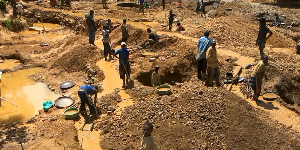 An illegal mining site | File Photo