The issue of inclusion of Queen Mothers in the Regional and National House of Chiefs has become topical, with some renowned and prominent personalities arguing for and against it.
It should be noted that a negligible number of women, whom the system is advocating for, are arguing against it for reasons best known to them.
I wish to remind all and sundry that, at the heart of Ghanaian tradition, the queen mother stands as a pillar of wisdom, moral authority, and cultural continuity. Yet, their deep influence in communities remains underrated and underrepresented in the Regional and National House of Chiefs. This imbalance reflects a historical oversight that deserves urgent redress.
This is not only a matter of gender equity but also of advancing effective, inclusive traditional governance.
To honour tradition and correct exclusion:
In many matrilineal societies like the Akan, queen mothers traditionally played significant roles in leadership, from nominating chiefs to settling disputes and guiding social values. These roles were, however, gradually eroded by the colonial and post-colonial governance structures that favoured male-dominated hierarchies.
Today, while queen mothers continue to provide community leadership — promoting education, protecting vulnerable groups, and preserving culture — they remain structurally weak and sidelined from key decision-making bodies at the Regional and National levels. As Dr James Kwegyir Aggrey profoundly stated, “If you educate a man, you educate an individual, but if you educate a woman, you educate a whole nation.” This idiom is a powerful reminder of the value women bring to leadership.
It is not only in the homes or communities but in government institutions.
Queen mothers, by their very role, nurture and guide entire communities. Their exclusion undermines Ghana’s goals of inclusive governance and gender-balanced development. If we are truly committed to national progress, we must actively involve those whose wisdom and leadership are already making an impact at the grassroots.
Political inclusion and development imperative
Queen mothers are central to grassroots mobilisation, peacebuilding, and education, especially in rural areas. Their inclusion in the Regional and National House of Chiefs will ensure broader and more representative discussions on development, culture, and policy. It will also align with Ghana’s commitment to the Sustainable Development Goals (SDG), particularly SDG 5 on gender equality and women’s empowerment.
Legislative action, a key to breaking the chain
While some Regional House of Chiefs have created informal spaces for Queen Mothers, what is required now is institutional recognition, backed by policy and law.
Women’s representation must be defined, protected, and operational. This is not just about inclusion; it is about restoring a traditional structure that was never meant to be male-only.
Therefore, if a woman decides to condemn this good-faith move, then that woman needs a rethink of how she represents womanhood. The call to include queen m others in our estimation is never outrageous. It is rather a call to straighten up the proverbial crooked path, which those behind the one charting the path have seen.
Interestingly, the call to include queen mothers at the higher levels is already being lauded by a greater section of our society. This is because Ghana has shown the world that it has accepted women to be at the forefront of national development by appointing a female vice president, a number of female DCEs, CEOs, and board chairs. Ghana has seen women entrepreneurs rise above their male peers to propel the wheel of development of the nation. Ghanaians have also realised that gone are the days when Queen Mothers were confined to the palace to learn tradition and culture.
Today, the contemporary queen mother is well-educated, well-groomed, articulate, and knowledgeable about the trend of events. Queen mothers are managing projects and are therefore fit to discuss socio-economic, socio-cultural, and political issues at any level, including the Regional and National House of Chiefs.
Above all, Ghana’s current population of 50.7 against 49.3 places women in a compelling position to be represented in all facets.
We therefore call on our dear father, who is known worldwide as the custodian of tradition with development acumen: Otumfuo Osei Tutu II (Nana wo nkwa so! We can never, and no one can ever challenge your authority, Akora), and other relevant stakeholders to reconsider how far the fight for women’s empowerment has traveled, with his own daughter Nana Konadu-Agyemang Rawlings at the forefront, and grant women this honour.
Let it not be said that women’s participation in Ghana has gone down the tomb with Nana Konadu. Let it not be said that Ghana has turned its back on its own women who fight to feed the nation, protect the vulnerable, and preserve tradition. And let it not be said that the Ghanaian woman’s role in traditional governance is struggling for recognition. Let this not be a fight between the 'boobs' and the 'balls.' No.
Let it rather be a ‘Sankofa,’ which we say is not taboo. Let us all rise up and join this discussion to ensure that it ends to our own admiration and that of the international community, which sees Ghana as a self-renewing country and a beacon of hope in Africa.
Conclusion
Allowing Queen Mothers at the highest levels of traditional governance is both a cultural correction and a national necessity. It strengthens our democracy, honours our heritage, and ensures balanced leadership.
A resilient and inclusive Ghana cannot be built without the voices of the mothers of our traditions. Let us act now with courage, clarity, and commitment to give Queen Mothers their rightful place in shaping Ghana’s future.
Opinions of Tuesday, 6 January 2026
Columnist: Ohemaa Osiabuor Abena Asantewaa
Claiming to Restore Balance: The case for including queen mothers in Regional and National House of Chiefs
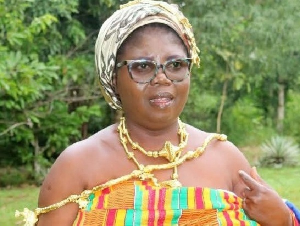 Ohemaa Osiabuor Abena Asantewaa I is the Tufuhemaa of Asato Traditional Area in the Oti Region