The opinions expressed in this article are entirely those of the author and should not be attributed to, or construed as representing the views of, any other individual, including family members, friends, or colleagues.
Any resemblance between these views and the positions of others is coincidental. Responsibility for the arguments presented rests solely with the author.
As President John Dramani Mahama’s tenure nears its conclusion, the political atmosphere within the National Democratic Congress (NDC) is shifting.
The real question is who carries its flag.
Several names have surfaced, as expected, but one towers above the rest. Hon Haruna Iddrisu must not settle for anything less than the ultimate.
His experience, credibility, and appeal position him as the natural choice not only for the NDC but for Ghana, and I will tell you why
For nearly two decades, Haruna Iddrisu has been at the centre of Ghana’s parliamentary life.
From his early days as MP for Tamale South to his time as Minority Leader, his legislative career has been marked by consistency, skill, and influence.
Few have mastered the art of negotiation, consensus-building, and policy advocacy as he has.
Beyond the chamber, his ministerial journey, covering Communications, Employment and Labour Relations, Trade and Industry, and now Education, gave him hands-on governance experience across critical sectors.
At a time when Ghana faces economic pressures and social demands, such a résumé is not a luxury but a necessity.
Politics is not only about competence; it is also about trust and connection.
Here, too, Haruna Iddrisu is well placed.
He enjoys organic acceptance across religious lines, respected by Christians and Muslims alike.
In a country where faith communities shape not just private life but public perception of leaders, this broad-based trust is invaluable.
Against a potential NPP candidate like Vice President Dr Mahamudu Bawumia, the contrast would be stark.
Both are Muslims, but while Dr Bawumia’s political identity has often felt constructed, Haruna’s is natural and deeply rooted.
In the eyes of many, authenticity matters, and Haruna has it.
No discussion of Haruna Iddrisu’s prospects would be complete without the northern factor.
Outside of President Mahama, no politician commands greater loyalty in Northern Ghana.
His dominance in the north and his consistent engagement with grassroots communities earned him the title Kugnaa, and a formidable force to be reckoned with.
For the NDC, this means the northern vote would be secure, freeing the party to focus its campaign machinery on swing regions like Greater Accra, Central, and Western.
Elections in Ghana are won by margins, and Haruna’s candidacy offers the NDC a head start.
Equally important, he is a household name.
After two decades in national politics, Ghanaians know him, respect him, and recognise his voice.
This is a strategic advantage.
Unlike other aspirants who may require heavy investment to build name recognition, Haruna comes ready-made.
The party can spend less time explaining who its candidate is and more time articulating what he will do.
And what of the question that many whisper: can Haruna Iddrisu stand toe-to-toe with Dr Bawumia?
The answer is simple: yes!
He is more entrenched in the north, more organically trusted among Muslims, and more experienced in the workings of government.
He combines technocratic knowledge with grassroots politics, something Dr Bawumia has often been accused of lacking.
In an election defined by relatability and authenticity, Haruna would present the stronger case.
The comparison with Dr Bawumia extends beyond authenticity.
The former Vice President has already been tried and tested in the highest echelons of government, and the results were nothing short of disappointing.
Under his stewardship as head of the Economic Management Team, Ghana witnessed its worst economic performance in decades, spiraling inflation, a collapsing cedi, unsustainable debt levels, and a return to the IMF under humiliating terms.
What made matters worse was the contrast between Bawumia’s lofty promises in opposition and the stark failures in government.
For years, he was touted as the “economic messiah,” yet when the economy faltered, he deflected blame, refused to admit responsibility, and offered no credible path forward.
It was only after leaving office that he began apologising, a move many Ghanaians view as too little, too late.
This raises fundamental questions of transparency and trust.
If he could not deliver on the very solutions he championed for years, why should the electorate believe him now?
Ghana is at a crossroads.
The challenges are real: stabilising the economy, creating jobs for restless youth, expanding infrastructure, and preserving national unity in an increasingly polarized environment.
This is not the time for apprenticeships.
It is the time for leadership forged in experience and tested in the public square.
Haruna Iddrisu embodies that readiness.
For him, the decision should not be whether to contest but how to contest.
Anything short of the presidency would understate his political stature and deny the NDC and the nation a chance at strong, authentic leadership.
History does not often wait for leaders to get ready. It rewards those who rise when the call is loudest.
For Hon Haruna Iddrisu, that call is clear: it is time to go for the ultimate.
Opinions of Thursday, 25 September 2025
Columnist: Kris Zankawah
Why Haruna Iddrisu must aim for the presidency
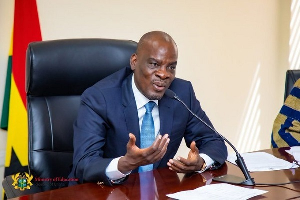 Haruna Iddrisu is the Minister of Education and a Member of Parliament