About a month ago, thousands of young Ghanaians looking for work descended on El Wak Stadium in Accra, as part of the process of enlisting in the Ghana Armed Forces.
What should have been a simple process of information gathering and decision-making resulted in the deaths of six young women and injuries to many others.
The success of the military, which is entrusted with the defence of our nation without a doubt, must rest on its organizational efficiency. A version of what occurred at El Wak Stadium, sadly, occurs every day in the lives of Ghanaian citizens, but not to this degree of morbid finality.
What is meant here is that governance in Ghana is completely bereft of any regard for the convenience or the safety of its citizens. The government does not go to the people; the people always have to come to the government to have their needs met and fulfilled.
The Progressive Alliance for Ghana (PAG) is a political party that has eight established core values, the first of which is citizen-centered governance. The others are National Security, Environmental Vigilance and Awareness, Principled Nationalization, Anti-Corruption, National and Cultural Identity, Social and Economic Justice, and Innovation. The party also has five transformational pillars to drive transparent and open development in the country.
For this discussion, our focus is on the failure of citizen-centered governance, which led to the loss of life and limb of young people who were simply looking for work.
As usual, a committee of inquiry has been established to investigate the obvious lack of proper planning with a fatal outcome. The usual delegations to bereaved families and visits by politicians to patients in hospital beds have occurred. We seem to learn nothing from these experiences.
In this day and age, there is no reason why recruitment into the Ghana Armed Forces should not be almost completely. Driven by digital technology. If indeed, as required, part of the process must be in person. Just as in battle, the army should have anticipated the size of the crowd and planned accordingly.
Knowing from previous experience that thousands of job-hungry youth come the night before to wait for a chance to wear a uniform and to serve, the authorities should have been much better prepared. The preparedness should have been rooted in nurturance and respect for these young citizens. Operational readiness was completely absent. There was little compassion for the applicants who had to weather the elements for an opportunity to be trampled upon.
To any discerning observer, applicants should not have been sleeping outside the stadium, exposed to the elements. These applicants must have paid application fees. Some of these funds should have been applied to ensuring that shelter, basic sanitation, and water would have been available to them during this process.
If citizen-centeredness had been at the core of operational planning, none of this would have occurred. What was convenient and humane for these young citizens should have served as the foundation of the design and implementation of the application process. No one needs to die looking for a job. Our national ineptitude knows no bounds and can be found in all sectors of our daily life, including education, health, roads, land administration, local government, and the mining sector, to mention a few.
I’ll provide another example of failure to respect and engage the rights of citizens in decision-making. We are all for development and advancement in our country. Currently, the road westward from Accra all the way to Takoradi is being converted into a four-lane highway.
I’ll share the experience of those of us on the Elmina stretch of this highway. About a month ago, the residents and business owners, as well as heads of government and parastatal institutions situated along the highway,y were awakened to a team marking structures with red Xs along the road. They were presumably from the Ministry of Roads and Highways.
There had been no prior consultation with the community about this. My personal experience in this situation is that of the Elmina Java museum, which the Ulzen Family Foundation (TUFF) has operated as a heritage site since 2003, as the oldest continuously operated private museum in the country. The museum is located on the north side of this highway.
As expected, the museum contains numerous photographic exhibits, sensitive documents, audiovisual, records, ana d variety of physical exhibits, such as sculptures and custom-designed artwork depicting Elmina and Ghana’s history.
Beyond the red markings on the building, we have no idea how much time we have to close down the business and make decisions about the future of the museum. You can imagine that all of the exhibits must be saved and sensitively stored indefinitely. We can only presume that we will find a new location to rebuild at some point. The future of this tourist site is now uncertain.
In the area, there are many homes and numerous small business people who operate out of commercial buildings and containers. There is a hotel that has recently been expanded and renovated in the vicinity. There are banks and offices of the Electricity Corporation, and other institutions. No one has received a single item of written communication about a timeframe within which to prepare for this seismic change in the lives of affected citizens. Just a red X and rumours.
The point of all of this is that the authorities must have known they were going to expand this road at least more than a year ago. The issue is not compensation, which everybody talks about. Simply receiving compensation for the value of a building that is destroyed does not begin to pay for the loss ofone'ss shelter, business, which will cease operation, or other costs related to possible relocation and rebuilding.
The issue is being sensitive to the needs and the lives of the citizens while the government carries out its responsibilities.
The first example involved death and injury, and the second example involves severe disruption of the personal and occupational lives of citizens who are contributing daily to their economy and society.
I am certain many citizens can relate to the events that have been described in this communication. The drivers of the current political culture have failed to serve the citizens of the land. The denigration and abuse of our citizens is partly rooted in our colonial and medieval past, when many were subjects of the British crown or local chiefs and overlords. We must be intentional about changing this.
Proper and sustainable development is anchored in the recognition of the people as the most precious resource in the nation.
Policy Solutions for Citizen-Centered Governance
• Digital Transformation of Public Services: Implement fully online recruitment systems for the Ghana Armed Forces and other public institutions to minimize physical crowding and risks. Use mobile-friendly platforms and SMS notifications to ensure accessibility for all citizens.
• Mandatory Risk Assessment and Crowd Management Protocols: Require all public events involving large gatherings to undergo risk assessments. Enforce crowd control measures, including designated waiting areas, sanitation facilities, and emergency medical teams.
• Community Consultation Framework: Establish legal requirements for prior community engagement before major infrastructure projects. Use town halls, public notices, and digital platforms to inform and involve affected citizens early in the decision-making process.
• Transparent Compensation and Relocation Support: Move beyond mere building compensation to include relocation assistance, business continuity grants, and psychosocial support for displaced families and enterprises.
• Citizen Impact Assessment (CIA): Introduce a mandatory CIA for all government projects, similar to environmental impact assessments, to evaluate social and economic consequences on citizens.
• Accountability and Monitoring Mechanisms: Create independent oversight bodies to monitor compliance with citizen-centered policies. Publish annual reports on citizen engagement and satisfaction metrics.

Opinions of Monday, 22 December 2025
Columnist: Prof. (Med) Thaddeus Ulzen
When citizens count for nothing
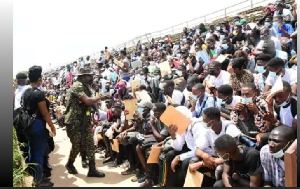 File photo of job seekers that gathered at El Wak Stadium in Accra