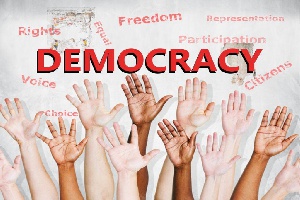
Ghana stands as one of Africa’s most admired democracies. Since the return to constitutional rule in 1993, the country has conducted successive elections with a regularity and credibility that few nations on the continent can match.
Power has transferred peacefully between rival parties — from NDC to NPP and back — in a cycle that has become a source of genuine national pride and international respect. The architects of the Fourth Republic built something worth defending.
And yet democracy is never merely an institution. It is a living practice, a daily negotiation between citizens, leaders, and the structures that bind them. It can be eroded gradually, through complacency and complicity, long before it collapses dramatically. Ghana’s democracy faces no single existential crisis today — but it faces many incremental ones.
This article names them plainly, in the belief that what is named can be fought.
“When the corrupt go unpunished, every citizen learns that power is above the law.”
Corruption is perhaps the most durable enemy of Ghanaian democracy. It is not new, and it is not unique to Ghana — but its particular manifestation in the country’s political culture has become deeply corrosive. When public funds are diverted, contracts inflated, and procurement processes manipulated for personal gain, it is not just money that is stolen.
It is trust — the foundational resource of any democracy. Ghana’s public institutions have been weakened by systemic corruption at multiple levels. The Auditor-General’s reports, year after year, reveal billions of cedis in unexplained expenditures, ghost names on payrolls, and procurement irregularities that never result in meaningful prosecution.
The Office of Special Prosecutor — established with great fanfare to address high-level corruption — has struggled for resources, political independence, and credibility. The message sent, whether intended or not, is that powerful people are above consequences.
Impunity is the oxygen of corruption. When the corrupt go unpunished — when they are re-elected, celebrated, and appointed to positions of further authority — society receives a devastating lesson: that the rules of democracy apply selectively.
This lesson, absorbed widely enough, produces apathy among the principled and ambition among the unscrupulous. It is a compound poison. Ghana’s democracy has long been shadowed by the spectre of ethnopolitics — the tendency for voting patterns, political appointments, and public resource allocation to follow ethnic and regional loyalties rather than merit, policy, or the public good. The country’s two dominant parties, the NDC and NPP, draw their support from broadly different ethnic and regional blocs, a reality that both parties exploit and that both have, at various points, attempted to transcend.
The problem is not ethnic diversity — Ghana’s remarkable cultural mosaic is a source of richness, not weakness. The problem is the political instrumentalisation of that diversity: the deliberate stoking of ethnic identity for electoral advantage, the appointment of kinsmen to public office irrespective of qualification, and the perception — frequently substantiated — that state resources flow more generously toward communities that voted for the ruling party.
When citizens vote for tribe rather than for ideas, political parties have no incentive to develop serious policy platforms. When governments distribute resources along ethnic lines, the national project — the idea that every Ghanaian citizen, regardless of region or ethnicity, has an equal claim on the state — is fundamentally compromised.
Tribalism does not merely distort democracy; it hollows it out. The Weakening of Democratic Institutions. A democracy is only as strong as the institutions that give it structure — the electoral commission, the judiciary, Parliament, the media, civil society, and the constitutional bodies that check executive power. In Ghana, many of these institutions have shown signs of strain that demand urgent attention.
The Electoral Commission of Ghana has been the subject of persistent controversy — accusations of partisan appointments, disputed voter registration processes, and electoral boundary decisions that have inflamed political tensions. While Ghana’s elections have generally been accepted, the margins of trust are narrow, and a single badly managed election could unravel decades of democratic credibility. Parliament, which should serve as the most robust check on executive power, has increasingly become a vehicle for partisan battles rather than substantive legislative oversight.
Committee work is often performative; debates rarely influence policy; and the appetite for genuine accountability has been weakened by a political culture that rewards loyalty over independence.
When institutions fail, strongmen fill the vacuum. Ghana’s history of military coups — 1966, 1972, 1979, 1981 — is a warning carved in the national memory. Every time a democratic institution fails in its function, it lends credibility to those who argue that democracy itself has failed. The defence of institutions is not bureaucratic procedure — it is the defence of freedom itself. “A hungry man’s vote is the most dangerous ballot in any democracy.”
Democracy promises equal political voice, but it cannot function equitably when material inequality is profound. A citizen who cannot feed their family, who lives without reliable electricity, clean water, or access to quality healthcare, relates to the democratic system very differently from one whose basic needs are met. For the desperately poor, the ballot is not primarily an expression of political preference — it is often a transactional instrument, exchangeable for cash, bags of rice, or roofing sheets.
Vote-buying is a structural problem in Ghanaian elections, not a marginal one. Both major parties have engaged in it. The consequences are devastating for democracy: when votes can be purchased, the wealthy determine election outcomes regardless of the will of the genuinely engaged citizenry. Politicians have no incentive to deliver governance between elections if they can buy compliance on election day. The poorest citizens — who have the most to gain from good governance — become the instruments of their own democratic dispossession.
Inequality also breeds democratic fatigue — the corrosive belief, particularly among the youth, that no election produces meaningful change in their material circumstances. When this belief becomes widespread, voter apathy rises, civil society weakens, and the space for demagogues who promise radical, extra-constitutional solutions expands dangerously Misinformation & Digital Manipulation. The digital age has brought extraordinary gifts to Ghanaian democracy — a connected citizenry, instant accountability journalism, social media platforms that allow ordinary people to report abuses and mobilise communities. But it has also introduced a dangerous new enemy: the weaponisation of information against truth itself.
Ghana’s information ecosystem is increasingly polluted by deliberately fabricated stories, doctored images, and coordinated disinformation campaigns — particularly during electoral periods. Political actors on both sides of the partisan divide have used social media platforms to spread falsehoods, manipulate public sentiment, and incite hostility against opponents. In a society where mobile phone penetration is high but media literacy remains uneven, these campaigns find fertile ground.
Voters who make decisions based on false information cannot exercise genuine democratic agency. Citizens who cannot distinguish between authentic journalism and fabricated propaganda lose the cognitive tools necessary for democratic participation. And politicians who succeed by lying face no incentive to govern with honesty.
Misinformation is not simply a media problem — it is a democratic crisis in slow motion. The state, civil society, media institutions, and technology platforms all share responsibility for building the information integrity that healthy democracy requires.
Ghana has been slow to develop the regulatory and educational frameworks necessary to meet this challenge.Executive Overreach & the Erosion of Checks Ghana’s constitutional architecture vests significant power in the presidency — perhaps too much.
The President appoints ministers, ambassadors, heads of public institutions, and members of key constitutional bodies. In a system where patronage is the currency of political survival, this concentration of appointment power creates structural conditions for the erosion of independence across the public sector. When the head of the Electoral Commission, the Auditor-General, the Attorney-General, and the leadership of major state-owned enterprises all owe their positions to the President, the checks and balances that democracy requires become formal rather than functional.
These officials may not be corrupt — many are not — but they operate in an environment where institutional loyalty and presidential favour are inseparable. There is also the question of parliamentary power vis-à-vis executive dominance. In Ghana’s political culture, a member of Parliament from the ruling party who votes against the government risks political marginalisation. The result is a Parliament that often acts as an echo chamber for executive decisions rather than a genuine counter-power.
Democracy without meaningful separation of powers is democracy in name only. Ghana’s constitutional reforms — long discussed, rarely implemented — must address the structural concentration of authority that makes genuine accountability so difficult to achieve.Youth Exclusion & Political Alienation Ghana is a young country — over 60% of its population is under 35. This demographic reality is simultaneously its greatest democratic asset and, if mismanaged, its most dangerous liability. The energy, idealism, and appetite for change that characterise Ghana’s youth have driven social movements, exposed corruption, and held power accountable in ways that older institutions have failed to do.
But this same generation faces systemic exclusion from formal political power. Party structures are dominated by older, established figures who manage access to candidacies and political resources. The cost of electoral campaigns makes political participation prohibitively expensive for talented young people without connections to wealthy patrons.
And the gap between the aspirations of educated young Ghanaians and the opportunities available to them — in employment, housing, healthcare — is a source of deepening resentment.
When an entire generation comes to believe that the political system exists to serve a closed elite and that their votes change nothing, democracy faces an existential question. The energy of excluded youth does not simply dissipate — it redirects. Ghana ignores its youth at the peril of its democracy.The Fight Worth Having Ghana’s democracy has survived coups, disputed elections, economic crises, and the full range of pressures that have broken democratic orders elsewhere on the continent.
It has survived because ordinary Ghanaians — journalists, judges, activists, voters — have again and again chosen to defend it, sometimes at considerable personal cost. That tradition of democratic defence is Ghana’s most precious political asset.
But tradition is not a guarantee. The enemies named in this article — corruption, tribalism, institutional weakness, poverty, misinformation, executive overreach, and youth exclusion — do not announce themselves dramatically. They work quietly, incrementally, eroding trust and accountability in ways that are easily dismissed individually but devastating collectively.
The answer to each of these enemies is not simple. But the beginning of each answer is the same: honesty about the problem. Citizens who understand the threats their democracy faces are citizens capable of resisting them. Political leaders who are held to account by an informed, engaged public cannot afford impunity.
Ghana’s democracy is worth the fight. Its history proves it. Its future demands it. The enemies of democracy in Ghana are real — but so, and more durably, is the democratic spirit of the Ghanaian people. That spirit, fully activated, is more powerful than any of the forces arrayed against it.
Opinions of Sunday, 31 May 2026
Columnist: Makafui Kwadzo Dzamesi
The enemies to democracy in Ghana
 Ghana stands as one of Africa’s most admired democracies