Introduction: A Nation at a Crossroads
There is a question that every generation of Ghanaian students, teachers, and parents has quietly answered — not through deliberate policy, but through habit, necessity, and pragmatism: how do you prepare for the BECE or the WASSCE? The answer, almost universally, has been: get a Pasco, solve the past questions, and you will be fine.
For decades, this approach worked well enough. Students who diligently worked through years of West African Examinations Council (WAEC) past papers earned their grades, secured their school placements, and proceeded through Ghana’s educational pipeline.
The Passco booklet became as synonymous with exam preparation as the school uniform, and the instruction “go and solve past questions” became a mantra passed from teachers to students, from parents to children, from older siblings to younger ones.
Then came 2025 — and the data shattered the comfort of that assumption.
The 2025 WASSCE results were the worst in nearly a decade. Core Mathematics pass rates collapsed from 66.86% in 2024 to just 48.73% — meaning more than half of Ghana’s SHS final-year students failed Mathematics. Social Studies fell from 71.53% to 55.82%. The outright failure rate in Mathematics nearly quadrupled in a single year, from 6.1% to 26.77%.
President John Mahama called the results “mind-boggling.” WAEC officials cited candidates’ inability to apply concepts and solve standard-level questions. Researchers described it as a “systemic correction” exposing long-concealed learning deficits.
And here is the uncomfortable part: the very practice that was supposed to prepare students — solving past questions — was itself implicated in the crisis. WAEC’s Head of Public Affairs, John Kapi, observed that many candidates relied excessively on rote learning of past question answers, which proved wholly inadequate when the 2025 exam demanded applied thinking rather than memorised responses.
So the question before Ghana’s education community is no longer a simple endorsement. It is more layered, more urgent, and more honest: should solving past questions continue to be the primary way to success in Ghana’s education system — and if so, in what form, and alongside what else?
“Many candidates relied excessively on rote learning, which proved inadequate for the 2025 exam format. This reliance undermined their ability to apply knowledge.” — John Kapi, WAEC Head of Public Affairs.
The Case For Continuing: Why Past Questions Still Have a Place
Let us begin with intellectual honesty. Past question practice, properly done, is not the villain of Ghana’s education story. The evidence for its effectiveness, when applied correctly, remains solid.
The Science Remains Sound
Cognitive science supports the principle at the heart of past question practice: retrieval practice, or the testing effect. Research consistently demonstrates that actively recalling information from memory — as happens when answering an exam question without notes — produces stronger and more durable memory consolidation than re-reading or passive review. This is not a contested finding. It is among the most replicated results in educational psychology.
When a JHS student solves a BECE Mathematics past paper question on algebra under timed conditions, they are not just practising a procedure — they are strengthening the neural encoding of that knowledge.
Done consistently, across subjects and over months rather than days, past question practice builds genuine competence. The problem, as we shall examine, is not the technique itself. It is how it has been applied in Ghana’s classrooms and homes.
WAEC Questions Do Follow Patterns
It remains true that WAEC examinations follow a defined syllabus with relatively consistent question patterns, recurring topic areas, and predictable formats.
A student preparing for the WASSCE who has worked through ten years of Mathematics past papers will have encountered every major question category: quadratic equations, mensuration, probability, statistics, transformation geometry, vectors, and more. That breadth of exposure is genuinely valuable.
The argument that past questions are irrelevant because WAEC changes its questions year to year misreads how the examination works. WAEC does not reinvent its syllabus annually — it tests the same competencies using varied question framings.
Students who understand the underlying concepts and have practised applying them through past questions are better equipped to handle those variations than students who have done neither.
Equity and Access
There is also an equity argument for past questions that must not be dismissed. In a country where the quality of teaching varies enormously between well-resourced private schools in Accra and under-staffed rural public schools in the Northern Region, past questions represent a great equaliser. A student in Wa or Bawku who has no access to a private tutor or a well-stocked school library can, with a Passco booklet and a determination to work through it honestly, access the same examination content as a student in Accra Academy or Achimota.
Platforms like Passco.com.gh, which now deliver free BECE and WASSCE past papers directly to mobile phones via WhatsApp, have extended this equity dividend to remote communities.
Over 10,000 students report having improved their grades through these digital resources. That is not a trivial achievement in a country where educational resource gaps between regions remain stark.
The Case Against Over-Reliance: Where the Model Is Broken
And yet. The 2025 WASSCE results demand that we look unflinchingly at what has gone wrong — and what role the misapplication of past question culture has played in Ghana’s examination crisis.
Memorisation Is Not Understanding
Research on Ghana’s secondary education sector has long indicated an overreliance on rote learning at the expense of analytical, inquiry-based, and problem-solving pedagogies. WAEC questions, particularly in Mathematics and the sciences, increasingly require applied knowledge, interpretation, reasoning, and analysis.
Students trained in memorisation struggle when confronted with non-recall questions. As one research analysis put it starkly:
“Rote learners, who focus primarily on memorizing formulas, definitions, or past questions, are unable to bridge the gap. Memorizing the formula for simple interest does not automatically equip a student to solve a novel loan-repayment problem.”
This is the crack at the foundation of Ghana’s Pasco culture. When students treat past question answers as content to be memorised rather than as exercises in applied reasoning, they build a brittle kind of academic knowledge — one that shatters the moment the examination demands something slightly different from the template they have stored in memory.
The 2025 Exam Exposed the Malpractice Crutch
The 2025 WASSCE crackdown on examination malpractice was a watershed. WAEC cancelled the results of 6,295 candidates for bringing unauthorised materials into examination halls, cancelled the entire results of 653 for mobile phone use, and prosecuted 35 education personnel.
When the scaffolding of cheating was removed, the underlying learning deficit became starkly visible.
But here is the deep irony: many of the “unauthorised materials” students were caught with were themselves compiled past question answers — condensed “cheat sheets” of predicted answers based on past paper patterns.
The Pasco, in its most degenerate form, had become not a study tool but a cheating tool — a collection of memorised responses to carry into the exam hall, not a curriculum of practice to build genuine competence.
When WAEC changed the framing of questions even slightly, those memorised responses were useless.
A Curriculum of Contradictions
Ghana introduced the Standards-Based Curriculum (SBC) in 2018 and has continued to update it through the New GES Curriculum of 2025, which centres on 21st-century skills including critical thinking, creativity, problem-solving, ICT, and national values.
The curriculum, in other words, explicitly moves away from rote learning and toward competency-based education.
But the examination system — particularly the WAEC examinations that serve as the gatekeepers of educational progression — has not been fully redesigned to align with this curriculum vision.
The result is a contradiction at the heart of Ghana’s education system: a curriculum that calls for creativity and application, assessed by examinations that students prepare for through memorisation.
As one commentator observed, this has “created a generation of students who are ill-equipped to navigate the complexities of the 21st century.”
The Opportunity Cost of Narrow Preparation
There is a further cost to an education culture dominated by past question practice that is rarely discussed: what students do not develop when their entire academic preparation is oriented toward a single examination format.
Ghana’s employers, universities, and industries consistently report a mismatch between the skills graduates possess and the skills the modern economy demands. Jobs are increasingly demanding creativity, critical thinking, problem-solving, and the ability to adapt to new technologies.
A young person who has spent three years of SHS solving past papers in exactly the format WAEC has used for the past decade is well-prepared for that examination — and potentially underprepared for the fluid, application-intensive demands of university study and professional life. “Ghana cannot afford to maintain an education system that rewards memorisation at the expense of critical thinking. The challenges of the 21st century require a workforce that is innovative, adaptable, and capable of solving complex problems.” — The Daily Statesman.
The Verdict: Necessary but Not Sufficient
A false binary has often dominated this debate: either past questions are good (and students should solve more of them) or past questions are bad (and students should abandon them in favour of “deeper” learning). This is the wrong frame entirely.
The honest verdict is more nuanced: past question practice, properly applied, remains a necessary component of effective examination preparation in Ghana’s current educational context. But it is not — and has never been — sufficient on its own.
The crisis of 2025 was not caused by students solving too many past questions. It was caused by students solving past questions in the wrong way, for the wrong reasons, as a substitute for genuine learning rather than as a complement to it.
The distinction matters enormously. Here is what separates effective past question practice from the rote-memorisation trap:
• Effective practice: Attempting a past question independently, marking it critically, identifying the conceptual gap revealed by a wrong answer, revisiting the underlying topic, and attempting similar questions again until the concept is genuinely understood.
• Ineffective practice: Reading through compiled “answers” to predicted past questions, memorising response templates, and relying on pattern recognition to reproduce stored answers in the examination hall.
The first approach uses past questions as a diagnostic and retrieval tool — exactly what cognitive science prescribes. The second approach uses them as a memory bank — a strategy that collapses the moment WAEC varies its question framing, as it did in 2025.
What Must Change: A Five-Point Reform Agenda
If past questions are to remain a legitimate and productive part of Ghanaian examination preparation — and they should — the following reforms are necessary at every level of the education system.
1. Reform How Past Questions Are Used in Schools
Teachers must integrate past questions into classroom teaching as analytical tools, not answer templates. Instead of distributing past paper answer compilations for students to memorise, teachers should use past questions as classroom exercises, require students to explain their reasoning, and use wrong answers as teaching moments. The WAEC Chief Examiner’s Report, published annually, should be read by every teacher as a guide to the specific reasoning and application skills the examination rewards.
2. Align the Examination System with the Curriculum
Ghana’s 2025 curriculum explicitly prioritises 21st-century competencies. WAEC’s examination design must evolve to consistently reward these competencies — application, analysis, reasoning — rather than recall.
This alignment would actually make past question practice more, not less, valuable: students practising for application-based questions must genuinely understand their subjects, not just memorise answers. The return to the international WASSCE format in May/June 2026 is an opportunity to reinforce this shift.
3. Build Critical Thinking Explicitly Into Revision Culture
Schools, parents, and students must understand that the goal of solving a past question is not to produce a correct answer — it is to understand why an answer is correct. Every incorrect answer should prompt a question: what concept did I misunderstand? What reasoning error did I make?
This metacognitive habit — thinking about one’s own thinking — is what transforms past question practice from mechanical drilling into genuine learning.
4. Address the Structural Deficits That Drive Malpractice
Students turn to malpractice and memorised past-question cheat sheets not primarily out of laziness but out of desperation born from inadequate teaching, overcrowded classrooms, incomplete syllabus coverage, and under-resourced schools.
The 2025 Budget allocated GH₵564.6 million for new curriculum-based textbooks and additional funds for the Capitation Grant and School Feeding Programme — but textbooks alone will not fix classrooms where one teacher serves sixty students. Real structural investment in teaching capacity is the foundation without which no study strategy reform will succeed.
5. Reimagine Success Beyond the Examination
Perhaps most fundamentally, Ghana must broaden its definition of educational success. The WASSCE grade is a critical milestone, and the strategies needed to achieve it matter. But a student’s education cannot be measured solely by their WAEC aggregate.
Schools must cultivate curiosity, creativity, collaboration, and resilience alongside examination competence. These are not soft additions to a core curriculum — they are the skills that determine whether a graduate thrives in university, builds a business, or contributes meaningfully to national development.
Conclusion: The Way Forward Is Through, Not Around
Should solving past questions continue to be the way to success in Ghana? The answer is: yes, but not in the way it has mostly been done.
Past questions, used as genuine practice tools for retrieval, application, and diagnosis, remain one of the most effective and accessible study strategies available to Ghanaian students. Their value is proven, their accessibility is expanding, and their alignment with the cognitive science of learning is solid.
To abandon them in favour of vague prescriptions to “think more critically” without a concrete study methodology would leave students worse off, not better.
But past questions used as memorisation databases — collections of predicted answers to be stored and regurgitated, shortcuts around genuine understanding rather than pathways into it — are not a road to success.
They are a road to the examination hall unprepared, discovered in 2025 by half a million students who found that the questions on their papers required something their compiled answers could not provide: the ability to think.
Ghana’s education system is at a crossroads. The 2025 WASSCE results were not just a statistical setback — they were a national diagnosis.
The good news is that the prescription is known: genuine learning, disciplined practice, application over memorisation, conceptual understanding over template recognition, and a system that rewards thinking rather than merely rewarding the ability to reproduce what has been thought before.
The way to success in Ghana’s education system runs through past questions — but it does not end there. It ends in the development of young people who can apply what they know, adapt to what they do not know, and contribute something new to a country that needs every ounce of their potential.
That is the standard Ghana must hold its education system to. Anything less is not preparation for success. It is preparation for the next crisis.
Opinions of Wednesday, 3 June 2026
Columnist: Makafui Kwadzo Dzamesi
Should solving past questions continue to be the way to success in Ghana?
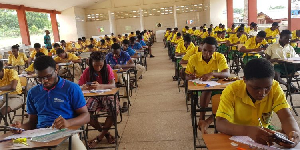 Students writing exams