Some stories are difficult to tell.
Some carry memories we would rather leave behind. Some connect to experiences that changed us in unexpected ways. And some remain silent for so long that we eventually begin to wonder whether we should ever speak about them at all.
For me, becoming an author was not part of a carefully designed career plan.
It began with a desire to give difficult experiences a voice.
Over time, I came to understand that a story does not have to remain defined by the pain from which it was born. When told with purpose, it can become a source of awareness, courage, reflection and hope.
That realisation became an important part of my journey.
THE BEGINNING: TURNING EXPERIENCE INTO A STORY
My first book, Revealed! The Storm Is Over, published in 2023, emerged from deeply personal experiences and explores difficult themes, including childhood abuse, marital abuse, divorce and grief.
Writing about such experiences required courage.
But I did not want the book to exist simply as a record of painful chapters.
I wanted it to create a conversation.
A conversation about experiences that are often hidden.
A conversation about courage when life becomes difficult.
A conversation about healing and the possibility of beginning again.
Writing became a way of transforming experience into something that could potentially help another person recognise their own strength, question their circumstances or simply realise that they are not alone.
That was one of the first lessons writing taught me:
Sometimes, the experiences we struggle to speak about can become the very experiences through which we find our voice.
THEN TUBERCULOSIS BECAME PERSONAL
My journey as an author later took an unexpected turn.
In The Shadow That Stayed: A Mother's Story of Tuberculosis, Loss, and Hope, tuberculosis is no longer simply a public health issue viewed from a professional distance.
It becomes personal.
The story reflects experiences of illness, loss, stigma, fear, treatment and hope. It also draws attention to the difference that knowledge and action can make when people understand tuberculosis and respond early.
This story became particularly meaningful because my professional journey had also brought me into the world of tuberculosis programming.
Since joining Stop TB Partnership Ghana, I have worked in programme coordination and PSEAH/SEAH, contributing to the Global Fund GC7 Case-Finding and Core TB Services programme across NGO implementing partners. My work includes supporting community TB case-finding, partner engagement, field monitoring, supportive supervision, data verification and programme performance reviews.
Suddenly, the subject I was writing about was also the subject I was working to address.
And that changed how I understood storytelling.
THE PERSON BEHIND THE STATISTICS
Public health teaches us to value data.
We count cases.
We monitor indicators.
We review results.
We measure progress.
These things matter.
But working in community TB programming has reinforced another truth for me:
Behind every number is a person.
There is a person living with the diagnosis.
A family carrying the consequences.
A community dealing with stigma.
A volunteer trying to find someone whom others might overlook.
A health worker trying to connect someone to care.
A team working to prevent exclusion for those in isolated areas.
The more I worked in this space, the more I understood that public health and storytelling do not have to exist in separate worlds.
Data tells us what is happening.
Stories can help us understand what it means to the people living through them.
WHY THE SHADOW THAT STAYED MATTERED TO ME
The second book allowed me to bring these two worlds closer together.
I wanted tuberculosis to be seen not only as a disease but as a human experience.
The effects of a diagnosis extend beyond the physical condition.
It can affect relationships.
It can create fear.
It can expose people to stigma.
It can affect families.
It can result in loss.
And when knowledge is absent or conversations do not happen early enough, the consequences can be devastating.
That is why storytelling matters.
A story can create a space where people are willing to ask questions.
It can challenge assumptions.
It can make an unfamiliar experience feel human.
It can encourage someone to take a symptom seriously.
It can remind us that seeking help should never be a source of shame.
And sometimes, a story can say something that a statistic cannot.
FROM PERSONAL EXPERIENCE TO PUBLIC PURPOSE
Looking back, I can now see a connection between my two books.
The stories are different.
The experiences are different.
But the purpose is closely related.
Both emerged from a desire to turn difficult experiences into something meaningful.
Revealed! The Storm Is Over speaks to courage, healing and moving beyond painful experiences.
The Shadow That Stayed brings together tuberculosis, loss, awareness and hope.
Together, they have helped me understand the role I want storytelling to play in my life.
I do not want to write simply for the sake of publishing.
I want to write stories that serve a purpose.
Stories that create conversations.
Stories that challenge silence.
Stories that make people think.
Stories that encourage empathy.
Stories that can contribute, in some small way, to positive change.
WHAT PUBLIC HEALTH HAS TAUGHT MY WRITING
My professional work has also changed the way I tell stories.
Working with programmes and partners in communities has reminded me that people are never just indicators.
They are parents.
Children.
Siblings.
Workers.
Caregivers.
Volunteers.
Neighbours.
They have responsibilities, fears, hopes and dreams.
When we design programmes, we need the numbers.
When we evaluate programmes, we need the data.
But when we serve people, we also need humanity.
That is where I believe storytelling has an important role.
It helps us remember the human being behind the programme.
The person behind the diagnosis.
The family behind the statistic.
The community behind the indicator.
I BECAME AN AUTHOR BECAUSE I BELIEVE STORIES CAN SERVE PEOPLE
Today, I do not describe myself as an author simply because I have written books.
I describe myself as an author because I believe stories have a responsibility.
Stories can educate.
They can challenge.
They can comfort.
They can inspire.
They can make invisible experiences visible.
They can give language to experiences people have struggled to express.
And they can open conversations that might otherwise never happen.
That is the kind of author I want to be.
Not an author whose words simply occupy bookshelves.
But an author whose stories can contribute to awareness, dignity, healing and change.
MY TWO WORLDS ARE NO LONGER SEPARATE
Today, I see my professional work and my writing as two expressions of the same purpose.
My work in public health reminds me that people need access to information, services and support.
My work in safeguarding reminds me that people deserve safety, dignity and accountability.
My experience in project coordination reminds me that good intentions must be translated into organised, measurable action.
And my writing reminds me that behind all of these things are human beings with stories of their own.
Perhaps that is why I became an author.
Not because I had everything figured out.
Not because every story was easy to tell.
But because I discovered that experiences can become more than memories.
They can become lessons.
They can become conversations.
They can become advocacy.
They can become a source of connection.
And sometimes, they can become a bridge between one person's experience and another person's understanding.
THE STORY CONTINUES
I used to think that becoming an author meant finishing a book.
Today, I see it differently.
Being an author is an ongoing responsibility to observe, to listen, to reflect and to tell stories with purpose.
There are still stories I want to tell.
Stories about health.
Stories about communities.
Stories about leadership.
Stories about women.
Stories about resilience.
Stories about dignity.
Stories about the people who are often represented by statistics but rarely given a voice of their own.
And perhaps that is the greatest reason I became an author.
Because I have learned that silence can hide experiences, but stories can bring them into the light.
I chose to write.
I chose to speak.
And I chose to believe that stories can serve people.
That is why I became an author.
Opinions of Tuesday, 18 August 2026
Columnist: Beatrice Shine Ayroe
When Silence Became a Story, and a Story Became a Voice: Why I became an author
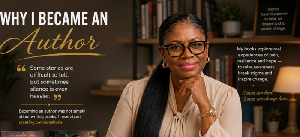 Beatrice Shine Ayroe is the author of this piece