Across Ghana’s rural landscapes, a quiet but devastating crisis is unfolding one that threatens the future of thousands of children.
Government basic schools in remote communities are suffering from an acute shortage of teachers, leaving young learners without the guidance and instruction they deserve.
In towns surrounding Tepa such as Supponso, Betiako, Nyamekrom, and Tetekrom and in Offinso communities like Bonsua and Worapong, schools are operating with skeletal staff.
Nyamekrom, for example, has only six teachers covering every class from Kindergarten to Junior High School.
In the Bono Region, a basic school near Goamu has just one teacher responsible for all levels.
Similar conditions persist in towns around Goaso, Koforidua, and Goamu, where schools struggle to maintain even six teachers.
Meanwhile, urban schools in cities such as Offinso, Tepa, Kodie, Goaso, Anyinasu, Jirapa, Tamale, Kasoa, and Takoradi enjoy a surplus of educators.
In some cases, a single subject is assigned two or three teachers one actively teaching while others remain idle.
This imbalance is not only unfair but deeply unjust.
Despite these disparities, students in rural schools are expected to sit for the same Basic Education Certificate Examination (BECE) as their urban counterparts.
These children, often without access to extra classes or private tutoring, are supervised by invigilators sent by the Ghana Education Service (GES) during exams.
The pressure to perform without adequate preparation leads many to resort to exam malpractice not out of dishonesty, but desperation.
Adding to the tragedy is the fact that many newly trained teachers remain at home, awaiting postings.
Meanwhile, children in underserved communities continue to suffer from the absence of educators.
This disconnect between available human resources and actual deployment is a glaring inefficiency that demands urgent attention.
To address this crisis, the following measures are proposed:
1. Reinstate Rural Incentives: Teachers in rural areas once received salary increments to compensate for the challenges of working in remote communities. This policy has been discontinued and must be reinstated to attract and retain educators in these underserved regions.
2. Restrict Transfers: GES should enforce stricter policies to prevent teachers from frequently transferring out of rural postings.
3. Redistribute Urban Surplus: Schools in cities with multiple teachers per subject should have some of their staff reassigned to rural schools in need.
4. Prioritise Rural Postings: When posting new teachers, priority should be given to schools that lack coverage across all subjects. Schools already fully staffed should not receive additional personnel.
Quality education should not be a privilege reserved for urban centers.
Every child, regardless of geography, deserves the opportunity to learn, grow, and thrive.
The future of Ghana depends on the equitable distribution of educational resources.
It is time for policymakers, educators, and citizens alike to rally behind our rural schools and ensure that no child is left behind.
Let us rise to the challenge because the promise of education must reach every corner of our nation.
Opinions of Thursday, 25 September 2025
Columnist: Kingsford Ansah & Priscilla Nsiah
Rural Schools in Crisis: The silent struggle for Basic Education in Ghana
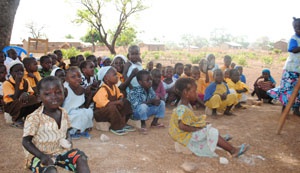 Students in rural communities in the country struggle to get access to good teaching instructions

![Wontumi allegedly appeared emotional and requested for water [This image is AI generated]](https://cdn.ghanaweb.com/imagelib/pics/975/97547141.295.jpg "Wontumi allegedly appeared emotional and requested for water [This image is AI generated]")