As someone working closely with agricultural systems in Sub-Saharan Africa (SSA), I have witnessed firsthand how deeply farmers rely on rain-fed agriculture and how dangerously exposed that leaves them.
We are at a critical juncture in our region's agricultural future. Over 90% of all farming activities here depend entirely on rainfall.
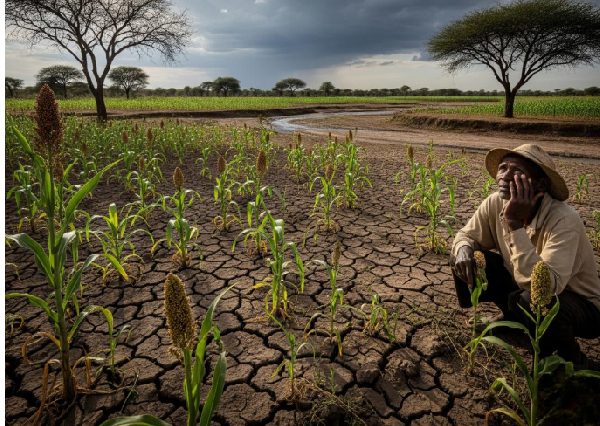
When the rain comes late, or not at all, the consequences are immediate: crop failures, empty markets, rising food prices, and deepening rural poverty. These shocks are no longer occasional; they are becoming the norm.
Rain-fed agriculture is the backbone of food production in SSA, and it is now under greater pressure than ever before. The triple threat of climate change, degraded soils, and poor water management is accelerating a crisis that puts millions of livelihoods at risk.
If we are serious about feeding our communities and building resilience, then we must change how we manage water, support farmers, and adapt our production systems to new climatic realities.
The Challenge of Rain Dependence
It is hard to overstate just how rain dependent we are in Sub-Saharan Africa. According to recent research, rain-fed systems support about 97% of total crop production in the region. In semi-arid and dryland zones, where more than 40% of our people live, the timing and quantity of rain can determine whether a harvest feeds a family or fails entirely.
I have spoken with farmers who lost entire fields because the rains came two weeks late or ended abruptly during the flowering stage.
These are not isolated events. Climate models are telling us what farmers already know: temperatures are rising, rainfall patterns are shifting, and extreme weather events, both droughts and floods, are becoming more frequent and intense.
In many parts of West Africa, rainfall patterns have become increasingly erratic over recent decades. We have seen a corresponding drop in cereal production and a sharp rise in food insecurity.
A meta-analysis of studies cited by Lamptey (2022) projects that by 2050, yield losses in major crops like maize, pearl millet, and sorghum could reach 5 to 15% due to climate variability. That is not a distant forecast; it is a warning we cannot afford to ignore.
Doing More with Less: Agronomic Adaptation
In the face of these challenges, I believe there is still room for hope, but only if we act boldly and intelligently.
One of the most practical responses lies in optimizing how we use the rain that does fall. Scientists refer to this as "green water," the moisture stored in the soil from rainfall. We need to improve how effectively we make every drop count.
Through my work and research, I have seen how agronomic practices such as mulching, conservation tillage, and cover cropping can significantly reduce evaporation and runoff.
These methods help retain moisture in the root zone, where crops need it most. Similarly, rotating crops and incorporating legumes can enhance soil structure and fertility, which in turn improves the soil’s capacity to hold water.
However, this is not just about techniques. It is also about timing, planning, and access to information. When farmers are equipped with reliable climate forecasts and clear guidance on when to sow, they can adjust planting dates and reduce the risk of failed harvests.
I have worked with farmers who, after adopting climate-informed planting calendars, reported better yields even during difficult seasons.
Still, these strategies are not reaching everyone. Extension services are often overstretched, particularly in remote areas. We must scale up advisory systems, invest in farmer training, and ensure that the most vulnerable farmers are not left behind as we adapt to changing climate conditions.
Irrigation: The Missing Puzzle Piece
While improving rainwater use is crucial, we must also address irrigation, as its absence remains one of the region’s most significant missed opportunities. Despite the presence of abundant surface and groundwater resources, only 4 to 7 percent of arable land in Sub-Saharan Africa is irrigated. When compared to 34 percent in Asia, it becomes evident that we are underutilizing a key tool for resilience.
Irrigation does not have to involve large dams or expensive infrastructure. In fact, some of the most promising solutions are small-scale and farmer-managed. I have observed how treadle pumps, drip irrigation kits, and solar-powered water systems can transform small plots into productive, year-round farms.
When properly supported, these systems enable farmers to cultivate vegetables during the dry season, diversify their crops, and generate consistent income.
They reduce reliance on unpredictable rainfall and can help stabilize the food supply, even in difficult years.
However, significant barriers remain. For many smallholders, the initial cost of irrigation tools is simply too high, and access to credit is limited, making it difficult to invest. Market systems are often weak, offering little incentive for farmers to expand production. In some areas, the absence of effective water governance has led to over-extraction and local conflicts. If we are serious about expanding irrigation, we must combine investment in technology with strong institutions and fair, transparent water management.
A Call for Integrated Solutions
The solutions are not simple, but they are within reach. To secure the future of agriculture in Sub-Saharan Africa, we must integrate rainwater management, soil health, and irrigation development. These issues cannot be treated in isolation, as they are deeply interconnected in both practice and impact.
I advocate for a systems approach that looks at the farm as a whole and accounts for water, soil, labor, finance, and markets. For example, combining water harvesting techniques such as half-moons (shallow, crescent shaped basins that capture rainwater) or bunds (raised embankments that slow runoff and retain moisture) with composting and timely planting has helped some farmers double their yields in drylands. When these interventions are locally tailored and co-designed with farmers, adoption rates rise, and the impact is more lasting.
We also need to support innovation from mobile weather apps to decision support tools that help farmers plan under uncertainty. Some models, such as the Crop Water Requirements and Irrigation Planning Tool (CROPWAT) and the AquaCrop Model, are helping governments and researchers simulate how crops will respond to different climate scenarios. That kind of insight can guide investments and reduce risk.
Looking Ahead: Resilience Starts Now
The reality is that we do not have decades to adapt; we must act swiftly and collectively. I have witnessed remarkable resilience among farmers in the face of adversity, but resilience alone is not enough. It must be matched with resources, secure rights, and meaningful recognition.
To build a food-secure future in Sub-Saharan Africa, we must act on multiple fronts: scaling up climate-smart practices that optimize soil moisture and improve the use of rainwater; investing in small-scale irrigation systems that are affordable, efficient, and sustainable; and supporting farmers with the knowledge, tools, and financing they need to adapt to increasing climate variability.
This is not only an agricultural challenge, it is a matter of equity, development, and human dignity. It is a challenge we cannot afford to postpone. As someone working in this space, I remain hopeful, not because the risks are small, but because the solutions are within reach and the time to act is now.
About the author
Name: Asamoah Oppong Zadok
Organization: Lincoln University, Jefferson City, Missouri, USA
Asamoah Oppong Zadok is a researcher in sustainable agriculture, agribusiness, and agricultural policy, and the Founder of Sustaina Harvest, a mission-driven agribusiness in Akim Oda – Adjobue, Eastern Region, Ghana.
He leads initiatives that combine eco-friendly crop and livestock production with social impact programs that empower women, youth, and persons with disabilities.
He holds an M.Sc. in Sustainable Agriculture from Lincoln University and a B.Sc. in Agribusiness from the University of Cape Coast, Ghana.
His research explores consumer demand, local food systems, agricultural policy analysis, and the use of artificial intelligence (AI) in agriculture.
Asamoah has presented his work at international research conferences and contributes to the academic community as a peer reviewer for journals in economics and agriculture.
Opinions of Friday, 15 August 2025
Columnist: Asamoah Oppong Zadok
Rain-fed agriculture under pressure in Sub-Saharan Africa
 Asamoah Oppong Zadok is the author of this article