Across Africa, debates on governance, development, and gender equality often focus on modern political institutions, electoral systems, and international development frameworks. Yet, embedded within many African societies are longstanding indigenous leadership structures that have historically shaped community life.
Among these is the institution of the queen mother—an authority figure deeply rooted in traditional governance systems, particularly visible in countries such as Ghana. Queen Mothers in Action Africa (QMIAA) emerges within this context as a transformative platform seeking to reposition traditional female leadership as a strategic driver of women’s empowerment, community development, and national progress.
Historically, the role of queen mothers extended far beyond ceremonial duties. In many Akan traditional systems, queen mothers were instrumental in selecting chiefs, advising on governance matters, resolving disputes, and safeguarding the welfare of women and children. They served as custodians of lineage, moral authority, and social stability.
However, colonial administrative structures and post-colonial state centralization often marginalized these roles, diminishing the formal influence of women within traditional governance systems. QMIAA represents a deliberate effort to restore and modernize this indigenous leadership institution, ensuring that it remains relevant within contemporary development discourse.
At the heart of QMIAA’s agenda lies the advancement of women’s leadership. Across the continent, women continue to face structural barriers to political representation and decision-making. Despite their central role in household economies and community welfare, their presence in national parliaments, executive offices, and high-level policy platforms remains limited in many contexts.
QMIAA addresses this imbalance by leveraging the cultural legitimacy and moral authority of queen mothers to amplify women’s voices in governance. Through advocacy, training, and engagement with traditional and state institutions, the organization strengthens pathways for female leadership at both grassroots and national levels.
This agenda resonates strongly with the development vision articulated by the United Nations through the Millennium Development Goals (MDGs). Adopted in 2000, the MDGs provided a global framework for addressing poverty, inequality, health disparities, and education gaps.
Of particular relevance is MDG 3, which emphasized gender equality and the empowerment of women. QMIAA’s work directly reinforces this objective by positioning queen mothers as catalysts for inclusive governance and social transformation. Rather than viewing gender equality solely through legislative reform, QMIAA recognizes the power of culturally embedded leadership to effect meaningful change.
The relationship between QMIAA’s agenda and the MDGs extends beyond gender equality. MDG 1 sought to eradicate extreme poverty and hunger—an objective closely tied to women’s economic empowerment. In many African communities, women are primary contributors to agricultural production, informal trade, and household income generation.
Queen mothers, through community mobilization and advocacy, can support initiatives that enhance access to credit, promote cooperative enterprises, and strengthen food security programs. By empowering women economically, QMIAA contributes to poverty reduction at the household and community levels, thereby reinforcing national development strategies.
Education, the focus of MDG 2, also aligns closely with the traditional responsibilities of queen mothers. As guardians of children’s welfare, queen mothers are influential in promoting school attendance and advocating for girls’ education. In settings where socio-cultural norms may discourage female education, their authority can challenge entrenched practices and encourage families to prioritize schooling.
Through community engagement and partnerships with educational institutions, QMIAA strengthens efforts to expand literacy, enhance human capital, and promote long-term socio-economic mobility.
The health-related MDGs—particularly those addressing maternal health, child mortality, and communicable diseases—further illustrate the strategic relevance of queen mother leadership. In many rural communities, public health initiatives require trusted intermediaries who can bridge the gap between formal health systems and local populations.
Queen mothers, respected for their moral standing, often serve this role effectively. They can mobilize participation in vaccination campaigns, promote maternal health awareness, and dispel misconceptions surrounding reproductive health services. In doing so, QMIAA contributes to improved health outcomes and reinforces the foundations of national public health systems.
Beyond its alignment with global development goals, QMIAA advances a broader vision of national development grounded in social cohesion and participatory governance. Sustainable development requires not only economic growth but also stable communities, inclusive institutions, and effective conflict resolution mechanisms.
Queen mothers have traditionally acted as mediators in disputes and arbiters in community conflicts. By strengthening these functions, QMIAA enhances peacebuilding efforts and fosters environments conducive to investment and development. Social stability, in turn, supports infrastructure expansion, entrepreneurship, and long-term economic planning.
An important dimension of QMIAA’s work is its emphasis on culturally embedded development. Development frameworks imposed without sensitivity to local contexts often encounter resistance or limited sustainability. By rooting initiatives within indigenous leadership structures, QMIAA ensures community ownership and legitimacy.
Programs championed by queen mothers are more likely to gain acceptance because they resonate with established cultural norms and authority systems. This bottom-up approach reflects participatory development theories that prioritize local engagement over externally driven interventions.
The relevance of QMIAA’s agenda extends into the post-MDG era, particularly with the transition to the Sustainable Development Goals (SDGs). While the MDGs focused on foundational human development indicators, the SDGs expanded the scope to include inclusive institutions, reduced inequalities, and sustainable communities.
QMIAA’s emphasis on inclusive governance, gender equity, and grassroots mobilization aligns seamlessly with these broader objectives. By integrating traditional authority with contemporary governance frameworks, the organization embodies a hybrid model of leadership capable of addressing complex development challenges.
In countries such as Nigeria and South Africa, where traditional leadership institutions are constitutionally recognized, the integration of queen mothers into formal advisory structures represents a significant step toward inclusive governance. QMIAA advocates for reforms that institutionalize the participation of queen mothers within houses of chiefs and policy platforms, ensuring that female traditional leaders contribute meaningfully to national decision-making processes.
Such inclusion not only corrects historical gender imbalances but also enriches governance with perspectives grounded in community welfare and social justice.
Ultimately, Queen Mothers in Action Africa represents more than a revival of traditional authority; it is a strategic reimagining of women’s leadership in Africa’s development trajectory. By harnessing the legitimacy of indigenous institutions, QMIAA demonstrates that sustainable national development can—and must—draw from Africa’s own cultural resources.
In linking traditional leadership with global development frameworks such as the MDGs, the organization underscores a critical insight: transformative progress is most enduring when it is rooted in local values, inclusive governance, and the empowerment of women at every level of society.
The writer, Millicent Bruce, is Sompahene Nana Nankan Bruce I of Gomoa Esaabakrom under the Gomoa Fetteh Traditional Council
Opinions of Tuesday, 3 March 2026
Columnist: Millicent Bruce
QMIAA: Reclaiming traditional authority for women’s leadership and national development
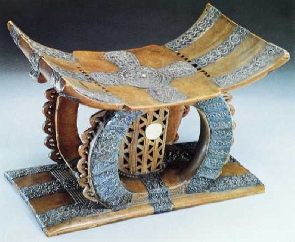
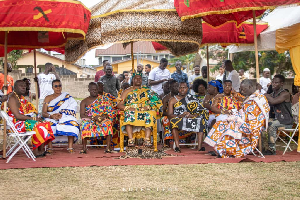 Some traditional leaders at an event