When a bottle labelled “Blood of Jesus” is placed into trembling hands, it is not merely liquid being sold; it is hope. But when that hope results in hospitalisation, psychological trauma, financial ruin, or even death, who is held accountable? When miracles are advertised but tragedies are buried, silence becomes complicity. Ghana cannot afford to look away any longer.
Petition to the Food and Drugs Authority
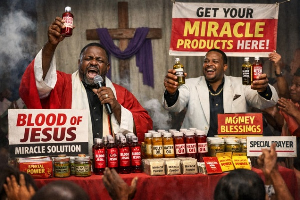
Across Ghana and within diaspora communities, a troubling trend continues to grow: the commercialisation of so-called “prayer materials.” These products, packaged as anointed oils, holy pomades, miracle porridge, healing soaps, perfumes, and bottled liquids labelled “Yesu Mogya” (“Blood of Jesus”), are aggressively marketed by self-styled prophets as divine solutions to life’s deepest struggles.
They promise healing for the sick.
Breakthroughs for the unemployed.
Marriage restoration for broken homes.
Immigration approvals for the desperate.
Behind the testimonies and theatrics, however, lies a darker reality — one of exploitation, manipulation, and potential public health risks.
The tragic death of Madam Cecilia, a Ghanaian woman residing in Toronto, has become a painful symbol of this crisis. According to close friends and members of her community, she was convinced that consuming a product labelled “Yesu Mogya,” while engaging in prolonged fasting without food or water, would miraculously secure her Canadian immigration status.
Acting in what she believed was faith, she followed the instructions diligently.
She later collapsed and died.
Her death has shaken the Ghanaian diaspora and raised urgent questions. What was in that bottle? Who approved its sale? Was it tested? Was it safe for human consumption? And most importantly, who bears responsibility when faith-based products cause irreversible harm?
While some individuals publicly testify about perceived miracles, there is little transparency regarding adverse outcomes. Reports of dehydration linked to prolonged fasting directives, worsening medical conditions due to abandoned treatment, psychological dependency on prophetic instructions, and severe financial exploitation continue to surface quietly within communities.
When desired outcomes occur, prophets claim divine credit. When harm follows, responsibility shifts. Victims are blamed for “insufficient faith,” or tragedies are described as spiritual attacks. Accountability disappears.
This growing industry of unregulated spiritual commerce raises serious public health concerns. Many of these substances are ingested, applied to open wounds, mixed with medications, or consumed under extreme physical conditions. Yet they often lack ingredient disclosure, dosage guidance, manufacturing information, expiration dates, or evidence of regulatory approval.
The Food and Drugs Authority was established to ensure that consumable and topical products meet safety and quality standards. Regardless of whether a product is labelled spiritual, herbal, or cosmetic, once it enters the human body, it falls within the scope of scientific scrutiny.
This petition therefore calls on the Food and Drugs Authority to:
Conduct a nationwide audit into the production, importation, and distribution of “prayer materials” marketed for ingestion or bodily application.
Perform laboratory testing to determine chemical composition, toxicity, and potential health risks.
Enforce strict labelling requirements and halt the sale of any unapproved consumable spiritual products.
Collaborate with public health institutions, including the Noguchi Memorial Institute for Medical Research, to publish findings and educate the public.
Establish clear regulatory guidelines to prevent religious language from being used as a shield against accountability.
This is not an attack on faith. Faith is sacred. Faith strengthens communities. But when faith is commercialised without oversight, it becomes vulnerable to abuse.
Ghana is a deeply spiritual nation. That foundation should not be weaponised against its own people. Vulnerable individuals — the sick, the poor, immigrants, widows, and those facing hardship — are often targeted with promises of supernatural shortcuts. Their desperation becomes a marketplace.
Madam Cecilia’s story is not isolated. It represents others who may have suffered in silence — those who experienced medical complications but were too ashamed to speak, families drained of savings in pursuit of prophetic promises, and individuals who delayed necessary medical treatment because they were told a bottle held divine power.
Regulatory intervention is not merely administrative; it is protective. It is about safeguarding life, preserving dignity, and restoring public trust.
If these products are harmless, scientific testing will confirm it.
If they are dangerous, lives will be saved.
Inaction, however, is no longer neutral. Every day without investigation allows unverified substances to circulate among unsuspecting believers. The line between prayer and potential harm must be clearly defined.
For public health.
For transparency.
For families who deserve truth instead of tragedy.
The time to act is now. Silence in this matter is not caution; it is risk. And no more lives should be lost in the name of miracles sold without scrutiny.
Opinions of Tuesday, 3 March 2026
Columnist: Stephen Armah Quaye
Prayer or Poison?: The deadly cost of fake prophets and miracle materials in Ghana
 Across Ghana and within diaspora communities, a troubling trend continues to grow