The NDC’s latest decision and the Obuasi headmaster’s withdrawal are welcome. What deserves scrutiny is the hesitation, the reversals, and the public appeals that preceded that position.
An allegation is not a conviction. Neither is stepping aside a confession. Between those two truths lies the space in which responsible leadership must operate.
On 20 October, the National Democratic Congress directed Zakaria Abdulai, the suspended headmaster of Obuasi Senior High Technical School, to step aside from the Juaben constituency chairmanship contest. He has subsequently resigned as the party’s constituency secretary and withdrawn his candidature.
These are welcome developments. The party deserves credit for correcting the course. Mr Abdulai’s decision to relinquish his existing position as well as withdraw from the contest also deserves acknowledgement.
But welcoming the outcome does not require us to overlook the journey. Why did a decision compatible with both fairness and public responsibility require so many changes of direction?
What Both Decisions Demonstrate
The party’s latest directive preserves the presumption of innocence while asking Mr Abdulai to step aside. His resignation letter similarly combines withdrawal with an assertion of innocence and an intention to clear his name through lawful means.
Read together, those positions demonstrate the argument that should have guided the response from the beginning.
Stepping aside is not a verdict. A person can defend his name while accepting that not every political ambition must proceed uninterrupted.
Permission to contest was never clearance of the allegations. Withdrawal is not proof of them. Neither the party’s decision nor Mr Abdulai’s resignation determines what happened. That remains a matter for investigation and, where proceedings follow, determination through the appropriate legal process.
The distinction was available before the latest directive. It did not require a new understanding of innocence. It required a clearer understanding of responsibility.
A Straightforward Principle, a Winding Route
The party initially signalled that Mr Abdulai should withdraw or face disqualification. It then allowed him to contest, citing the ongoing investigations and concern for his rights. It has now directed him to step aside.
An institution should be willing to reconsider its decisions. Correcting an error is better than defending it out of pride. But repeated changes of position on a matter this serious invite scrutiny of the judgment behind them.
Protecting an accused person from premature condemnation is a legitimate concern. It does not, however, settle the separate question of whether pursuing higher party office is wise under the circumstances.
Even if compulsory disqualification appeared inappropriate, an appeal for voluntary withdrawal remained available. The party could have affirmed his rights while urging restraint. Mr Abdulai could have maintained his innocence while deciding that his candidacy should wait.
Neither course would have required abandoning him or prejudging the allegations.
Advocates Should Not Have to Explain the Obvious
The Network for Women’s Rights in Ghana, NETRIGHT, publicly called for prosecution and urged the NDC to reverse its decision allowing Mr Abdulai to contest. Its intervention also raised concerns about reported failures to protect the students and respond to their complaints.
We cannot know from the sequence alone what persuaded the party to change its position. It would therefore be wrong to attribute the reversal conclusively to any particular intervention.
But the public appeal itself matters.
Women’s rights advocates should not have to explain that grave allegations involving schoolgirls demand exceptional care from a political organisation. Their vigilance is indispensable. It should not become a substitute for the judgment that institutions ought to exercise themselves.
The burden of insisting on consideration for the students should not fall repeatedly on those already working to ensure that their voices are heard.
Credit Without Complacency
Withdrawal carries a cost. Political opportunities do not necessarily return at a convenient time, and relinquishing an existing office is not an empty gesture.
That is why Mr Abdulai’s decision should be acknowledged without mockery or insinuation. Having argued that stepping aside need not signify guilt, we must not now interpret his departure as evidence against him.
The party’s correction should likewise be welcomed. But the correction does not erase the earlier misjudgment.
The standard should be more demanding than eventual arrival at a defensible position. It should include recognising that position early, explaining it consistently, and showing that concern for the students can coexist with fairness to the accused.
The Students Must Not Become an Afterthought
There is a danger that the political reversal becomes the closing headline: the party has acted, the candidate has withdrawn, and public attention moves elsewhere.
Yet stepping aside answers only the question of his immediate political position.
It does not establish what happened to the students. It does not resolve questions about earlier complaints or determine who, if anyone, received warnings and failed to act. Those matters require evidence and answers, not assumptions.
In my earlier article, “Obuasi SHS Girls Are Not Your Content,” I argued against turning the students’ experiences into partisan ammunition. That warning remains necessary.
Their welfare must not become secondary to either an attack on the NDC or a celebration of its correction. The students require protection, appropriate support, and a serious response to their accounts. Mr Abdulai remains entitled to a fair determination of the allegations. Institutions must fulfil both obligations.
A Standard, Not a Partisan Weapon
Anyone who welcomes this argument only because it concerns the NDC should ask whether they would apply it to their own party.
Nor should every accusation automatically produce permanent exclusion. Expectations of stepping aside must be proportionate and accompanied by fair, timely investigations. Otherwise, restraint can become punishment without proof.
But those safeguards should make responsible withdrawal possible, not provide a reason to reject it.
We need a political and civic culture in which a person can pause an ambition without surrendering his dignity, and a party can encourage that decision without declaring him guilty.
The high road has now been taken. That is welcome.
Next time, it should not require a map drawn by public appeals.
Opinions of Wednesday, 21 October 2026
Columnist: Ras T. Acolatse
Obuasi SHS: The high road should not require a map
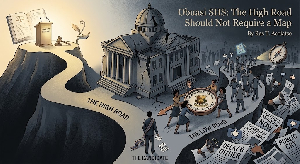 The article addresses concerns about the Obuasi SHS saga