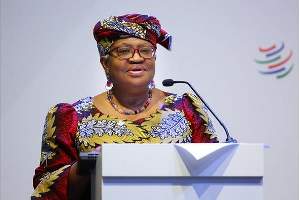
Strikingly nice-looking and the putative attorney of Kwesi Nyantakyi, erstwhile Ghana Football Association President, Amanda Clinton shared an opinion piece about the dismissal of Gertrude Torkonoo, the former Chief Justice (CJ) of the Republic of Ghana. Amanda intimated as follows:
“At the heart of Ghana’s constitutional framework is the doctrine of separation of powers. Under the 1992 constitution, the president, the speaker of parliament, and the chief justice are coequal in status as heads of the executive, legislature, and judiciary, respectively.
Each is designed to be independent of the other, with checks and balances preserving the delicate equilibrium of our democracy.
Amanda Clinton raises four constitutional questions after Torkornoo's removal
Amanda not only overlooked the conceptual and epistemological lacuna in the principle of separation of powers, the historical antecedent to the doctrine, but also underestimated the powers of the President under the 1992 constitution.
Dear Amanda, the social, economic, religious, and political exigencies in Europe
influenced the writings of many political thinkers. The writings of Montesquieu ( credited with theseparation of powers and checks and balances). Denis Diderot, credited with the famous quote
“ Man will never be free until the last king is strangled with the entrails of the last priest, responded to the happenings in the era. J. J Rousseau, noted for his book “The Social Contract” and credited for the famous quote.
“Man is born free, and everywhere he is in chains” was a response to social issues of the time. Adam Smith's work,"Wealth of Nations," published in 1776, stressed the economic vitality of separating functions, and Voltaire, remembered for his famous quote,
“Those who can make you believe absurdities can make you commit atrocities,
"was responding to Jacobism and religious panjandrum in Europe.
The English Revolution of 1688-1689 saw the end of the reign of the catholic king James II of England by the protestant, William of Orange. James was replaced by his protestant daughter, Mary, and her husband, William, creating parliamentary supremacy and paving the way for a constitutional monarchy.
James was an Iron-fisted King who usually bypassed parliament by leveraging his royal prerogative to suspend laws, such as the Test Acts, which prohibited Catholics from holding public office. He dissolved parliament when the members resisted his action.
King James demonstrated his close ties to the predominantly catholic France under the king Loiux XIV. This created fear that he was determined to set up monarchical absolutism in England based on the French model.
Louis XIV sadistically and ruthlessly killed the French protestants and those holding dissenting views from the monarch. The English Revolution of 1688 was perceived as the boomerang effect of the abuse of power.
After 1688, the House of Commons (Lower House in the English
legislature), as the institutional expression of one part of the nation, could limit the prerogative of the House of Lords (Upper House in the English legislature) and the king. Many writers and philosophers saw the overthrow of King James and constitutional changes as a new model.
Montesquieu was thus destined to benefit from the changes in England to conceptualise the doctrine of separation of powers. Montesquieu travelled to England and, upon his return to France, he erroneously reported that in England, the three organs of government, legislature, executive, and judiciary performed
their functions separately in terms of employees and responsibilities.
It follows ipso facto that different groups of workers constituting the legislature made the laws, different workers constituting the executive implemented the laws, and different groups of workers constituting the
judiciary interpreted the law and prescribed punishments for those who breached both civil and criminal laws. Montesquieu coined the doctrine of separation of powers based on the above observations.
Montesquieu did not observe accurately in England because the English Attorney-General and the Minister of Justice at the time belonged to all three arms of the government. As a minister of Justice, he was part of the executive and the head of the Judiciary. He was also an elected member of the House of Commons, hence belonging to the legislature.
The concept of separation of powers was framed on false assumptions.There is no country in the world that practices a strict separation of powers.
Although the United States Constitution is said to be framed on the principle of separation of powers, the Senate has quasi-judicial powers.
In India, the doctrine of separation of powers is practiced, albeit the legislature being endowed with powers to set up tribunals that operate like courts.
Dear Lawyer Amanda, the 1992 Constitution has a semblance of separation of powers. The framers of the constitution appeared to have presented the constitution to the then Chairman Rawlings as a compensatory package for transitioning to a multi-party democracy.
Amanda, it is wrong to think that the President, the Speaker of parliament, and the Chief Justice (CJ) are co-equals representing the executive, the legislature, and the judiciary, respectively. Justice Torkonoo herself stated that not even the President or the Vice President can disobey the court.
In the 1992 constitution, the Minister of Justice is, by inference, higher
than the CJ. The office of the CJ is akin to the Director-General (D.G) of the Ghana Education Service or the Director-General of Ghana Health Services. The two DGs are under their respective sector ministers.
The constitution of a country must address the social, political, and economic necessities of the citizens. History does not really offer complete solutions to the conundrums we face today.
In times of uncertainty, the prevailing exigencies, history may provide understanding of the value thought to be served. The framers of the United States Constitution might have considered factors like the rise and fall of the Roman Empire, the 100-year war (1337-1453) between England and France, and the War of the Spanish Succession (1701-1714).
Factors like a weak military that led to the fall of the Roman Empire, political and strategic aggrandisement that led to the 100 Years' War, and the diplomatic brinkmanship that led to the Spanish Succession War might have goaded the framers of the American Constitution to focus on a strong military.
The framers of the 1992 constitution were pretty much fixated on how to convince Chairman Rawlings to relinquish power.
Lawyer Amanda, the 1992 constitution of Ghana is nothing short of executive dictatorship. The president has more powers than the Speaker of Parliament and the CJ. They are never coequal. Judge Montesquieu himself was aware of the conceptual errors in his theory of separation of powers.
It partly explains why Montesquieu amended errors with the principle of checks and balances. God bless our homeland, Ghana.
Opinions of Saturday, 6 September 2025
Columnist: Nana Yaw Osei
Letter to Amanda Clinton: The doctrine of Separation of Powers was a flaw on arrival
 Amanda Clinton is the lawyer of former GFA President, Kwesi Nyantakyi