The formal introduction of the Constitution (Amendment) Bill, 2025, marks a pivotal and arguably perilous shift in Ghana’s republican architecture. While the proponents of the bill utilize the seductive language of "inclusivity" and "diaspora mobilization," a cold-eyed political science analysis suggests that this amendment is less about national development and more about the formalization of an "exit-option" for the Ghanaian political elite.
To understand why this amendment threatens the "spirit of the law," one must look beyond the text of Article 94 and Article 8 and examine the intersection of dual allegiance, geopolitical vulnerability (FIMI), and the systemic culture of elite impunity.
1. The "Moral Hazard" of the Exit Strategy
In political theory, the efficacy of a social contract relies on the "shared destiny" of the rulers and the ruled. Article 1(1) of the 1992 Constitution explicitly states that sovereignty resides in the people of Ghana, in whose name and for whose welfare government power must be exercised. When a leader holds dual citizenship, they possess a sovereign insurance policy.
In the Ghanaian context, where political accountability is often reactive rather than proactive, this creates a profound moral hazard. If a Minister or a Member of Parliament oversees the depletion of national reserves or the degradation of public institutions, their personal exposure to the resulting fallout is mitigated by their second passport.
The dual citizen can "opt-out" of the consequences of their own policy failures. This creates a profound moral hazard that contradicts the duty of every citizen under Article 41(f) to "protect and preserve public property and expose and combat misuse" For the Ghanaian political elite, who already demonstrate a penchant for seeking medical care, education, and asset storage abroad, this bill legitimizes a "transient" form of leadership that lacks "skin in the game."
2. Geopolitics and FIMI
From a Foreign Information Manipulation and Interference (FIMI) perspective, the amendment creates significant structural vulnerabilities. Modern statecraft is no longer just about physical borders, but also about the "cognitive sovereignty" of decision-makers.
. Jurisdictional Leverage: A dual citizen is legally subordinate to the laws of a foreign power. Whether it is tax compliance, judicial subpoenas, or "national interest" directives from their second home, the official is inherently compromised.
. The Trojan Horse Risk: In a geopolitical climate where global powers are vying for influence over Ghana’s strategic minerals and digital infrastructure, a dual-citizen official becomes a high-value vector for foreign influence. This potential conflict of interest directly challenges Article 40(a), which mandates that the government "promote and protect the interests of Ghana" in international dealings.
Their second allegiance provides a "backdoor" for foreign intelligence services to exert pressure, via threat of asset seizure or revocation of citizenship, to sway Ghanaian policy in favor of a foreign capital. Can an official truly exercise the "absolute, irrevocable commitment" required by the state when their second allegiance provides a "backdoor" for foreign influence?
3. Corruption, Extradition, and the Pattern of Evasion
The history of the Fourth Republic is replete with examples of the "Flight to Sanctuary." When the political tide turns and the specter of the prosecution looms, the Ghanaian elite have historically utilized foreign residencies to evade the reach of domestic law.
If we allow dual citizens to occupy roles such as the Inspector-General of Police (IGP) or Chief of Defence Staff (CDS), the state is effectively lowering the cost of corruption. Article 35(8) commands the State to "take steps to eradicate corrupt practices and the abuse of power."
Yet, extradition is notoriously difficult when the subject is a citizen of the requested state. If a dual-citizen official facilitates a fraudulent high-value procurement deal, they don't just flee; they go home, to a jurisdiction that is legally obligated to protect them from the "unreliable" judicial processes of a developing nation. This amendment, therefore, provides a legal shield for the very "rent-seeking" behaviour that has historically hindered Ghana’s growth.
4. The Formalization of "Protocol" Nepotism
Undoubtedly, the Ghanaian political culture is defined by neopatrimonialism (the use of state resources to maintain patronage networks). The inclusion of dual citizens into the restricted list of Article 8(2) risks expanding this network into a "Transnational Elite."
We are likely to see the emergence of "Parachute Appointments": wealthy, well-connected individuals from the diaspora who are handed sensitive security and diplomatic roles as rewards for political financing. These individuals, while ethnically Ghanaian, may lack an organic understanding of the local socio-political fabric. Their loyalty is often to the appointing authority (the President) rather than the abstract concept of the Ghanaian State, further entrenching the "winner-takes-all" culture that bypasses local meritocracy.
5. Conclusion: The Erosion of Singular Allegiance
The 1992 Constitution was crafted with a spirit of defensive sovereignty, born from the lessons of a turbulent post-colonial history where foreign interference was a recurring theme. The "allegiance" requirement was never intended to be a slight against the diaspora, but rather a safeguard against the dilution of national loyalty.
To amend these articles is to signal that Ghana is comfortable with "part-time" patriotism at the highest levels of government. For a nation still grappling with systemic corruption, weak institutional oversight, and the constant threat of elite evading accountability, this bill does not represent progress.
It represents the ultimate surrender of the "shared destiny" principle. True leadership in a developing state requires an absolute, irrevocable commitment to its survival, not a "Plan B" stored in a foreign safe-deposit box.
Opinions of Thursday, 26 February 2026
Columnist: Ebenezer Obeng-Akrofi
Is Ghana's Shared Destiny at Risk?: A policy analysis of 2025 Constitutional Amendment Bill
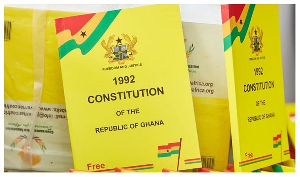 A copy of Ghana's Constitution






Entertainment