Members of the Iranian community living in Ghana are intensifying their calls on the Government of Ghana and the international community to take strong and decisive action against what they describe as systematic human rights atrocities and extrajudicial killings committed by the Islamic Republic of Iran.
Their demands come as unprecedented repression back home has drawn global condemnation and concern over the loss of civilian lives and violations of fundamental human rights.
Since late December 2025, protests have erupted across Iranian cities, initially sparked by economic distress and quickly spiralling into broad expressions of dissent against political repression.
Rights groups have warned that security forces in Iran have employed lethal force, with reports of mass unlawful killings and arbitrary detentions intensifying the toll on civilian lives.
In recent weeks, Iranian residents and students in Ghana — part of a small but vocal diaspora community — have staged vigils, press briefings and letter-writing campaigns urging Ghana’s leadership to speak out.
Protesters holding placards reading “How many more?" "Stop the extra judicial killings," "Make Iran great again," "This is genocide" among others, have gathered near the Iranian embassy in Accra to shine a spotlight on the unfolding crisis.
Among their demands is a formal statement to the Iranian embassy and Ghana’s Ministry of Foreign Affairs condemning the extrajudicial killings and urging accountability measures for Iranian authorities.
One community leader, speaking at a peaceful protest in front of the Iranian embassy in Accra on Saturday January 17, said: “We cannot remain silent when our families and friends back home are shot, detained without charge, or executed in cruel conditions. We ask Ghana and the international community to champion human rights like it has for other global causes.”
Their appeals reference ongoing international concerns over Tehran’s crackdown — including reported mass unlawful killings, internet blackouts to impede reporting, and legal processes that rights groups say lack due process.
The Human Rights Context Inside Iran
International human rights organizations have documented a pattern of lethal force used against largely peaceful demonstrators and critics.
An urgent Amnesty International report describes “mass unlawful killings committed on an unprecedented scale” since late December 2025, with security forces firing live ammunition and metal pellets at protesters and bystanders alike.
Similarly, the World Organisation Against Torture (OMCT) condemned the extrajudicial killings, torture and arbitrary use of force against civilians in multiple provinces, noting that many victims include young people and bystanders with no affiliation to armed groups.
The escalating violence has also led to widespread arbitrary arrests, with credible reports indicating tens of thousands detained and numerous individuals facing criminal charges under broad legal statutes that human rights advocates argue are used to suppress dissent.
Global calls for accountability
The Iranian diaspora is not alone in calling for international action.
A coalition of 46 human rights organisations has urged the United Nations Human Rights Council to convene an emergency session to address the mass killings and hold Iran accountable for alleged crimes under international law.
They argue that longstanding impunity for state actors emboldens continued violence against civilians.
Beyond diplomatic pressure, rights advocates are pushing for international justice mechanisms, including potential referrals to the International Criminal Court (ICC) and criminal probes under universal jurisdiction to ensure that perpetrators of human rights violations do not escape accountability.
Ghana’s Role — A test of principles
For the Iranian community in Ghana, educating Ghana's policymakers and the public about the crisis is a priority.
Their petitions highlight Ghana’s own democratic traditions and participation in regional human rights frameworks, urging leaders in Accra to leverage diplomatic channels and multilateral fora to champion the protection of civilians and the rule of law.
A group of Iranian students attending universities in Ghana recently presented a petition to Ghana’s Ministry of Foreign Affairs, urging support for UN resolutions condemning the extrajudicial killings and an open investigation into reported violations.
“Ghana has a proud tradition of advocating for justice,” said Samia, a student.
“We ask that, that tradition be honoured by standing with those who cannot speak freely in their homeland.”
A struggle seen from afar
As the situation in Iran remains volatile and communication with those inside the country continues to be restricted, diaspora communities like those in Ghana play a critical role in ensuring that the voices of victims and their families are heard globally.
Their stance underscore a broader pattern of international Iranian communities mobilizing in support of human rights — a movement that has seen protests, vigils, and advocacy in North America, Europe, and elsewhere in Africa.
Looking ahead
Whether the Government of Ghana or other African states will respond with official censures or diplomatic initiatives remains to be seen.
But for now, Iranian expatriates in Ghana are doubling down on their calls for justice, determined to transform grief and anger into sustained international engagement.
As one community organiser summed it up: “Our demand is simple — dignity, human rights, and an end to the killings. How many more will have to die before the world acts?—Iran is not an Island on its own, and the time for the world to intervene is now, echoing calls on the international community to call Iran to order."
Opinions of Monday, 19 January 2026
Columnist: Leo Nelson
How Many More: Irans in Ghana protest human rights abuses
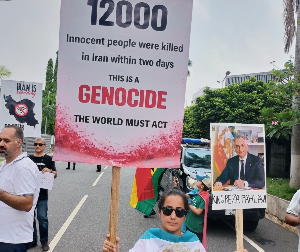 A lady holding placards reading; 12000 Innocent people were killed in Iran within two days