In response to the Ghana EPA's announcement of a styrofoam ban effective January 1, 2027.
The Environmental Protection Authority's announcement on May 25, 2026, that Ghana will ban the production, importation, distribution, sale, and use of polystyrene foam (styrofoam) products from January 1, 2027. The announcement has attracted lots of conversations from various critic point of view.
With our expertise in environmental intelligence and the enormous contribution to plastic policy development around the continent, we agree that the intention is correct and the urgency is real. But good intentions, in Africa's long experience with single-use plastic bans, have rarely been enough. And if Ghana's EPA is truly serious, not performatively serious about this ban, then it is time for a far harder conversation beyond a press statement.
The obvious is that plastic pollution, as we have documented extensively, contributes to what scientists describe as a triple planetary crisis: climate change, pollution, and biodiversity loss. Styrofoam, among many other “unnecessary single-use plastics, is one of the most visible contributors to Ghana's choking drains, polluted waterways, and plastic-strewn streets.
The African graveyard of well-intended bans
First off, Ghana is not the first to announce a “form” of plastic-related ban around the continent; hence, it is not introducing this policy into a vacuum. It is entering a landscape littered with the wreckage of failed or weakly enforced bans across the continent. Cote d'Ivoire, DR Congo, and Morocco, among others, have all enacted plastic restrictions that collapsed under the weight of inadequate enforcement and a lack of viable alternatives.
Youth organisations in Ghana itself have been advocating for a single-use plastics ban for years, yet as EAS's 2022 workshop findings noted, the authorities never publicly announced any strategic plans in response. The styrofoam announcement, then, arrives not as the culmination of a sustained national strategy but as a policy decree, and those two things are very different.
Countries like Kenya, Malawi, Zimbabwe, South Africa, and Uganda have developed plastic waste policies to varying degrees of enforcement success. The operative phrase there is varying degrees. Even Kenya, often cited as a regional leader, has experienced enormous implementation gaps. The announcement from Accra this week looks, in structure and tone, uncomfortably like the announcements made in those countries before enforcement quietly collapsed.
Pacesetter - what Rwanda got right
As part of our team at EAS's vision to develop a basic template for plastic policy development across Africa (owing to several failed than successful examples), we conducted a deep-dive case study on Rwanda's plastic bag ban, which offers an instructive counterpoint. Rwanda's success was not accidental, and it was
not primarily the result of a forceful government decree. It was the product of a painstaking, multi-year, multi-stakeholder process that began in 2003, thus, five years before the landmark Law No. 57/2008 was even adopted. Before Rwanda banned plastic bags, its Ministry of Environment assessed the country's plastic problem methodically, commissioned research, ran public awareness campaigns, implemented incremental restrictions (first on bags under 60 microns, then under 100 microns), and built a shared national understanding of why the ban was necessary.
Enforcement was ensured through strict border controls, penalties for factories and individual sellers alike, and active involvement of the Rwanda National Police, which was embedded into the policy architecture from day one, not bolted on afterwards.
Rwanda also made a foundational decision that is conspicuously absent from Ghana's announcement: it commissioned private companies to create alternatives before the ban came into force. Cotton and banana leaf bags were available to consumers because the government ensured they would be, not because the market was expected to sort itself out. When Ghana's EPA directs "manufacturers, importers and distributors to begin preparations immediately by adopting reusable, recyclable and eco-friendly packaging alternatives," it is issuing a request, not building a system.
The Rwanda story teaches that there is a world of difference between the two, and the gaps between our approach and theirs are very clear. We may be on the way to adding another policy to the list of “African Graveyard of Well-Intended Bans”.
The structural deficits that this announcement does not address
A close reading of the EPA's statement reveals what is missing as much as what is present.
No baseline data. The announcement does not reference any national data on the volume of styrofoam currently in circulation, the number of businesses dependent on it, or the market for alternatives. EAS's research has consistently highlighted the catastrophic data gap in African plastic policy. As our 2022 workshop concluded, there is no one-size-fits-all solution to plastic pollution, and robust data is fundamental to determining which solutions are feasible. Evidence-based data eliminates the financial waste that results from implementing policies that will not work. Ghana is, once again, announcing a policy before it has the data to design it properly - something I believe stakeholders with the Ghana National Plastic Action Partnership (Ghana NPAP) are very aware of.
No alternative supply infrastructure. The EPA notes that the ban will cover food packaging containers, takeaway packs, disposable cups and plates, foam packs used by restaurants and chop bars, precisely the products that millions of food vendors, market women, and small chop bars across Ghana rely on daily.
What will replace these products? Where will they come from? What will they cost? Who will subsidise the transition for low-income vendors who cannot absorb a price increase? These questions go entirely unanswered and are impossible to answer or realise by January 2027. The Rwanda lesson is stark here: even with a two-year transition period for manufacturers, it still was not enough time. Ghana is offering seven months.
No community-level strategy. The EPA says it will undertake "extensive nationwide stakeholder engagements." This is precisely the kind of language that sounds substantive and means very little without specificity. EAS's workshop findings were direct on this point: overcoming implementation hurdles requires buy-in at the local level, and awareness creation must involve youth, waste practitioners, local authorities, and activists in a meaningful, sustained way. It is not sufficient to hold a few consultations and issue a press release. Rwanda's Umuganda community engagement model, school environmental clubs, and neighbourhood-level enforcement committees were built over the years.
A broadcast media campaign is not a substitute. Our company was a lead consultant in developing Ghana's first PET recycling standard with the Ghana Standards Authority in 2024. After two years of making this standard public, how many stakeholders in the value chain know, understand, and work with it? The answer to this question explains how slow our system is. So, is the system ready for this?
No dedicated enforcement framework. The EPA states it will "collaborate with Metropolitan, Municipal and District Assemblies (MMDAs), port authorities, customs officials and industry regulators." This is encouraging in principle. But the history of inter-agency collaboration on environmental enforcement in Ghana does not inspire confidence.
Rwanda's success was anchored in having the Rwanda National Police, not just environmental officials, fully on board, monitoring, seizing, and confiscating banned materials. The institutional will to enforce had to be built deliberately. MMDAs across Ghana vary enormously in capacity, funding, and political will. Without a dedicated, funded, coordinated enforcement mechanism, the ban will be selectively applied at best and ignored at worst.
No acknowledgement of the informal sector. Ghana's food service economy is overwhelmingly informal. The chop bar operator who serves two hundred portions of rice a day in styrofoam containers is not an importer or a distributor. She is a micro-entrepreneur operating on margins that leave no room for premium-priced eco-friendly packaging. If this ban lands on her without alternatives she can afford and access, it does not reduce plastic pollution, it pushes the use of styrofoam underground, as happened with black market plastic bags in Rwanda and illegal imports elsewhere. The informal sector is not a footnote to Ghana's plastic problem; it is the heart of it.
The dangerous comfort of the announcement effect
A truth is that there is a particular political comfort in announcing a ban. It signals environmental seriousness, satisfies international partners and development funders,s and generates headlines. And critically, it shifts the burden: the government has spoken; if the ban fails, the fault lies with businesses and citizens who did not comply. This is precisely the dynamic that Eco Amet Solutions’ research warns against.
One panellist at the 2022 workshop noted that regulations across Africa are now "mostly externally driven," making them less responsive to domestic needs. There is a real risk that Ghana's styrofoam ban, announced just two days after the government celebrated World Environment Day, falls into this category; a policy shaped more by international optics than by a rigorous domestic feasibility assessment.
This is not a cynical reading. It is a pattern that the evidence demands we name. And it matters because a failed ban does not leave Ghana where it started. It leaves Ghana worse off with a black market for styrofoam, with businesses that invested in alternatives now competing against illegal operators who did not, and with a public that has learned, once again, that environmental policy announcements in Ghana should not be taken at face value. If this ban is to have any chance of success, Eco Amet Solutions calls on the EPA to urgently provide public answers to the following:
1. What is the current volume of styrofoam in Ghana's supply chain, and which sectors are most dependent on it?
2. What affordable alternatives are currently available at the scale required to replace styrofoam in the informal food sector, and what is their cost differential relative to current products?
3. What is the specific enforcement mechanism (including staffing, funding, jurisdiction, and penalties) that will govern compliance after January 1, 2027?
4. How will the EPA support low-income food vendors to transition without destroying their livelihoods or driving them toward illegal alternatives?
5. What is the strategy for border control, given that styrofoam products enter Ghana through multiple formal and informal channels from neighbouring countries?
6. How will community-level compliance be monitored and reported, and what role will MMDAs play in data collection?
7. What happens on February 1, 2027, if major markets in Accra, Kumasi, Takora, di and elsewhere are still operating with styrofoam? Is there a graduated enforcement plan, or will the first violation be treated the same as the hundredth?
Conclusion: This is not the moment to celebrate; it is the moment to work
Eco Amet Solutions’ position is unambiguous: the styrofoam ban is the right policy direction. Styrofoam is among the most environmentally harmful single-use materials in circulation in Ghana. Ending its use is a legitimate and necessary environmental goal. We are not arguing against the ban. We are arguing, forcefully, that an announcement is not a policy, and a deadline is not a plan.
The Rwanda story is instructive not because Rwanda is Ghana; it is not, in culture, political context, GDP, or governance structure. But because Rwanda demonstrates what deliberate, research-driven, adequately enforced environmental policy actually looks like. It took Rwanda five years of groundwork before its first major law.
It took another eleven years of iteration to reach the comprehensive 2019 single-use plastics legislation. And even Rwanda, with its strong political will, disciplined enforcement culture, and deeply engaged citizenry, acknowledges the sacrifices, the black markets, and the ongoing gaps.
Ghana has seven months, no public data framework, no alternative supply ecosystem, no dedicated enforcement mechanism, and a history of environmental policies that have quietly expired. That is the honest starting point. The EPA's announcement is a beginning. Whether it becomes a genuine turning point for Ghana's plastic pollution crisis, or another entry in the long register of well-intentioned African bans that the continent cannot afford, depends entirely on what happens in the coming months, not on what was said in a press release on May 25, 2026.
The work starts now, but the timeline is not realistic.
Africa Eco-Research Report (AFRICER) is a specialist environmental intelligence and advisory department at Eco Amet Solutions operating at the intersection of environmental governance, development finance, and circular economy transitions across Africa. Our mandate is to make Africa’s environmental challenges legible, investable, and actionable for governments, financial institutions, the private sector,r and civil society.
EAS’s work is grounded in rigorous evidence, frank analyses, and a deep understanding of the political economy of environmental governance across the continent. We do not simply describe problems; we structure the intelligence, financial modeling, ing and stakeholder convening needed to move from awareness to action.
Opinions of Tuesday, 2 June 2026
Columnist: David Ewusi-Mensah
Ghana's new styrofoam ban 2027: A critical look
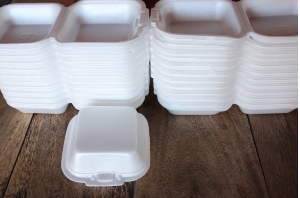 Photo of styrofoam







Opinions