Ghana’s evolving 24-Hour Economy agenda has renewed interest in how local governments can strengthen domestic revenue mobilization, particularly within the growing night-time business landscape, including informal evening food vendors.
To understand the opportunities and constraints within this emerging space, a study conducted between June and September 2025, by Cosmos Kwame Akorli, examined factors affecting revenue mobilisation from night-time food vendors.
Using structured questionnaires, interviews with officials from eight (8) Metropolitan, Municipal, and District Assemblies (MMDAs), and nighttime observations of 47 purposively sampled night-food vendors, the study identified key operational and institutional factors that affect local governments’ revenue mobilisation in the evening food sector.
The findings show that the night-time food economy represents a significant, but largely untapped source of internally-generated funds for local governments. Although 82% of the purposively observed vendors, particularly those selling noodles/indomie, kenkey, waakye, kebab, and banku, operate primarily in the evening and benefit from public services such as street lights, they are largely absent from MMDA revenue databases.
Most vendors begin operations around 5:00 p.m. and close between 10:00 p.m. and 11:00 p.m. Despite their substantial contributions to food security, youth employment, and urban livelihoods, these businesses remain predominantly informal and unregistered.
Officials from the sampled MMDAs mentioned multiple constraints to revenue mobilisation from food vendors that mainly operate in the evening. These include inadequate data on night time vendors, misalignment between MMDA operating hours and night-time economic activities, and high collection costs relative to expected returns.
Additional challenges include limited digitalization of revenue collection, inadequate enforcement capacity after dark, staff safety concerns, low motivation, and mistrust between vendors and state authorities.
The study recommends the need to strengthen revenue mobilisation through the creation of dedicated vendor databases, enhanced enforcement and safety measures, capacity-building for night-time revenue officers, improved engagement with vendors, and the adoption of technology-enabled tax collection systems aligned with Ghana’s 24-Hour Economic vision.
Opinions of Tuesday, 11 November 2025
Columnist: Cosmos Kwame Akorli
Ghana's 24-Hour Economy: Institutional and policy challenges facing local governments
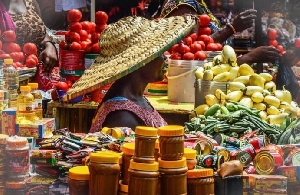 A file photo of a market woman






Entertainment