To say cocoa holds a place of pride in Ghana’s heart would be the understatement of the decade. Cocoa paid for our schools, our roads, our railways, and the foundations of the modern Ghanaian state.
Long before oil, long before gold exports expanded, cocoa was the backbone of our economy and the pride of our farmers.
That is why the now-predictable news that the Ghana Cocoa Board must once again rely on large, syndicated loans to buy cocoa should deeply worry every Ghanaian.
It is reported that COCOBOD has begun experimenting with alternative financing models, including requiring international buyers to provide upfront funding to support cocoa purchases, alongside some domestic and private financing mechanisms.
Although a step in the right direction, it is nowhere near enough.
Each year, Ghana borrows billions of dollars from foreign banks to purchase cocoa from its own farmers. We are told this is normal. We are told this is “how cocoa is financed.”
But when a country must borrow abroad every single year to buy the very crop that once built its economy, something is fundamentally wrong.
Let us be clear: this is not because cocoa is unimportant or unprofitable. Cocoa remains one of Ghana’s most significant sources of foreign exchange. The problem is not cocoa. The problem is how we have managed it.
Consider these figures. In 2024, Ghana earned approximately US$1.7 billion from cocoa, US$1.3 billion from oil (petroleum), and about US$11.1 billion from gold.
In 2025, cocoa earnings rose to about US$3.9 billion, while oil earnings fell to roughly US$769 million.
Now, remember oil and gold are nonrenewable natural resources. Cocoa is not, unless we continue to mismanage the sector, as we are doing now.
So, what exactly is this syndicated loan everyone keeps talking about?
A syndicated loan is a large loan provided by a group of banks, usually led by one or two international banks. Each bank contributes part of the funds, and the risk is shared among them.
For COCOBOD, this loan is used each season to pay cocoa farmers upfront, with repayment made later when cocoa is exported and sold, with interest.
The advantage is obvious: farmers are paid on time, and cocoa exports continue. But the costs are just as real. Syndicated loans come with interest, fees, and significant foreign-exchange risk. Currency fluctuations alone can dramatically increase the cost of repayment.
Syndicated loans may solve a short-term cash problem, but when used year after year, they signal weak financial management. Cocoa built Ghana. With discipline, transparency, and reform, cocoa should be able to finance itself without permanent dependence on foreign loans.
For decades, cocoa revenues have flowed through the state, yet very little has been saved, reinvested, or transformed into lasting strength.
Instead of building firm financial reserves, improving productivity, or adding value through processing and industrialization, we have relied on borrowing to keep the system running season after season.
The syndicated loan has become a crutch, keeping the sector alive while preventing meaningful reform.
These borrowings hide inefficiencies. They allow waste, bloated administrative structures, and weak planning to persist without consequence. It delays difficult political decisions. And it exposes Ghana to serious risks: rising global interest rates, currency pressures, and the possibility that lenders may one day say “no” or demand far harsher terms.
Worse still, these risks do not fall on politicians or technocrats. They fall on farmers due to unstable incomes. They fall on the nation through mounting debt pressure. And they fall on future generations who will inherit a cocoa sector that cannot stand on its own.
This is not just a COCOBOD problem. It is not just a government problem. It is a national failure to honor the legacy of the farmers whose sweat built this country. Previous generations used cocoa to build Ghana. Our generation has used cocoa to borrow.
There is nothing shameful about borrowing occasionally. What is disgraceful is borrowing every year, with no clear plan to stop. What is dangerous is treating this dependence as usual.
Cocoa built Ghana. If we continue on this path, cocoa will no longer build Ghana; it will merely keep us afloat, season by season, loan by loan, until the system finally breaks. That should alarm us all.
Some Long-Term Solutions
If we are serious, then long-term solutions are unavoidable.
First, establish a Cocoa Stabilization and Savings Fund. A fixed portion of cocoa revenue in good years should be saved to reduce future borrowing.
Second, reduce administrative and operating costs. COCOBOD must streamline its structure and retain more value within the system. We cannot continue to justify excesses; cut down on the endless Land Cruisers and so-called 4x4s.
Third, focus on productivity, not just acreage. Invest consistently in yields, disease control, and farmer support.
Build a credible research ecosystem around cocoa. How many universities are actively researching cocoa? How much sustained financing goes into the Cocoa Research Institute?
Fourth, expand local processing and value addition. We have been talking about this for over 50 years. Yet what percentage of cocoa is processed in Ghana today? Exporting semi-finished or finished cocoa products earns far more per ton than exporting raw beans.
Fifth, gradually replace dollar-denominated borrowing with local financing. Domestic bonds, pension funds, and cedi-based instruments can reduce currency risk and keep more value within the economy.
Finally, adopt a clear exit plan from annual borrowing. Even a 10- to 15-year transition plan would signal seriousness, discipline, and respect for the future. If this has to be done through parliamentary legislation, so be it.
I hope my generation will live to see a Ghana run with the level of competence and stewardship that this country truly deserves.
Opinions of Saturday, 7 February 2026
Columnist: Henry Adobor
Ghana Cocoa Board, syndicated loans, and our collective failure as a nation
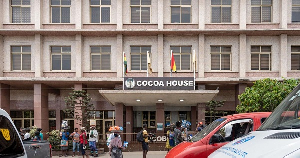 Headquarters of the Ghana COCOBO