The comment made by His Excellency John Dramani Mahama in August this year, while attending a conference in Singapore, has ignited widespread debate on whether he should seek another term in office.
In just eight months of assuming the reins of leadership, Ghana has witnessed a remarkable turnaround across all sectors, with its RESET Agenda gaining both traction and popular acceptance.
Notably, the once alarming appetite for graft within state institutions has
declined, and Ghanaians have become increasingly vigilant and interested in the conduct of public officials.
Before the 7th of January, 2025, Ghana was beset with corruption, misgovernance, and the abuse of power.
The nation was polarised, fragmented, and directionless, its people groping in uncertainty.
But when hope seemed lost, divine providence smiled upon Ghana and gave us President John Mahama once again.
To many, his second coming represents a providential intervention, God’s mechanism of rescue for a struggling nation, much like Moses leading the Israelites from bondage in Egypt.
The 1992 Constitution of Ghana provides for a two-term limit for the presidency.
The President’s statement in Singapore aligns perfectly with this constitutional provision, affirming his respect for the rule of law and his commitment to democratic norms.
Yet, the question persists: must a nation deny itself the continued service of a transformational leader simply because of a man-made limitation?
Great leaders, it is said, leave the stage while the applause is loudest.
However, one might argue that it is equally unwise, even cowardly, to exit when one’s performance still resonates deeply with the needs and aspirations of the people.
The claims of others
The constitutional provision limiting presidents to two terms is often cited by those focused solely on electoral cycles rather than national progress.
But the Constitution, though revered, is a human creation, a living document meant to guide governance, not hinder growth.
As Justice Sowah famously noted in Tuffuor v Attorney-General, “the Constitution is a living organism capable of growth.”
Ours is a hybrid constitution, both rigid and flexible, crafted with foresight that allows for amendment where necessary.
Except for specific entrenched clauses, most provisions can be altered through due constitutional processes.
Hence, if the national interest so demands, an amendment permitting an additional term for President Mahama could be pursued legitimately and democratically.
An abuse of power?
Some may argue that extending a president’s tenure constitutes an abuse of power.
Indeed, across Africa, constitutional amendments have often been misused by leaders to entrench themselves in office, frequently resulting in instability and conflict.
However, Ghana’s case is fundamentally different.
President John Mahama stands as a model of democratic leadership, respected for his commitment to human rights, freedom of expression, the rule of law, and institutional integrity.
Under his stewardship, Ghana has remained a beacon of democracy in Africa.
Granting him an extended term would not be an act of tyranny, but a continuation of tested, visionary leadership.
His record, past and present, speaks of peace, humility, and progress.
As the late President Jerry John Rawlings once remarked at the University for Development Studies, “John Mahama is a President for the future.”
Indeed, his leadership transcends partisan boundaries, and his vision serves posterity rather than politics.
A clarion call
The discussion surrounding an extension of President Mahama’s tenure should not be clouded by political bias or personal ambition.
It should be guided by the higher purpose of national renewal and sustained development.
Ghana’s destiny should not be curtailed by rigid constitutional dogma when the opportunity exists to refine our laws for the greater good.
To President John Dramani Mahama, a third term would not symbolise an abuse of power; it would represent an act of benevolence and continuity.
It would provide Ghana the chance to solidify institutional reforms, deepen democratic resilience, and expand socio-economic growth.
More importantly, it would allow for the strengthening of Ghana’s bilateral relations, particularly within ECOWAS, and the promotion of unity and stability across the subregion.
Conclusion
Ghana today stands at a crossroads, between tradition and transformation, between constitutional rigidity and visionary adaptation.
In President John Mahama, we find a leader whose proven integrity, humility, and foresight offer hope for a prosperous future. History will remember those who dared to rethink conventions for the sake of progress.
It is, therefore, not merely a question of extending a presidential term; it is a question of securing Ghana’s destiny.
Opinions of Monday, 20 October 2025
Columnist: Samuel Mahama
From the Wilderness to Promise: President Mahama's second exodus
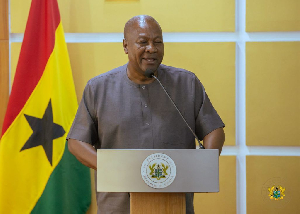 President John Dramani Mahama



Entertainment