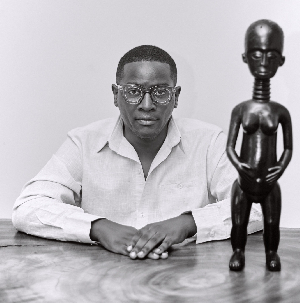
V. L. K. Djokoto, as he’s referred to within the dim-lit corridors of conservative Ghanaian power — or Letsa, as he’s more informally known, especially in shrine-like handicraft streetside galleries, where he regularly collects tribal art — has always been a silent disruptor.
An experimental cultural theorist, V. L. K. Djokoto, was born in 1995, and hails from Anyako, a lagoon-island in Ghana’s Volta Region. He strikes an unassuming figure: Fairly tall, introverted, bespectacled — indistinguishable, perhaps, from the average Ghanaian worker you might see in a trotro. But beneath Djokoto’s reserved exterior lay a lucid intellect and fierce artistry. Remaining as calm as a river, he flows and executes with acute finesse.
Djokoto graduated from Swansea University with a degree in law, but found a career as a columnist for Enjoy — after brief working spells with the Ghana Armed Forces and Judicial Service of Ghana — executing public relations gigs for multinational clients such as Hero MotoCorp Limited, and local clients such as the Ghana Investment Promotion Centre.
Since his late teens, Djokoto has loved African sculptures — of which he is now a prolific collector — chess, highlife, and the works of revolutionary icon Kwame Nkrumah. Now a decades-old tradition, his residence — the Ka xoxowo Salon — is a live-in gallery which brings diverse personalities together in a liberal environment. Often indulging in exquisite wines and sumptuous meals — this is where soothing music is made, scripts are conceptualized, and indigenous African art analysed.
Between 2018-2021 were a period of rapid evolution in Djokoto’s journalism career. Inspired by Senegalese Poet-President, Léopold Sédar Senghor, he developed a unique writing style and, in the months, and years that followed, fired out a myriad of archive-worthy articles across a variety of newspapers and online portals. His tireless work found its way into the hands of influential figures such as the late Jerry John Rawlings. Djokoto offers an uncensored account of his encounter with Rawlings in his highly anticipated debut book, Revolution, which comes out later this year.
On Djokoto’s return from London, after a year-long training as a solicitor at the City Law School, University of London, he became a regular panellist on Class FM, advancing eloquent arguments on the radio station’s morning show. This period intensified his work rate. He simultaneously produced another current affairs program on Class FM — and a television program, Good Evening Ghana, where he also doubled as a court reporter, working with Metropolitan Entertainment Television.
For Djokoto, ‘Pan-Africanism is not an extension of politics but rather an extension of life.’ He points to I Speak of Freedom, a book by Kwame Nkrumah, which he says had a big influence on him. A work of Pan-African reality, it highlighted the struggles and triumphs of the Ghanaian. But regardless of the deep well of knowledge he draws inspiration from, there’s an element in Djokoto’s practice that’s pioneering. His approach as a cultural theorist — exploring the human relationship with literature, music and art — isn’t in response to the currents of the times, but rather an extension of a consistent aesthetic within.
The year 2020 was a turning point. That year, Djokoto hosted sitting Vice-President, Professor Opoku-Agyemang, in her debut forum, after her historic nomination as Vice-Presidential candidate. He went on to work as a public relations specialist on the 2020 campaign. In an interview about Nkrumah’s Secret Society on Xpressive, GHOne TV the same year, Djokoto exhibited his firm grasp of Pan-African history with a deep dive into the subject. He later found his feet as a publisher, producing the Pop Statesman, illustrated by Prince Ampofo Bonsu, and managing the Accra Evening News — media startups he established a few years prior.
After the 2020 campaign, he took up full-time leadership of his family office, D. K. T. Djokoto & Co — exiting an exciting career in political journalism — and has since been at the helm of the family office’s affairs.
Soon after V. L. K. Djokoto assumed responsibility, it quickly became clear that D. K. T. Djokoto & Co’s remit would stretch far beyond real estate and rural development.
A result of his vision for a vibrant arts and culture department of his firm, Djokoto forged a professional relationship with Alfred Osom — a Jamestown-based art director who specialises in music and fashion — who co-executive produced D. K. T. Djokoto & Co’s debut record Coastal Therapy. Produced by Albert Kofi Dankwa and Tepeh Bismark Kwesi, the family office has unveiled a dreamy, meditative melody. Deep, soothing, and wistful Coastal Therapy is a 4-minute record of pulsating highlife, jazz and reggae bliss.
Djokoto believes in the old approach of executives like Dick Essilfie-Bondzie, opting for records rooted in Ebo Taylor inspired highlife and Tony Allen inspired Afrobeat — while defying genres and pushing new boundaries through electronic dance music.
‘Taking a down-to-earth approach to executive production, I’m philosophically oriented towards an equilibrium of futuristic alternative melodies and the age-old fundamentals of African music. And I look forward to working with avant-garde creatives, steadily developing our palette of music, on our ascent to the high plateau of creative genius. The long-term idea is to executive produce music that sounds like nothing else, immortalized by limited edition vinyl’s’ Djokoto said.
His debut EP Counting the Drums — offering a glimpse into a private universe, will introduce into Ghana’s landscape, paradigm-shifting records which bear no resemblance to each other — or, indeed, pretty much anything else out there at the moment.
Opinions of Thursday, 14 August 2025
Columnist: Authored by Lee Gyamfi.