Introduction
The Constitution occupies a unique and exalted place within Ghana’s legal and political order. It is sui generis among laws and the fundamental law from which the validity of all other enactments, actions, and omissions derives.
Beyond its binding legal force, the Constitution embodies the collective will, history, and aspirations of the Ghanaian people. As the Supreme Court aptly observed in Tuffour v Attorney-General [1980] GLR 637, a Constitution mirrors the people’s history and contains within it their hopes for “a better and fuller life.”
It was in recognition of this profound significance that Constitution Day was introduced into Ghana’s calendar of public holidays. Yet, several years after its introduction, a persistent question remains: what is the relevance of Constitution Day to the ordinary Ghanaian?
This article revisits that question and argues that Constitution Day must be transformed from a symbolic holiday into a meaningful national civic exercise.
The Rationale for the Constitution Day
The introduction of Constitution Day was not accidental. It was informed by Ghana’s remarkable constitutional journey under the 1992 Constitution, which ushered in the Fourth Republic on 7th January 1993.
This constitutional order has produced the longest uninterrupted period of democratic governance in Ghana’s history.
Under the Fourth Republic, Ghana has conducted multiple successful presidential and parliamentary elections and witnessed peaceful transfers of power between the country’s major political parties, the National Democratic Congress (NDC) and the New Patriotic Party (NPP).
This achievement has earned Ghana both domestic pride and international recognition as a stable constitutional democracy and an oasis of peace on the African continent.
The Constitution Day, therefore, goes to the very core of Ghana’s existence as a sovereign democratic state. It celebrates not merely a document, but a constitutional culture, one that values the rule of law, democratic accountability, and peaceful political competition.
A Constitution beyond Lawyers and the Courts
Despite its importance, the Constitution remains largely inaccessible to many Ghanaians. Outside legal professionals, public officers, and a limited segment of civil society, the Constitution is often perceived as a distant, technical, or abstract legal document.
This disconnect undermines constitutionalism itself, because a constitution that is not understood by the people cannot be effectively defended by them.
The Constitution Day must therefore serve as a deliberate opportunity to bridge this gap. It should be a day for national civic reflection, education, and dialogue. Citizens must understand not only their rights, but also their duties; not only the powers of government, but also the limits imposed by the Constitution.
Constitutional Review and Living Constitutionalism
Ghana’s commitment to constitutional development was further demonstrated through the establishment of the recent Constitution Review Commission (CRC) led by Professor Henry Kwasi Prempeh.
The CRC undertook nationwide consultations and examined the operation of the 1992 Constitution after years of practice. Its recommendations were far-reaching, touching mainly on proposals for the reframing of Ghana’s governance architecture.
Notably, the CRC proposed, among other reforms, an increase in the presidential term from four to five years and the abolition of the hybrid system under which Members of Parliament are appointed as Ministers of State, with a view to strengthening the separation of powers.
The submission and publication of the CRC report reinforced an important constitutional truth: the Constitution is not static; it is a living instrument capable of reform through democratic engagement. It is commendable that the current review process has been completed within the first year of the new Administration.
The recommendations of the CRC have received mixed reactions. This requires a careful consideration of all the recommendations possibly by the president before the White Paper is issued to that effect.
The Constitution Day should therefore also remind Ghanaians that constitutionalism is an ongoing project, not a completed task.
Making the Constitution Day more meaningful
For Constitution Day to achieve its full purpose, it must be deliberately used as a platform for constitutional education. The framers of the 1992 Constitution anticipated this need by establishing the National Commission for Civic Education (NCCE). While the Commission has a crucial mandate, its impact has been constrained, in part, by limited resources.
There is a compelling case for positioning the NCCE at the centre of Constitution Day activities, supported by adequate funding and institutional collaboration.
Community-based education, school outreach programmes, public forums, media discussions, and simplified constitutional materials should all form part of the annual celebration.
In addition, sustained constitutional education should be integrated into second-cycle institutions through structured curricula, inter-school quizzes, and the distribution of simplified or miniature versions of the Constitution. People who understand their Constitution are more likely to protect it.
The Constitution Day under the new holiday policy
This year, the Constitution Day falls midweek but has been moved to Friday under the new public holiday policy. While the shift is administrative, it presents an opportunity rather than a limitation. A Friday observance offers greater public engagement and visibility. What matters, however, is not the day on which the holiday falls, but how it is observed.
Without intentional programming and public education, the Constitution Day risks becoming just another break from work. With deliberate effort, it can become a treasure of Ghana’s democratic culture.
Conclusion
Constitution Day remains the most important public holiday in Ghana because it celebrates the foundation of the nation’s democratic life. It commemorates political stability, constitutional continuity, and the supremacy of the will of the people expressed through law.
To celebrate the Constitution is to celebrate Ghana itself. That celebration must go beyond symbolism to substance, beyond rest to reflection, and beyond ritual to renewal.
A meaningful Constitution Day deepens constitutional literacy, strengthens democratic commitment, and reminds every Ghanaian that the Constitution belongs not to lawyers or politicians, but to the people.
Opinions of Monday, 5 January 2026
Columnist: Benjamin Tachie Antiedu
Constitution day in Ghana: Relevance, Reflection, and Renewal
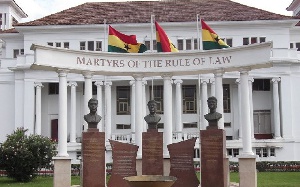 The Supreme Court of Ghana