China is a country at the forefront of technological innovation and modern development. Having witnessed its remarkable progress during my previous visit, I was confident that this trip would be even more impressive and memorable.
As our plane approached Shanghai International Airport, I gazed through the window in awe at the breathtaking skyline that unfolded before my eyes.
The magnificent architectural designs, towering skyscrapers, spectacular bridges, and well-developed expressways painted a vivid picture of a nation driven by innovation, vision, and progress.
Even before we landed, the remarkable scenery offered a glimpse of China's extraordinary transformation and left me filled with excitement and admiration for what lay ahead.
At the arrival hall, I was once again impressed by the level of technological advancement. Almost everything had been digitised, with arrival formalities processed electronically, making the entire process faster, more convenient, and more efficient. Within a remarkably short time, I had completed the necessary procedures and was on my way out.
As we drove through the streets of Shanghai, the magnificent scenery I had admired from the skies came vividly into view, confirming my first impressions of the city.
From the well-organised road networks and impressive architectural designs to the clean, serene, and carefully maintained surroundings, everything seemed thoughtfully planned and executed.
The experience reinforced my belief that meaningful development goes beyond constructing magnificent buildings and modern infrastructure; it is about creating an environment that serves the people, improves their quality of life, and makes their daily activities more convenient, comfortable, and efficient.
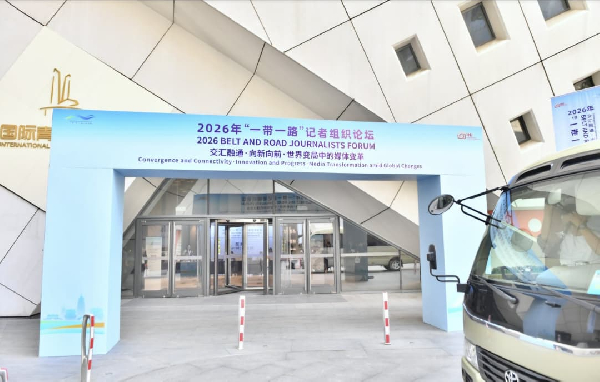
However, the following day, my group boarded a high-speed train, another impressive example of advanced technology that offered a very comfortable ride. Within an hour and a half, we arrived in Nanjing, a beautiful city by all standards and the venue for the conference is the International Youth Convention Hotel Nanjing, Jiangsu Province, China
Furthermore, the welcome reception and guest registration were exceptionally well organized, creating a warm and welcoming atmosphere.
I had the pleasure of reconnecting with friends from the Belt and Road Journalists Forum, including Chuanjun Wang, Gao Xuan, and Zhong Yan. We exchanged pleasantries, engaged in warm conversations, and fondly reminisced about memories from previous encounters.
I also had the opportunity to meet Jingyan Wang for the first time, a student at Nanjing University majoring in Korean Language and Literature. She was among the volunteers who assisted me during the event. Her warmth and willingness to help added to the welcoming experience and made the occasion even more memorable.
Later that evening, while on the bus, I met Professor
Zheng Changzhong, who had previously briefed my group on China’s development model and its strong connection to the country’s rich traditional heritage. He shared valuable insights into the remarkable developments taking place in China, deepening our appreciation of the country’s progress and cultural identity.
The bus tour took us around the beautiful city of Nanjing, where we admired its impressive architecture, magnificent buildings, and well-planned urban layout.
We also enjoyed a ferry ride along the historic Qinhuai River, which offered us an opportunity to learn more about its rich history and cultural significance.
It was truly a memorable experience. To make the evening even more special, I had the opportunity to interact with some local Chinese citizens, making the visit not only educational but also culturally enriching and delightful.
Clarify my personal interactions
Nanjing South Railway station is a magnificent architectural edifice with precision engineering design and very big. We were there to join the train to Suzhou for another wonderful experience.
However, upon our arrival in Suzhou, we were warmly welcomed by our hosts with gifts.
Suzhou is a major central city in eastern China, located in the Yangtze River Delta, one of the country’s most economically dynamic regions. Covering a total area of 8,657.32 square kilometres and home to a population of over 16 million, Suzhou has long enjoyed the reputation of being a beautiful water town and a “paradise on earth.”
We were told in 2025, Suzhou recorded a regional GDP of approximately US$387.7 billion, ranking sixth among cities in mainland China and 20th globally. The city also boasts a strong industrial and commercial base, ranking second in mainland China in terms of the number of industrial enterprises above the designated size and fourth in import and export volume.
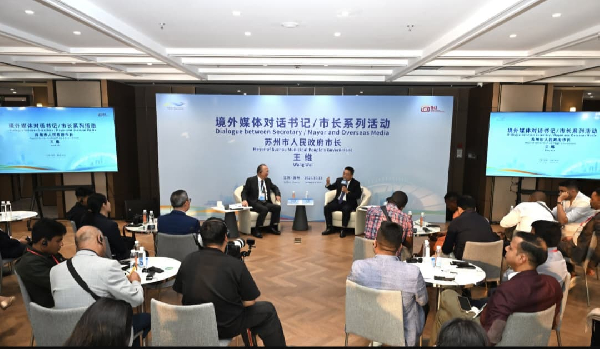
As part of the tour, my group (Group 2) had the opportunity to interact with Wang Wei, Mayor of the Suzhou Municipal People’s Government. During the engagement, he shared six key indicators that define Suzhou’s development and identity: Innovation, Smart Manufacturing, Openness, Culture, Beauty, and Good Fortune.
He emphasized that innovation serves as a key driver of development. Suzhou invests more than RMB 100 billion annually in R&D, with R&D expenditure exceeding 4.2% of GDP, surpassing the average of developed economies.
The city is home to several high-level innovation platforms, including the Suzhou National Laboratory, and has established partnerships with more than 260 leading universities and research institutes.
Enterprises play a central role in the innovation ecosystem, accounting for 90% of the city’s R&D investment, science and technology platforms, high-level innovative and entrepreneurial talent, and high-value invention patents.
Furthermore, the Shanghai–Suzhou innovation cluster ranks sixth globally in the World Intellectual Property Organization’s rankings, underscoring the region’s growing global competitiveness in innovation.
Smart Manufacturing. Suzhou is home to nine Global Lighthouse Factories and approximately 160,000 industrial enterprises.
Its industrial output value from enterprises above the designated size exceeds RMB 4.9 trillion, ranking second among Chinese cities.
The city has developed three industries each valued at over RMB 1 trillion—electronic information, equipment manufacturing, and new materials—as well as 11 industries with an output value exceeding RMB 100 billion each.
With its extensive industrial base and well-developed manufacturing ecosystem, Suzhou has emerged as a key hub connecting and anchoring industrial supply chains across China and around the world.
Culture. With a history of more than 2,500 years, Suzhou’s ancient city is a living testament to China’s rich cultural heritage.
The city boasts two UNESCO World Cultural Heritage sites and eight elements of UNESCO Intangible Cultural Heritage. It is also the world’s first “World Heritage Model City” and has been recognized by UNESCO as a “City of Crafts and Folk Art.”
Beauty. Bordered by the Yangtze River to the north and home to Taihu Lake, China’s third-largest freshwater lake, Suzhou is blessed with an exceptional natural landscape.
More than 20,000 rivers and waterways weave through the city, creating a picturesque setting where blue skies, clear waters, birdsong, and fragrant blossoms are part of everyday life.
Good Fortune. Suzhou’s prosperity is reflected in both its economic strength and quality of life.
Its per capita GDP is nearly USD 30,000, comparable to that of a moderately developed economy, while its average life expectancy exceeds 85 years.
For 15 consecutive years, Suzhou has also been named one of “the Most Attractive Chinese Cities in the Eyes of Foreign Talent,” underscoring its appeal as a place to live, work, and thrive.
Professor Zheng Changzhong, who also served as our tour guide during my previous visit, accompanied my current group and explained how Suzhou’s development formula reflects the broader vision of Chinese modernization.
One question frequently raised by journalists from around the world is: What has enabled Suzhou to achieve such remarkable development?
In his view, the answer lies in the systematic integration of different dimensions of progress. Rather than pursuing development in isolated areas, Suzhou has adopted a coordinated approach in which multiple sectors advance together.
Innovation drives industrial upgrading, intelligent manufacturing strengthens the real economy, openness connects the city with global resources, culture enriches its identity, ecological beauty safeguards its natural environment, and public well-being becomes an integral part of everyday life. Ultimately, all these efforts serve one overarching goal: enabling ordinary people to live happier, more fulfilling lives.
China has long cherished the saying, “Above there is Heaven; below, there are Suzhou and Hangzhou.”
Even today, Suzhou’s quality of life continues to reflect the enduring appeal of this ancient adage. The concept of xingfu—encompassing happiness, good fortune, and overall well-being—captures the fundamental aspiration that China’s approach to governance has consistently sought to fulfil.
The six keywords presented by Mayor Wang offer a practical illustration of how a city can enhance people’s happiness while developing new quality productive forces.
At its core, Suzhou’s development formula embodies the broader vision of Chinese modernization, translating this vision into tangible progress through the city’s distinctive strengths, coordinated development strategies, and concrete actions that improve people’s lives.
African countries need to study and adapt some of China’s development models to their own contexts as a pathway to lifting the continent out of poverty, accelerating industrialization, and achieving greater economic independence in ways that directly benefit their people.
China’s development journey offers valuable lessons in industrial transformation, technological innovation, infrastructure development, and poverty alleviation.
These experiences provide practical examples of how strategic planning and sustained investment can drive economic growth and improve livelihoods.
The opportunity provided by the Belt and Road Journalists Forum to visit and witness firsthand the ongoing industrial transformation in China is therefore commendable.
Such exposure broadens our understanding of China’s development experience and equips journalists to share meaningful stories of progress, cooperation, and innovation across the Global South.
More importantly, it creates an opportunity to highlight how countries of the Global South can learn from one another, strengthen partnerships, and pursue development pathways that promote shared prosperity and a better future for their people.
Opinions of Friday, 23 October 2026
Columnist: Fiifi Nartey
China’s fresh perspectives on global governance
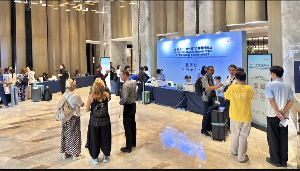 Some of the stakeholders at the event









Opinions