There are professionals who optimise systems and then there are those who redefine what those systems make possible.
Selasi Kofi Ahorlumegah belongs firmly in the latter category.
Recognised as a Charles F. Knight Scholar at Washington University in St. Louis Olin Business School and inducted into Beta Gamma Sigma, Ahorlumegah represents a rare combination of academic distinction, global experience, and purpose-driven leadership. Yet the true significance of his work is best understood not through accolades alone, but through the systems he has spent his career quietly transforming across continents.
There is, however, a deeper layer to that work, one shaped long before boardrooms and global operations.
As a child, Selasi fled civil unrest in Togo with his family, forced to rebuild their lives in neighbouring Ghana after a sudden and dangerous displacement. In the years that followed, access, to stability, education, and opportunity, was never guaranteed. It was sustained, in part, by the generosity of others. That early exposure to fragility and resilience would later inform a defining perspective: well-functioning systems are not conveniences, they are lifelines.
It is a perspective that has consistently shaped his career.
Across Africa and the Middle East, Selasi Ahorlumegah built his professional foundation in telecommunications, working on large-scale infrastructure that underpins modern economies. At organisations such as MTN Group and Huawei Technologies, his work extended beyond technical optimisation to enabling broader access, ensuring that networks remained reliable in environments where stability could not be assumed.
In the United Arab Emirates, he played a key role in delivering advanced performance management systems at scale, contributing to high-integrity data environments and successful adoption across multiple global operations. His work bridged geographies and standards, reinforcing a capability that would come to define his trajectory: the ability to operate effectively across complex, multi-national systems while aligning technical execution with strategic outcomes.
Yet even as his impact expanded, so too did his sense that infrastructure could serve an even more fundamental purpose.
That realisation was deeply personal.
After losing a close friend’s mother to breast cancer, Selasi found himself confronting a different kind of system failure, one not of connectivity, but of care. He recalls wishing, in that moment, for “a magic wand” to make the pain disappear. It was a simple thought, but one that lingered. What began as a quiet reflection would later evolve into a clearer sense of direction.
By what he describes as serendipity, but perhaps more accurately as convergence, Selasi Kofi Ahorlumegah transitioned into the biotechnology sector.
Now working within global manufacturing strategy at Amgen, his focus has shifted from enabling connection to enabling care. The systems he helps shape today are responsible for producing life-saving therapies, where operational performance directly influences patient access.
In his current role, Ahorlumegah has contributed to initiatives driving over $200 million in cost savings, while improving efficiency and resilience across global manufacturing networks. But as with his earlier work, the importance lies not in scale alone, it lies in the outcome: stronger supply chains, more reliable production, and ultimately, broader access to essential medicines.
What distinguishes Selasi Kofi Ahorlumegah is not simply his ability to move across industries, but the consistency of his purpose within them.
At Washington University in St. Louis Olin Business School, this perspective extended beyond academic achievement. As President of the Olin Africa Business Club, he led initiatives that elevated dialogue around Africa’s role in the global economy, bringing together voices across business, healthcare, and technology to challenge outdated narratives and spotlight emerging opportunities.
His leadership reflected the same principle evident throughout his career: that systems, when thoughtfully designed, can expand participation on a much larger scale.
This throughline, across continents, industries, and lived experience, is what makes his work particularly relevant in today’s global context.
As industries increasingly confront the need for resilient infrastructure, efficient supply chains, and equitable access to critical resources, professionals who can bridge technical depth with strategic vision are essential. Selasi Kofi Ahorlumegah’s career reflects not only that capability, but a sustained commitment to applying it where it matters most.
Whether strengthening telecommunications networks in emerging markets or optimising manufacturing systems that deliver life-saving therapies, his work has consistently centered on one idea: the true power of any system lies in its ability to serve people, reliably, efficiently, and at scale.
In an era where impact is often equated with visibility, Kofi Ahorlumegah’s work offers a quieter, more enduring model, one embedded in the systems that shape everyday life.
And in that quiet scale of impact, his work stands out.
Opinions of Monday, 30 March 2026
Columnist: Franklin Humprey
Building systems that matter: The quiet scale of Selasi Kofi Ahorlumegah's impact
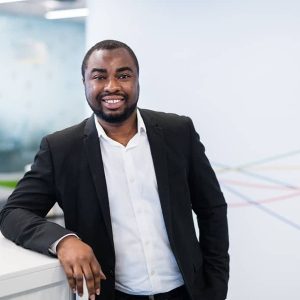 Selasi Kofi Ahorlumegah is a Charles F. Knight Scholar at Washington University (St. Louis)