I have hesitated several times to weigh in on the ongoing debate surrounding the allowance of Muslims to practice their faith freely in Christian mission schools. As someone who has lived on both sides, I am compelled to speak up in support of fairness for all.
I fully support Muslims being allowed to observe their religious practices in Christian mission schools. Religious freedom is a cornerstone of our democracy, and no one should be forced to hide their faith in an educational setting.
That said, as we insist on fairness in Christian-dominated spaces, I believe we should also be honest about what happens in Muslim-dominated schools and communities across the country.
Some of us attended schools that favored polarized faith-based environments. While the schools themselves were officially nonreligious, the lived experience did not always reflect neutrality. Unfortunately, we had to bend to the majority’s practices sometimes.
During the holidays, we would wait for our Muslim colleagues to finish prayers at the mosque before lunch could be served—even when it clashed with the school’s timetable or even when this clearly disrupted the structure of the school day.
At times, the non-Muslim students would be told to wait in the dining hall for the Muslim students to join.
As the dining hall Prefect then, I was compelled to ‘grace the hall’ while our Muslim colleagues were away at midday prayers. Hindsight is 20/20! Therefore, having had the benefit of hindsight today, I guess I could have provided another alternative, but hey, I was nearly stoned for not facilitating a polarized religious culture at a non-religious school.
It took the intervention of my Muslim friends and the Master on duty, a Muslim, to come to my defense and insist that the school wasn’t religious.
I vividly remember a teacher standing at Monday morning assembly, warning Scripture Union (SU) members that if he caught us praying under a particular mango tree, he would “suspend our Jesus” and make us sweep the area instead. As executives of SU, we were pained, but we exercised restraint and allowed God to do His own thing.
Yet, here’s the beautiful part: Not all experiences were negative. My Muslim friends were incredibly supportive—they defended us. I was seen more with my Wala, Sissala, and Dagaara friends.
The few honest friends that I have till today are Muslims. I still count many of them as close friends today, and our relationships transcend religion. That is the Ghanaian spirit we should champion!
The irony stings when some of those who benefited from such accommodations (or even enforced them) now write lengthy posts demanding rights in Christian mission schools without acknowledging the need for reciprocity. We should not turn this into a one-way street.
If we are advocating for Muslims to pray freely in Christian mission schools, we must ensure that Christians in Muslim-majority spaces can do the same without threats, suspensions, or forced delays.
Regarding Bongo Ideas’ recent post and those who believe that a Muslim presidency would somehow “Islamize” Ghana, we should pause and look more closely at our own history.
That fear does not match the lived reality of Ghanaian Islam. First, Ghanaian Muslims have, for decades, resisted attempts at radicalization from external groups and countries.
Their religious identity is deeply shaped by local traditions, historical encounters, and centuries of coexistence with other faiths, not by foreign ideological imports.
Secondly, long before widespread Christian influence, the major kingdoms in Ghana, Dagoma, Mamprugu, Wala, Asante, Domaa, and Akwamu had already developed enduring relationships with Islam.
I dare say there is no kingdom in Ghana whose cultural practices are not influenced by Islam, yet they remain largely African Traditional Religion (ATR) and Christianized. This early contact produced a uniquely Ghanaian form of Muslim identity—one that blends religious practice with indigenous customs.
Among the Dagomba, Mamprusi, Wala, or Gonja, for instance, ethnic identity and belonging run deeper than religious divides.
This is precisely why tensions sometimes arise between indigenous Ghanaian Muslims and more recent Muslim migrant communities.
They do not share the same historical trajectory or cultural grounding. History offers a clear example: have we ever asked why the Muslim Association Party (MAP) in the 1950s received little to no support from Tamale and other Muslim-majority areas in the then Northern Region, yet gained traction in parts of Ashanti?
The answer was straightforward—many Dagomba and other northern Muslims perceived the party’s leadership as “strangers,” and a southern import with no roots in their communities. Their loyalty was to their ethnic heritage first, not to an externally driven religious agenda.
Anyone who has lived in Tamale will recognize the visible distinctions between the minority Hausa Muslim communities and the indigenous Dagomba Muslims. Their practices, leadership structures, and social identities differ in clear, meaningful ways.
True religious harmony isn’t about “winning” for one side: it’s about mutual respect. Ghana has thrived on this for decades. Let’s commit and endeavor to treat each other as we would want to be treated - fairly, kindly, and without double standards.
My Muslim brothers and sisters, I stand with you for your rights, but I urge us all to extend that same grace to everyone.
Opinions of Sunday, 30 November 2025
Columnist: Emmanuel John A. Awine
Beyond the Mango Tree: Why Ghana won't be Islamised
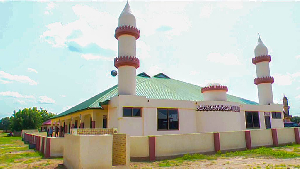 Religious freedom is a cornerstone of Ghana's democracy