At the 80th United Nations General Assembly (UNGA80), Ghana’s Minister of State for Climate Change and Sustainability, Hon Seidu Issifu, stood before world leaders at the Climate Vulnerable Forum (CVF) Leaders’ Meeting with a powerful message: climate accountability must move from rhetoric to remedy.
His words, delivered on behalf of the President of Ghana, now extend beyond the halls of New York to chart a pathway for vulnerable nations.
Ghana’s Vision at UNGA80
Speaking under the theme “A New Era of Climate Accountability: Adaptation Package, Debt Solutions, and Health Resilience for Vulnerable Nations,” Hon Issifu outlined a bold framework for collective action:
• Adaptation must be prioritized through scaled-up finance, community-driven resilience, and technology partnerships.
• Debt justice is non-negotiable, with Ghana calling for an institutionalized Climate Debt Forgiveness Mechanism to redirect resources from repayment toward climate action.
• Health resilience must be integrated into adaptation, with urgent investments in climate-resilient health systems and disease surveillance.
With this vision, Ghana has placed vulnerable countries at the center of global climate governance, shifting the narrative from dependency to leadership.
Beyond New York: Turning Inspiration into Action
While UNGA80 provided the platform, the greater challenge lies in how climate vulnerable nations leverage this momentum. Hon Issifu’s statement offers a blueprint that can be advanced in several ways:
1. Institutionalizing Climate Accountability – CVF members can adopt Ghana’s model of embedding climate and sustainability units across all ministries and agencies, ensuring that adaptation is mainstreamed into governance.
2. Building Regional Alliances – African, Caribbean, and Pacific states can unite behind the call for debt-for-climate swaps and concessional financing, strengthening their collective bargaining power with creditors and international institutions.
3. Driving South–South Leadership – By investing in shared research hubs, technology transfer, and community-led adaptation programs, climate vulnerable countries can show that leadership is not limited to the global north.
4. Linking Climate and Health Agendas – Hon. Issifu’s emphasis on health resilience should inspire nations to frame climate action not just as an environmental issue, but as a public health and security imperative.
A Collective Call Forward
The high-level dialogue was chaired by HE Mia Amor Mottley, Prime Minister of Barbados and Chair of the Barbados Presidency of CVF–V20. Other prominent speakers included HE Mohamed Nasheed, Secretary-General of the CVF Secretariat and former President of the Maldives; HE Allah-Maye Halina, Prime Minister of Chad; HE Elizabeth Thompson, Ambassador Extraordinary and Plenipotentiary on Climate Change and the Law of the Sea for Barbados; and HE Fouzul Kabir Khan, Adviser to Bangladesh’s Ministry of Power, Energy, and Mineral Resources.
Conclusion
Beyond the stage of UNGA80, the words of Hon. Seidu Issifu must be carried into COP30 in Brazil, into national development plans, and into every negotiation room where climate futures are decided.
For the CVF and other coalitions of vulnerable nations, Ghana’s intervention is more than a statement. It is an inspiration to build alliances, a guide to design effective policies, and a nudge to demand accountability from the global system.
If acted upon, this moment can mark the turning point where climate vulnerability transforms into climate leadership, anchored not in promises, but in action, justice, and resilience.
The writer, Cedric Dzelu, is the Technical Director at the Office of the Minister of State for Climate Change and Sustainability
Opinions of Wednesday, 1 October 2025
Columnist: Cedric Dzelu
Beyond UNGA80: Leveraging Ghana’s call for a new era of climate accountability
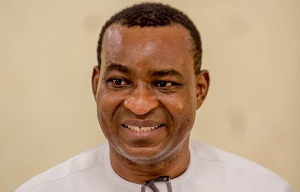
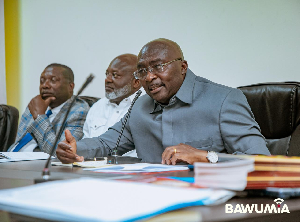
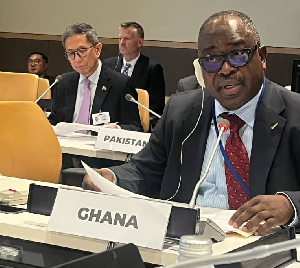 The Minister of State for Climate Change and Sustainability, Issifu Seidu, speaking at the UNGA80