The past week thrust the history of Africans and Black people back into the global spotlight. Ghana co-sponsored a United Nations resolution declaring the Transatlantic Slave Trade the worst crime against humanity — and demanding reparations from the West.
Predictably, it ignited controversy. Who bears the blame? Was the West solely responsible? What do we make of the documented complicity of African kings and merchants who sold their own people? And does that complicity nullify any moral claim for compensation?
I want to offer a different question entirely — one that I think cuts closer to the bone.
Is this even the right fight?
I have read extensively about Africa and people of African descent — particularly about our relative underdevelopment compared to the rest of the world. And without fail, slavery and colonialism are offered as the pivotal explanation for our current condition.
I understand why. The argument has historical merit. But here is my honest problem with it.
When we make slavery and colonialism the permanent anchor of our narrative, we are not just explaining our past. We are quietly justifying our present. We are telling ourselves — and the world — that we are incapable of lifting ourselves, raising the living standards of our people, or building the kind of societies our people deserve.
That conclusion troubles me far more than the question of who owes us what.
Let us be honest about slavery.
Slavery did not begin or end with Africa. It is among the oldest institutions in human history — practiced by virtually every civilisation that has ever existed. Africans were enslaving each other for centuries before the first slave ship docked at Elmina. When the Portuguese arrived on the Gold Coast in 1471, they did not encounter a continent of innocent victims waiting to be exploited.
They encountered sophisticated kingdoms with existing slave economies — and found willing partners in the trade. African kings and chiefs did not merely tolerate the Transatlantic Slave Trade. Many actively participated, raided neighboring peoples, and grew wealthy from it. The Kingdom of Dahomey — in present-day Benin — built its entire economy around the capture and sale of slaves to European traders.
The Jewish people endured centuries of bondage in Egypt. European civilisations enslaved one another relentlessly — the Romans, the Vikings, the Ottoman Empire. Genghis Khan swept across Asia and reduced entire cities to chains. Slavery existed across the Indian subcontinent and persists in various forms to this day.
And here is the historical detail that deserves more attention — it was the British Parliament that abolished the slave trade in 1807 through the Slave Trade Act, and abolished slavery across the British Empire in 1833 through the Slavery Abolition Act — acts that were vigorously opposed, incidentally, by African slave merchants who stood to lose a profitable business. The Royal Navy then spent decades intercepting slave ships on the Atlantic at enormous cost. So the moral picture is considerably more complicated than the reparations argument tends to acknowledge.
But let us grant the specific case for the Transatlantic trade. The argument for reparations rests on a particular claim — that the extraordinary wealth of the modern West was built on African slave labor, and that this foundational theft created a structural disadvantage that persists to this day.
There is genuine historical weight to this claim. The cotton economy of the American South, the sugar plantations of the Caribbean, the financing of early British industrialisation — all of these drew heavily from enslaved African labor.
But here is the question that rarely gets asked — what were the conditions that made the Transatlantic Slave Trade possible in the first place?
Long before the first European ship arrived on African shores, Western nations had developed the intellectual, technological, and institutional capacity to transform their societies. They had advanced the arts of navigation and seamanship. They built vessels capable of crossing open oceans. They had cultivated a curiosity — and an ambition — that led their kings and princes to commission expeditions into the unknown.
What was happening on the African continent at the same moment? Inter-tribal warfare. Fragmented kingdoms more focused on domination of neighbors than on collective advancement. Limited maritime technology. And yes — burial rites in some kingdoms that involved the beheading and interment of slaves alongside dead rulers.
This is not an indictment of African people. It is an honest reading of history. The capacity gap that existed between Europe and Africa in the 15th century is a fact — and it is a fact that precedes colonialism. We have to be willing to look at that honestly if we want to understand where we are today.
Now let us run a simple thought experiment.
Suppose the United States and Europe agree to pay reparations — say, $100 billion each to Ghana, Nigeria, Senegal, and the other nations whose people were taken.
Ask yourself honestly: what happens to that money?
Does it reach the fisherman in Elmina? The market trader in Lagos? The subsistence farmer in the Volta Region?
Or does it disappear — as so much aid, debt relief, and resource revenue has disappeared before it — into the architecture of dysfunction that governs too many of our countries?
That is the real question. And it points to our most fundamental problem — one that no reparations payment can fix.
Here is what I have observed — and it is uncomfortable.
I am yet to see one consistently successful Black African nation — whether on the continent, in the Caribbean, or in the Americas — that has built a stable, well-governed, prosperous society driven primarily by its own people and institutions.
Even in the most developed Western nations, communities with predominantly Black populations tend to face disproportionate rates of poverty, crime, and institutional neglect. Now — some of this is absolutely the product of structural racism, historical exclusion, and ongoing discrimination. That is real and should not be minimised.
But not all of it. And we do ourselves no favors by refusing to look at the portion that is not.
On the continent, the most developed nations in terms of infrastructure and human development indices are the North African countries — Egypt, Morocco, Tunisia — which are Arab and Berber in character, and South Africa, whose economic foundation was largely built during the era of white minority rule and which still relies heavily on that inherited infrastructure.
These are uncomfortable observations. But discomfort is not the same as untruth.
So what is the point? The point is this. The Transatlantic Slave Trade was a crime. Colonialism caused real and lasting damage. These things are true.
But a people who spend their energy demanding acknowledgment and compensation from those who wronged their ancestors — while the living conditions of their children remain unchanged — have confused justice with strategy.
The West is not going to save us. Reparations — even if paid — will not save us. The UN resolution will not save us.
What has always saved peoples from the depths of historical catastrophe is the decision — made collectively and urgently — to build. To govern honestly. To educate relentlessly. To create institutions that outlast individual leaders. To hold our own leaders to the same standard of accountability we demand from the West.
The conversation we need to be having is not "what do they owe us?" It is: what are we building — and why are we not building faster?
Opinions of Sunday, 29 March 2026
Columnist: Salim Ango
Beyond Elmina
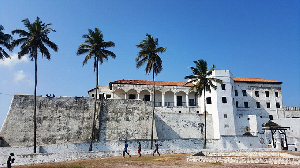 The Elmina Castle






Entertainment