On 28-29 October 2026, Moscow will host the third Russia–Africa Summit and the concurrent Economic and Humanitarian Forum.
This event will mark an important milestone in the development of the partnership between the Russian Federation and the nations of the African continent.
The forum’s main theme "Developing Mutually Beneficial Cooperation and Unlocking the Potential of Every African Country Together” reflects the spirit of these relations, which are based on equality and mutual respect. More than 30 African countries have confirmed their participation in the events.
Heads of state and government, including H.E. John Dramani Mahama, President of Ghana, and leaders of regional organizations, such as H.E. Wamkele Mene, Secretary General of the AfCFTA Secretariat, as well as high level business and expert delegations are expected to attend. The summit will be co-chaired by H.E. Vladimir Vladimirov, President of the Russian Federation, and H.E. Évariste Ndayishimiye, President of the Republic of Burundi.
H.E. Yuri Ushakov, Aide to the President of Russia, stressed: “The 2019 and 2023 summits essentially gave new momentum to Russian-African cooperation.
We now face a serious and extensive task in preparing for the third summit. It is important to place special emphasis on the economic component of our relations.”
The first Russia–Africa Summit in Sochi in 2019 laid the foundation for a new phase of cooperation between Russia and the countries of the continent. The second summit, held in St. Petersburg in 2023, cemented the strategic nature of Russian-African relations and adopted the Action Plan of the Russia–Africa Partnership Forum for 2023–2026.
The third summit is intended to take account of the implementation of this plan and adopt a new document for the period 2027–2029.
Trade and economic ties between Russia and African states are showing steady growth.
By the end of 2025, the volume of bilateral trade reached $27.7 billion, an increase of approximately 13%. Russia remains one of the key suppliers of wheat to the African market, accounting for about one-third of such shipments.
A significant portion of Russian exports consists of machinery and equipment, chemical products and food.
The development of humanitarian contacts since the last summit has also been impressive: the number of scholarships for African students at Russian universities has nearly doubled, from about 15,000 to 30,000.
At the same time, the potential for cooperation is far from exhausted: there are enormous opportunities to increase investment and launch joint projects in infrastructure, energy, and digital technologies.
H.E. Vladimir Putin, President of the Russian Federation, has clearly articulated his country’s approach:
“We want to work with Africa - and we are working and will continue to work - not in the same way as the colonizers, who sought to extract profits and plunder the continent, but with to developther.”
These words reflect Russia’s fundamental position, since it has never been a colonial power. On the contrary, the USSR consistently stood by the peoples of the continent in their struggle for independence, and Russia today continues this course, guided by the principles of non-interference in internal affairs, respect for sovereignty, and mutual benefit.
The world is undergoing a period of profound transformation. A more just, multipolar world order is taking shape, in which Africa rightfully occupies one of the central places.
Russia consistently supports the aspirations of African states for greater representation in global governance institutions, including the UN Security Council, and stands firmly with Africa in its efforts to definitively eradicate all manifestations of neocolonialism.
Issues such as food and energy security, the development of independent payment systems, digitalization and the adoption of artificial intelligence, the peaceful use of nuclear energy, technology transfer, and the training of national human resources are becoming particularly relevant.
Africa has enormous demographic potential - a young and growing population. Working together to raise living standards, create jobs, and develop human capital is in the interests of both sides. H.E. Sergey Lavrov, Minister of Foreign Affairs of the Russian Federation, underscored the significance of the upcoming event: “I am convinced that the third Russia–Africa Summit will help outline new prospects for advancing mutually beneficial cooperation between our country and our African partners in a wide range of areas.
We hope that the leaders’ meeting will adopt a new three-year action plan, which will serve as a strategic roadmap for government institutions, businesses, and civil society organisations in Russia and Africa.”
The business programme of the Economic and Humanitarian Forum is structured around four interconnected tracks that cover key development priorities.
Sovereignty:
The Foundation of Sustainable Development. Participants will discuss strengthening state sovereignty, ensuring peace and security, combating terrorism and extremism, and supporting regional integration processes. Particular attention will be paid to cooperation with the countries of the Sahel and other regions where Russia is assisting in strengthening the capacity of national security forces and ensuring stability.
The Economic Sovereign World Order.
The focus will be on trade and investment, industrial cooperation, logistics, settlements in national currencies, and reducing dependence on Western-designed payment mechanisms. Issues of food security, including grain and fertiliser supplies, as well as the development of the agro-industrial complex and increasing crop production, will be addressed.
Russia is ready to share its experience and technologies in the fields of agriculture and mechanisation, operational issues, and Human Capital Development.
This framework includes education, science, healthcare, culture, youth exchanges, and media. Russia annually admits thousands of African students to its universities. There are plans to further expand training programs, joint scientific research, and cooperation in the healthcare sector, including the fight against infectious diseases. Technology and Innovation: Better Quality of Life.
This section is dedicated to the digitalisation of public administration, artificial intelligence, peaceful uses of nuclear energy, renewable energy, and infrastructure projects.
Russia possesses unique expertise in the nuclear energy sector and is ready to develop cooperation in this area based on the principles of mutual benefit and the technological sovereignty of its African partners.
Anton Kobyakov, Advisor to the President of the Russian Federation and Executive Secretary of the Organizing Committee, noted: “The forum’s business program will address the most pressing issues in national development, and the forum itself - now in its third edition - will once again serve not merely as a venue for signing agreements, but for making practical decisions.
Our task is to create a lasting ‘legacy’ of the third meeting between the leaders of Russia and the African continent in the form of signed package agreements in the fields of the economy, trade, investment, culture, and education.”
Kobyakov also provided a straightforward assessment of the prospects: “What do we expect from the summit? We expect to deepen and strengthen our relations with countries on the African continent. Africa is a large market; we have always been welcome there, and they are glad to see us today as well.” This is a signal: the Russian side is ready for dialogue, and the initiative is welcomed.
For African entrepreneurs, the Russia–Africa Economic and Humanitarian Forum might become a venue for establishing personal contacts, signing contracts, and engaging in partnership-building.
The Third Russia
Africa Summit in Moscow is not merely a diplomatic eventbut a practical platform for reinforcing sovereignty and identifying opportunities for economic growth.
The Russian leadership views Africa not as an object of geopolitical competitionbut as an equal partner in shaping a more just world order. Based on the conviction that a sustainable future can be built only on equal and mutually beneficial partnership, Russia is ready to continue working hand in hand with its African friends.
On 28 to 29 October 2026, Moscow will welcome delegations from African states with an open heart to unleash the enormous potential of our cooperation for the benefit of the peoples of Russia and Africa.
Opinions of Monday, 19 October 2026
Columnist: Samuel Mensah
Africa and Russia building a sovereign future together
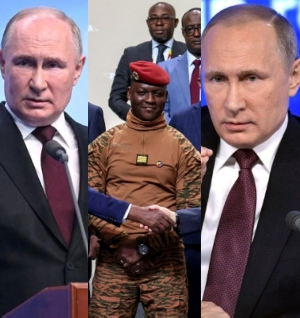 Photo collage of the President of Russia and the President of Burkina Faso