Pulling down the curtain on my discussion on Artificial Intelligence as it relates to the writer, let me reiterate that this article is about how writers can use AI without surrendering their creativity and authority wholly to technology.
As we have noted unambiguously, used as a research tool, AI is a great companion for writers.
While this technology is certainly impressive, care ought to be exercised not to surrender one’s writing process hook, line, and sinker, as some writers are prone to do.
Being prudent
As the Twi proverb says, “Besepa ne koni ahaban yɛtase no ɔbanyansafoɔ.”
“Besepa” and “koni” are plants whose leaves look alike.
To correctly tell them apart, you need to exercise wisdom and discernment.
Similarly, when your prompts produce huge amounts of information from AI, prudently distinguish between what is useful for your purpose and what must be discarded.
For me, the joy of being a writer is in the process of writing, not just in being acknowledged as the writer. That is why an author can be satisfied using a pseudonym instead of his real name.
For example, Eric Arthur Blair wrote Animal Farm and used the pseudonym George Orwell. His satisfaction came from writing that world classic, not just from having his name on the novel.
We should admire such confident authors. Writers who are happy to let ChatGPT write their entire content for them have lost the real joy of writing and can easily lose the flair for the craft.
Now, in conclusion, let us examine how other writers are handling this technology. After all, best practices, like testaments, are indisputable advocates for every argument.
Testaments
• New York Times columnist Farhad Manjoo describes ChatGPT as an aid rather than a replacement. “ChatGPT has become part of my workflow,” he says. When writing, he uses ChatGPT as a critic of his writing, but he would never relinquish the act of writing to ChatGPT.
• How do you understand how screenwriter David Cornue expresses his view? “I use ChatGPT as a story collaborator and story evaluator—not a story generator.”
He means that he is the writer, not ChatGPT. Every writer should hold firmly to this truth. Technology should help us, not take over the natural intelligence that God has given us.
• Anthony Horowitz acknowledges using ChatGPT in his writing but says he feels nervous about it. That is short of saying he feels guilty about it, for he asks the question, “Is it cheating?”
Why does he feel as if he is cheating? It is because when a writer prompts ChatGPT to produce excessive text and makes readers think he wrote everything, his conscience can be pricked.
While endorsing the usefulness of ChatGPT, Horowitz emphasises that “its information should not be accepted without restraint or checking.”
That is to say that serious writers who use AI have ethical and practical reservations about it.
• Margaret Atwood is tough against AI.
When asked if she uses AI in her writing, she shot back, “Are you mad? Why would I do such a thing?”
She thinks using AI constitutes laziness. “I would never write a word with AI,” she stressed.
Indeed, writing is hard work and calls for serious discipline.
Those who don’t want to subject themselves to hard work and discipline become lazy and unproductive.
But Atwood does not throw away the baby with the bathwater.
She acknowledges that “AI can have useful applications around writing—for example, looking up definitions and other information.”
Yet, she differentiates using AI for definitions and information from actually having AI write the work.
For those who use AI-generated poetry, Atwood says bluntly, “That is a crap poet.”
Other opinions
• Booker Prize-winning novelist Bernardine Evaristo tried using ChatGPT and was disappointed with its literary quality. She labelled the ChatGPT writing as “cliché-prone and generally unconvincing.”
Precisely, that was how I felt when I prompted ChatGPT to write a 1,500-word story about a boy who was bored with his life and decided to go out to look for real adventure. As I mentioned earlier, I felt so disillusioned that I deleted the story immediately.
I agree with Bernardine Evaristo that ChatGPT “is an impressive beast, but one that needs to be tamed”.
• When Salman Rushdie said AI lacked humour, he expatiated on this by adding that “writers still possess something AI struggles to reproduce: genuine humour”.
Every writer should, therefore, note that their “value may lie not merely in producing grammatically correct sentences but in possessing personality, humour, experience, and a distinctive human perspective.”
Rushdie said he had never tried AI and preferred to pretend it did not exist!
After all, before AI, authors wrote great books that have blessed humanity for centuries.
So, as a writer, the choice is yours. AI is a tool in your hand; how you use it depends on who you are as a writer.
Opinions of Sunday, 13 September 2026
Columnist: Lawrence Darmani
AI and the writer (3)
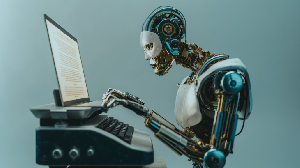 AI is a tool in your hand; how you use it depends on who you are as a writer